
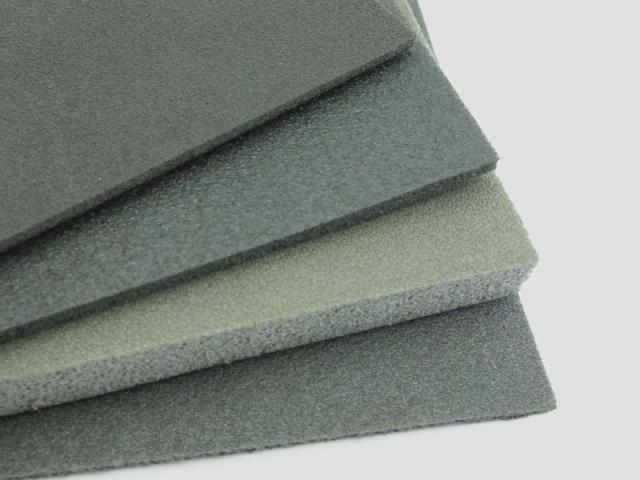
Foam density — usually expressed in kg/m³ — is the single most useful number for specifying XPE foam. It controls stiffness, cushioning, insulation and price. This guide maps common XPE densities to typical applications and explains density vs hardness so you can specify the right grade.
What Foam Density Means
Density is the mass of foam per cubic metre (kg/m³). Higher density means more polymer and smaller, stronger cells. XPE foam is commonly produced from about 30 kg/m³ (soft, low-cost cushioning) up to 250 kg/m³ (rigid, structural sheets).
Common XPE Densities and Their Uses
- 30-45 kg/m³ — soft cushioning, general packaging, light protection.
- 45-60 kg/m³ — all-round grade for packaging inserts, floor underlayment and gaskets.
- 60-100 kg/m³ — firmer, structural; sports mats, insulation panels, anti-vibration.
- 100-250 kg/m³ — high-density; insoles, gaskets, spacers and machining stock.
Density vs Hardness (ILD)
Density and hardness are related but not the same. Hardness (ILD — indentation load deflection) measures how much force is needed to compress the foam. Higher density usually gives higher hardness, but formulation also matters. Specify both when performance matters: the density for cost and insulation, the ILD for feel and load-bearing.
How to Choose the Right Density
- Lightweight cushioning → low density (30-45 kg/m³).
- Compression resistance and long life → 60 kg/m³ and above.
- Thermal insulation → mid-to-high density with thick sheet.
- Gaskets and spacers → high density for dimensional stability.
Density vs Thickness
Density and thickness are independent: a 5 mm low-density sheet is soft but thin, while a 2 mm high-density sheet is firm. For a full guide to choosing thickness as well, read how to choose foam density & thickness — the two guides work together.
Ask us for density samples or a quote →
Related Reading
See also: XPE foam product page · IXPE foam product page · All foam materials · How to choose foam density & thickness