
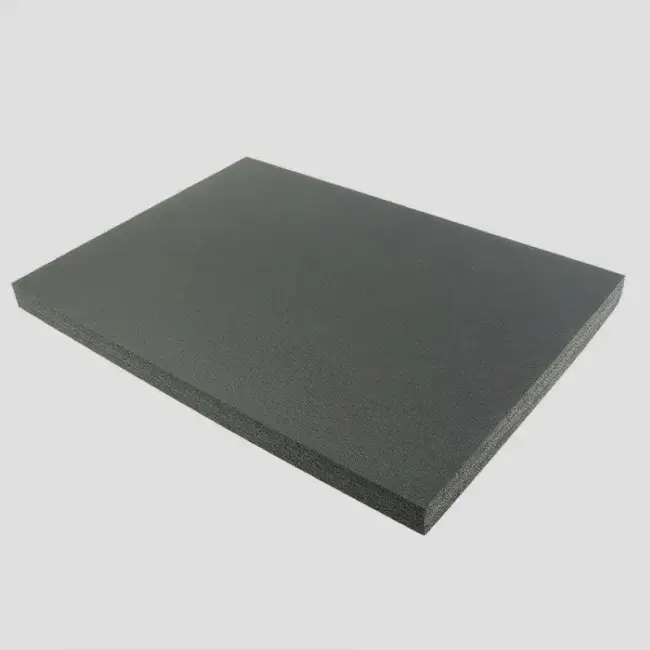
Flooring and construction foam provides sound insulation, impact damping, thermal insulation and moisture protection under floors and inside buildings. Bofeng Foam supplies XPE and laminated foam underlayment, acoustic liners and insulation panels for residential and industrial projects.
As a direct manufacturer of cross-linked polyethylene foam in Zhuhai, China, Bofeng Foam supplies flooring underlayment and construction foam in rolls or die-cut panels.
What is Flooring & Construction Foam?
Flooring and construction foam is a closed-cell XPE or laminated foam used as underlayment beneath laminate, wood and tile floors, and as acoustic or thermal insulation inside walls, roofs and ducts. Its closed-cell structure resists moisture, adds cushioning and reduces sound transmission between floors and rooms.
Foam Materials for Flooring & Construction
XPE Foam
Chemically cross-linked polyethylene foam — resilient, moisture-resistant and available in many densities. The standard choice for acoustic underlayment, impact mats and insulation panels.
Laminated Foam
Foam laminated with aluminium foil reflects radiant heat, ideal for underfloor heating and roof insulation; non-woven lamination adds surface durability for acoustic panels.
View laminated foam products →
Flooring & Construction Foam Products We Make
These application pages cover the flooring and construction foam Bofeng Foam supplies:
- Floor damping foam
- Underfloor heating insulation foam
- Floor acoustic foam
- Wall insulation foam
- Wall acoustic foam
- Wall impact foam
- Roof insulation foam
- Ceiling acoustic foam
- Acoustic foam
- Door & window caulking foam
- Pipe insulation foam
- Building construction foam
- Tunnel seam splicing foam
- Industrial plant roof insulation foam
Common Flooring & Construction Applications
Acoustic underlayment for laminate and wood floors, underfloor heating insulation, wall and ceiling soundproofing, roof and duct insulation, and industrial construction joint materials. Bofeng Foam supplies standard and high-density grades in rolls or custom die-cut panels.
Why Choose Bofeng Foam as Your Flooring Foam Manufacturer?
Bofeng Foam is a direct factory with more than ten years of XPE production experience. We offer density and thickness control, foil and non-woven lamination, and custom die-cutting — so your underlayment or insulation is produced exactly to spec with consistent quality.
Request a flooring or construction foam sample or quote →
Flooring and construction foam FAQ FAQ
What thickness of foam underlayment do I need?
It depends on two things: the finish going over it and whether the layer has to insulate as well as decouple. A thin layer of a few millimetres is normal under laminate and engineered wood, where the floor must stay firm. A thicker layer is used where impact noise reduction or an insulation value matters more than rigidity, or where the subfloor is uneven and the foam has to take up the tolerance. Tell us the finish, the subfloor and the load, and we will specify a thickness and density.
Does foam underlayment actually reduce noise?
It reduces impact and structure-borne noise very effectively, because a resilient layer between a floating floor and the slab interrupts the path that vibration travels along. It does not add mass, so it cannot replace a heavy or double-skin construction where airborne noise is the problem. Used in the right place it is often the step that makes the rest of the build-up perform.
Can the same foam insulate an underfloor heating system?
Yes, and the two functions work together. A closed-cell foam layer under a heated floor directs heat upwards into the floor build rather than down into the slab, and because the material absorbs 0.2% or less water by the GB/T 1034 method 4 test it does not lose that performance in damp service. A foil facing adds a radiant barrier to the same layer.
Is the foam suitable under a floating floor?
Yes, provided the layer is chosen for the static load it will carry. A foam that is too soft will compress under furniture and allow the floor to move; one that is too firm will not decouple. This is why the density matters as much as the thickness, and why we size the grade against the load rather than supplying a single stock underlayment.
What about construction and roofing applications?
The same closed-cell material is used for wall, roof and ceiling build-ups, where a foil-faced layer adds a radiant barrier and a vapour barrier to a cavity. See the wall insulation and roof insulation pages for those cases.
Related Reading
See also: All foam materials · XPE underlayment for laminate flooring · How to choose foam density & thickness