
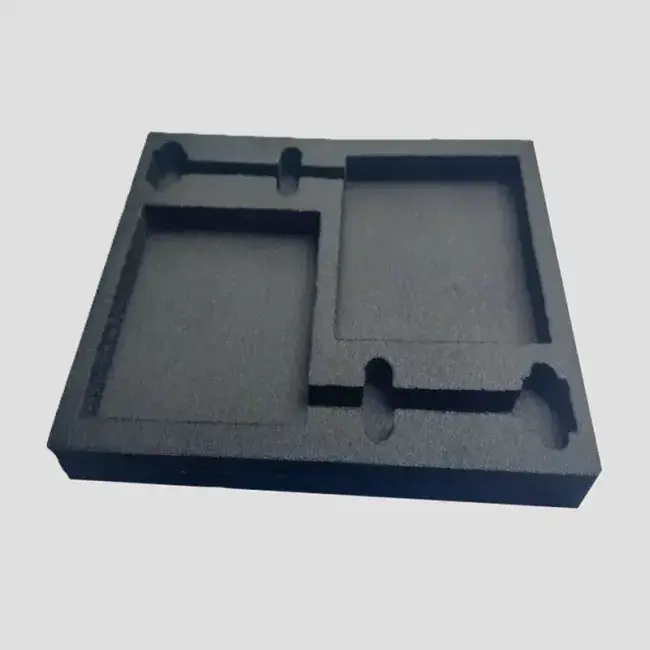
ESD foam (electrostatic discharge foam) protects sensitive electronic components from static damage, shock and contamination during storage, handling and transport. Bofeng Foam supplies conductive and anti-static XPE, IXPE and PE foam for ESD trays, dividers, blister trays and packaging inserts.
As a direct manufacturer of ESD-safe foam in Zhuhai, China, Bofeng Foam provides custom conductive foam with controlled surface resistance for the electronics industry.
What is ESD Foam?
ESD foam is a closed-cell polyethylene foam treated with a conductive or static-dissipative coating, or formulated with conductive fillers such as carbon black, so that static charge drains safely to ground instead of building up on the surface. It is specified by surface resistance (typically 10&sup4;–10&sup9; ohms) and is used wherever static-sensitive components such as PCBs, ICs and LCDs are handled.
ESD Foam Materials
Conductive PE Foam
Polyethylene foam made conductive with carbon additives — the workhorse of ESD packaging. Used for conductive trays, dividers, shipping tubes and IC packaging.
See how conductive PE foam fits in the materials hub.
Anti-static XPE / IXPE Foam
Cross-linked foam with a static-dissipative surface — soft, resilient and available in thin gauges. Used for anti-static protective films, LCD padding and blister tray cushions.
ESD Foam Products We Make
These application pages cover the ESD products Bofeng Foam manufactures:
- Conductive foam dividers
- Conductive foam trays
- Anti-static crates
- Anti-static blister trays
- Anti-static injection molded trays
- Anti-static foam LCD protection film
Common ESD Foam Applications
ESD foam is used in PCB shipping, IC tray packaging, hard-drive and display protection, medical electronics and automotive electronics. Bofeng Foam can add die-cutting, lamination and surface resistance tuning to match your ESD specification.
Why Choose Bofeng Foam as Your ESD Foam Manufacturer?
Bofeng Foam is a direct factory with more than ten years of cross-linked foam experience and conductive / anti-static R&D capability. We control surface resistance, density and thickness to your spec, and support custom die-cut ESD packaging with fast prototyping.
Request an ESD foam sample or quote →
ESD foam FAQ FAQ
What is the difference between conductive and anti-static foam?
The difference is how fast charge moves. Anti-static, or dissipative, foam has the higher surface resistance and bleeds charge away slowly enough not to disturb a sensitive device, which is what is used where the foam touches an assembled board. Conductive foam has a lower resistance and gives charge a faster path to ground, and is used for the tray, divider or container around the device rather than directly against it. Both are made from the same carbon-compounded cross-linked PE base material at different loadings.
What surface resistance do I need?
It follows from your ESD control plan rather than from the foam. Our grades span 10³ Ω to 10⁶ Ω (conductive) and 10⁶ Ω to 10⁹ Ω (dissipative), which covers the dissipative band used for material in contact with assembled boards and the conductive band used for trays and divider systems. Send us the target range your plan states and we will confirm the grade, thickness and cut that hold it.
Does the ESD property wear off over time?
No, and this is the reason for choosing a volume-conductive foam over a coated one. The carbon is compounded through the polyethylene before expansion, so the resistance is a property of the material itself rather than a surface treatment. It cannot be rubbed off where the tray is handled most, it is not removed by cleaning solvents, and it is preserved on every cut face.
Does humidity affect the resistance?
No. Materials that rely on absorbed moisture to conduct become less effective as the air dries out, which is a real problem in air-conditioned assembly areas and in dry climates. A carbon-compounded foam holds its resistance across the humidity range.
Can ESD foam be die-cut into trays and dividers?
Yes, and that is how it is most often supplied. We die-cut and CNC-contour the foam into trays, dividers, tote liners and interleaves, and can laminate it to a firmer substrate where the part has to carry a stack. Because conduction runs through the volume of the material, the cut faces remain conductive.
Related Reading
See also: All foam materials · Conductive foam & ESD guide · XPE vs IXPE vs IXPP
New guide: IXPE foam for electronics: surface, dielectric and lamination properties