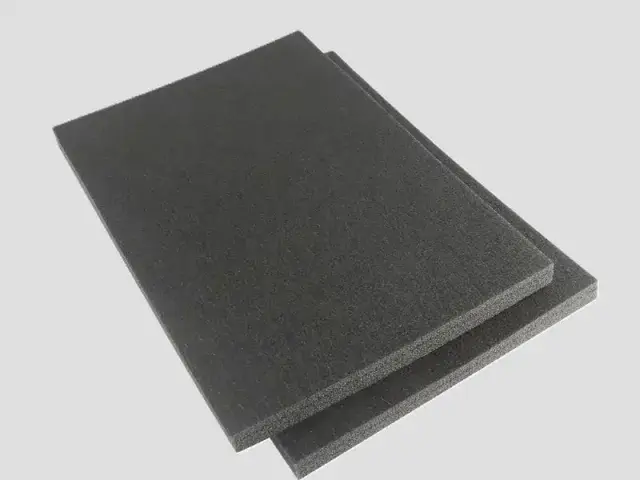

- Material: IXPE (polyethylene foam)
- Expansion ratio: 8 times (125±15 kg/m³), 10 times (100±10 kg/m³), 15 times (66.7±8 kg/m³)
- Thickness: 0.5 mm, 1 mm, 2 mm (thickness can be customized)
- Colour: black, white, skin tone (colour can be customized)
- Flame retardant grade: UL94 HF-1
Customization
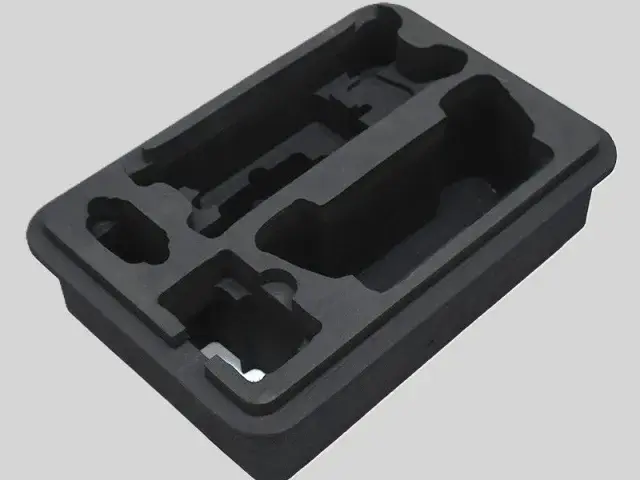
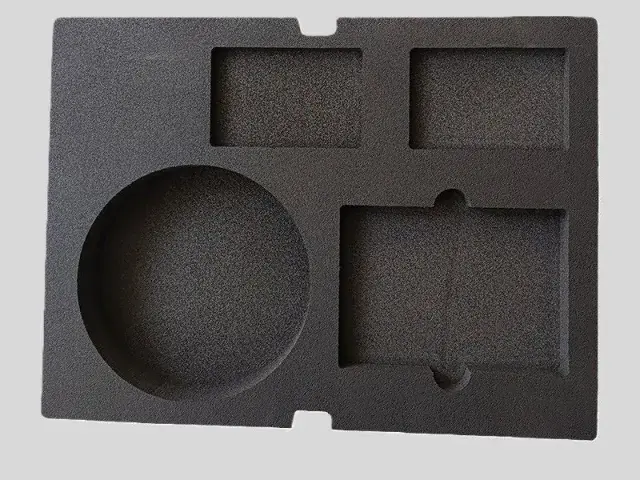
Made to order: density, thickness, colour and shape to your drawing. Die-cutting, CNC routing, lamination to film or fabric, slitting and adhesive coating all run in-house, so the part we quote is a finished part, not just a sheet. How a custom part is cut and routed explains what to send with the drawing.
Regular material: MOQ 1,000 m², lead time 15–20 days from order confirmation. Custom parts are quoted from the drawing. A4 samples are free, shipping included.
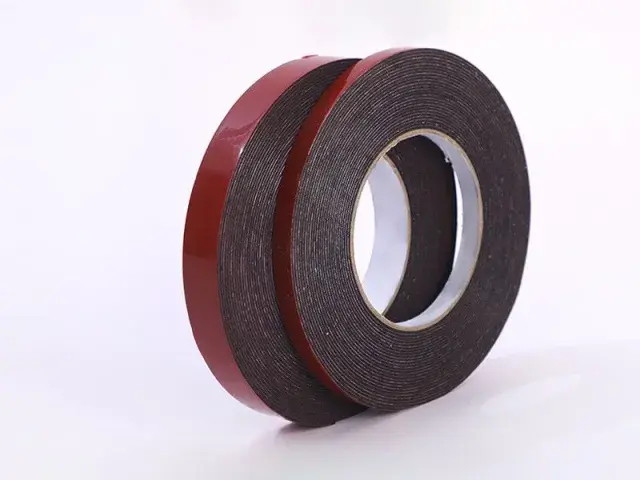
Industrial tape foam is a foam backing coated on one or both faces with pressure-sensitive adhesive, supplied in rolls and cut to width. It is the material that holds two surfaces apart while holding them together: the adhesive does the fixing, the foam does the sealing, damping and gap filling that a plain tape cannot.
Features
- Cushioning in the joint: the foam core compresses to fill an uneven gap, so the bond holds across a surface that is not perfectly flat – which is the usual reason a rigid tape fails.
- Vibration and acoustic damping: the foam layer isolates the two bonded surfaces, breaking the path that would otherwise carry noise and vibration between them.
- Very thin gauges: from 0.5 mm, in 1 mm and 2 mm, which is what modern device and appliance assemblies allow.
- Three densities: 8× (125±15 kg/m³), 10× (100±10 kg/m³) and 15× (66.7±8 kg/m³), to tune firmness and conformability.
- The backing, adhesive and substrate require assessment together for the specified environment; carrier properties do not establish bond durability.
- Flame retardant grade: UL94 HF-1 available.
Applications
- Electronics assembly – fixing and insulating components inside phones, tablets and wearables
- Automotive – anti-squeak and anti-rattle tape between trim panels and the body
- Building – sealing door and window gaps and bedding glazing units
- White goods – damping vibration in refrigerators, washing machines and air conditioners
- Signage and display – mounting panels where a gap has to be filled
Specifications for industrial tape backing, where the foam is the carrier and the adhesive is applied to it
Tape foam is a backing material: the sheet has to be uniform in thickness, hold an adhesive coat and conform to the surface it is applied to.
| Foam | Expansion | Apparent density | Single-layer thickness | Why this grade |
|---|---|---|---|---|
| IXPE | 8–15× | 66.7–125 kg/m³ | 0.1–15 mm | The usual backing grade, because the fine cell structure gives a uniform thickness across a wide web and single layers down to 0.1 mm. |
| XPE | 8–15× | 66.7–125 kg/m³ | 3–15 mm | Firmer backing where the tape also has to fill a gap or take a compression load. |
Base material specifications are on the XPE, IXPE and IXPP material pages; finished products are on the XPE foam and IXPE foam pages. Tell us the load, the space available and the service temperature and we will confirm the grade against your drawing.
Why Choose Bofeng Foam
We supply the IXPE backing at 8×, 10× or 15× foaming, from 0.5 mm to 2 mm, in black, white or skin colour, to UL94 HF-1 where required. The foam can be supplied as sheet for a converter to coat, or as a finished tape laminated to a specified adhesive system – the lamination options are on the laminated foam page. The backing material is described on the IXPE foam page, and the automotive variant under automotive tape foam.
Which carrier foam suits which sealing job, and how the adhesive and release liner are chosen, is set out in our foam tape guide.
Industrial Foam Tape Backing: Qualify the Carrier Before Coating
State the Converting Route
Provide backing gauge, roll or sheet format, coating route and finished tape dimensions. Review handling through winding, slitting and lamination, not only unloaded appearance. Identify the liner and every facing so approval describes the actual supplied construction. A raw material swatch is not a finished-roll acceptance sample.
Separate Carrier and Bond Evidence
Recovery and dimensions are not peel strength or holding-power results. Identify substrate, adhesive and service conditions, then assess the completed tape. Resistance of the carrier does not demonstrate that its bond survives the same exposure. Keep failure locations and sample identification when comparing candidates.
Check Roll and Cut-Part Quality
Agree thickness method, width, edge, winding and registration requirements. Review small holes and bridges after adding adhesive and liner. Confirm how the part is peeled, presented and assembled rather than relying on an ideal flat outline. These details may change which converting arrangement is appropriate.
Retain the Accepted Combination
Keep foam and adhesive identities separate, with the approved surface preparation and exposure assessment. No universal outdoor life, adhesive strength or cleaner compatibility follows from the IXPE name. Review either material when the application or substrate changes, and agree acceptance criteria for the actual order.
For sample identity, dimensions and the acceptance record, use the first-article review checklist with the application-specific checks above.
Writing an industrial foam tape qualification brief
Identify both bonding surfaces
A useful tape brief names both substrates and their actual finishes. Include coatings, texture, release agents and the cleaning process proposed by the assembly owner. A metal name alone does not describe a painted, plated or oily production surface. Supply representative production pieces when possible, and identify whether they are new parts or parts recovered from an existing assembly. The purpose is to select a sample construction for evaluation, not to guarantee adhesion from a substrate label.
Show the tape position and the load path in the assembled product. Mark the bond width, any corners, interruptions and areas that the tape must avoid. Distinguish a locating pad, a seal, an anti rattle layer and a load carrying bond. These functions can call for different approval criteria even when the proposed foam thickness is the same. State whether another fastener carries part of the load so the tape is not accidentally evaluated as the sole attachment.
Reproduce the production process in the sample
Document the application sequence, liner removal, positioning and pressure application that the operator will actually use. State the conditions and dwell period proposed by the adhesive supplier or assembly developer for review. A manually prepared laboratory sample may not represent a production line with a different cleaning process or access to the bond. If the tape is applied to one surface before a later assembly step, include the intermediate storage and handling arrangement in the qualification brief.
For die cut pieces, show the intended supply format and the direction in which the liner is removed. Trial the part using the planned fixture or operator access. Observe whether the adhesive is touched during handling, whether the foam is stretched and whether the part can be placed without trapped folds. These are process observations that should be resolved before changing the material solely because an early sample lifted at an edge.
Define acceptance around the failure mode
Ask the product owner to define the relevant peel, shear, sealing or dimensional criteria and the conditions under which they are checked. Keep the conditions with the result rather than reporting a single strength value without context. Examine where a failed sample separated: at a substrate, within the foam or in another layer of the construction. This supports a targeted revision and avoids assuming that a higher density core automatically fixes an adhesive interface problem.
Approve the complete tape construction, including the foam, adhesive on each side and liner where it affects handling. A foam data sheet is not an adhesive performance report. Retain the tested construction, surface preparation and assembly process with the first article. If a coating, cleaner, bond geometry or adhesive changes, review which checks must be repeated before releasing an apparently equivalent reorder.
Keep the sample reference on the qualification record so an adhesive or liner substitution remains visible even if the converted part looks unchanged.
Conclusion & Inquiry
Tell us the substrate, the gap and the environment the joint sees, and we will recommend a backing density and thickness. Contact us for samples.