
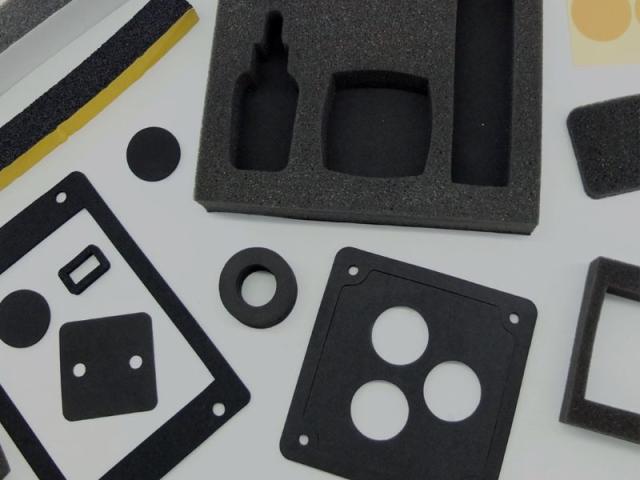
Most foam parts are not rectangles. They are inserts with cavities, gaskets with holes, spacers with a profile — shapes that have to be cut, and the way they are cut decides both the unit cost and how the first order goes. There are two routes, and choosing the wrong one is the most common reason a custom foam project runs over budget.
Die-cutting and CNC routing are different tools for different jobs
Die-cutting uses a steel rule die, bent to the outline of your part. The die is a one-off cost. Once it exists, each part is pressed out in seconds, so the per-unit cost falls sharply with volume and stays flat. It is the right process for a shape that will not change and will be ordered again and again.
CNC routing cuts from the drawing with a moving spindle and no tooling at all. There is no die to build and no setup to amortise, so the first part costs the same as the hundredth. It handles prototypes, small batches, thick blocks, and any design that is still moving. It is also the only sensible route when the part is deep — a pocket or a contour that a flat die cannot reach.
We run both in the same plant, so the answer to "which one?" is a question about your quantity and your timeline rather than about capability.
Which process fits your part
| Your situation | Route | Why |
|---|---|---|
| Prototype or first sample | CNC | No tooling, drawing changes cost nothing but a re-cut |
| Design not final | CNC | A die built against a shape that changes is money lost |
| Recurring volume | Die-cutting | Die cost amortises; per-unit price drops |
| Thick part with a pocket | CNC | A flat die cannot cut a 3D cavity |
| Thin part, large quantity | Die-cutting | Fastest and cheapest at volume |
| Mixed sizes in one order | Depends | One die per shape; CNC may be cheaper overall |
What makes a part expensive to cut
Price is set by the drawing more than by the material. Three things drive it:
- Sharp internal corners. A die cannot turn a true 90° internal corner; a radius is required, and a corner that ignores this is either changed later or cut badly. CNC can do sharper corners, at the cost of a slower pass.
- Very small holes and narrow bridges. Foam has to hold together around a hole. A hole that is too small relative to the foam's thickness and density will tear, or will need to be punched in a separate step.
- Deep pockets in thick foam. Depth is what pushes a part from die-cutting to CNC routing, and routing time is what raises the price.
None of these are refusals. They are cost drivers, and the earlier they are raised the cheaper the part is — a 3 mm radius added at the drawing stage costs nothing; the same radius added after tooling costs a new die.
Materials we convert
XPE, IXPE and IXPP, from 3x to 40x expansion, in single layers and laminated blocks. Parts can be laminated to film, foil, fabric or non-woven, and supplied plain or with pressure-sensitive adhesive and a release liner. If the part needs to be soft on one face and firm on the other, that is a lamination decision, and it is made before cutting.
From drawing to delivery
- Send the drawing. PDF, DWG, DXF or STEP, with the material, thickness, quantity and any tolerance that matters. A sketch with dimensions works for a first look.
- Design review. We come back on the things that affect cost or feasibility: corner radii, hole sizes, whether the part should be die-cut or routed, and where the tolerance should sit.
- Sample. A cut sample of the actual part, or an A4 sheet of the actual material — free of charge, shipping included — so the foam itself can be tested in your process.
- Tooling and production. A die is built for die-cut parts; routed parts go straight to production. Standard lead time is 15–20 days from order confirmation.
Quantity and minimums
Standard rolls and sheets start at 1,000 m². Custom parts are quoted individually, because the minimum depends on two things: whether a die has to be built, and how much material the job needs to run. For a first order, tell us the annual volume as well as the first order — a part ordered once a year and a part ordered every month are priced differently, and only one of them justifies a die.
Common mistakes on the first order
- Ordering a die before the design is frozen. Prototype with CNC first.
- Specifying a tolerance on a dimension nobody measures, and none on the one the assembly depends on.
- Choosing the material after the shape. Thickness and density decide what can be cut.
- Forgetting the adhesive. A liner changes the cutting and the packing, and it is cheaper to decide up front.
FAQ
Can you cut a part from my drawing without a die?
Yes. CNC routing works directly from a PDF, DWG, DXF or STEP file. No tooling is required.
What is the minimum order for a custom part?
Custom parts are quoted individually. The minimum depends on whether tooling is needed and on the material run, so send the drawing and the quantity and we will confirm it.
How long does a first sample take?
A material sample (A4 sheet) ships without delay and is free. A cut sample of the actual part depends on whether a die is needed; routed samples are quicker.
Can the foam be supplied with adhesive?
Yes. Pressure-sensitive adhesive with a release liner, applied before cutting, is a standard option.
Related reading
XPE foam · IXPE foam · IXPP foam · All foam materials · How to choose a foam supplier
Send the drawing and the quantity and we will tell you which route is cheaper for that part — and which one we would use ourselves.