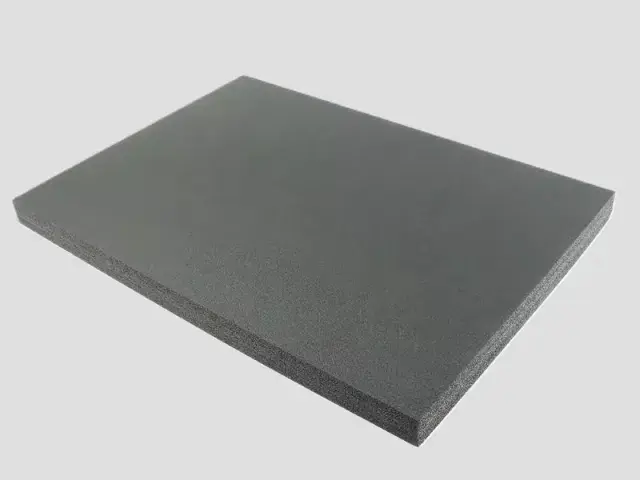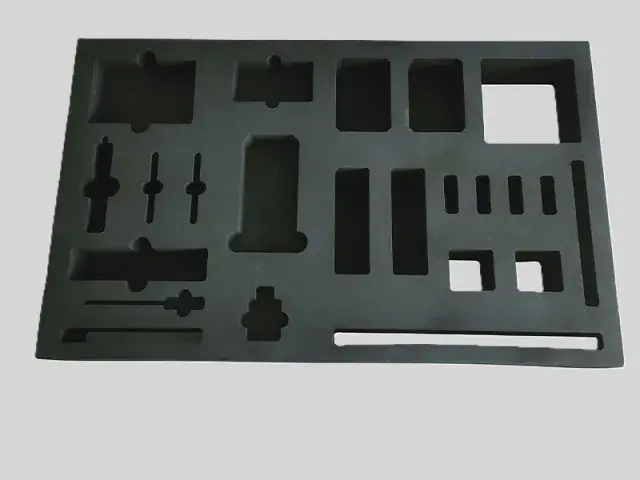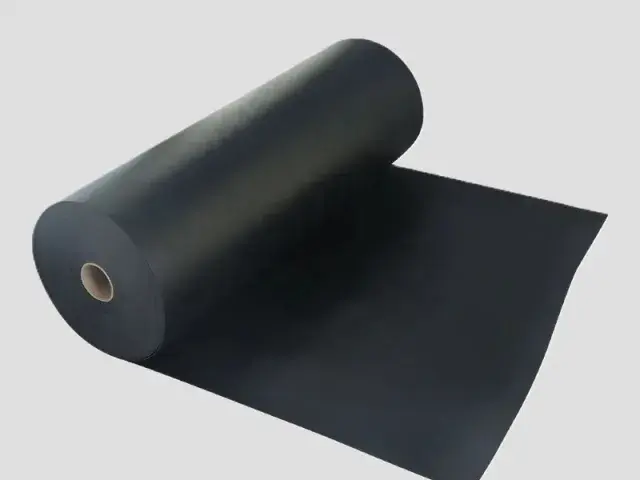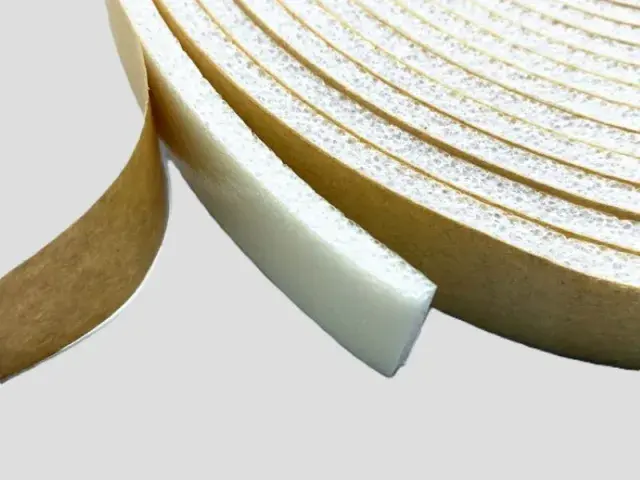

- Material: IXPE foam, anti-static or conductive grade
- Resistance range: anti-static 10⁶–10⁹ Ω; conductive 10³–10⁶ Ω. Measurement quantity and method to be agreed.
- Thickness: 0.1–15 mm single layer; dividers commonly 2–10 mm
- Width: 500–2000 mm master roll; parts cut to drawing
- Density: 26.8–300 kg/m³
- Forms: magazine divider, slot insert, shuttle-tray liner, stack cushion, edge protector, dunnage
- Conversion: die-cutting, CNC routing, slitting, lamination, adhesive backing
Customization
Made to order: density, thickness, colour and shape to your drawing. Die-cutting, CNC routing, lamination to film or fabric, slitting and adhesive coating all run in-house, so the part we quote is a finished part, not just a sheet. How a custom part is cut and routed explains what to send with the drawing.
Regular material: MOQ 1,000 m², lead time 15–20 days from order confirmation. Custom parts are quoted from the drawing. A4 samples are free, shipping included.
A PCB or a PCBA spends more time in handling than in any single process step, and most handling damage happens between steps. Foam dividers, slot inserts and stack cushions separate boards, take up tolerance and prevent edge and component contact. For an assembled board the divider must also fit around components that stand above the surface, and it must not rub, mark or shed onto the board.
Request a quote · Request A4 samples · Ask for selection help
Where the foam is used
- Magazine and rack dividers. Slotted foam sheets between boards in a magazine, so boards are held at the edges or in a defined zone and cannot touch each other.
- Slot inserts. Foam pieces set into the slots of a rigid magazine or a shuttle, sized to the board thickness with a controlled compression.
- Shuttle-tray liners. Foam on the floor or the lid of a handling tray, to cushion the board during transfer.
- Stack cushions and end pads. Foam at the top and bottom of a stack, taking the shock before it reaches the board.
- Edge protectors and dunnage. Foam strips on board edges, and void fill between packs.
Designing the slot
A divider that is too thin lets the board move; one that is too thick loads the board and the magazine. Define:
- Board thickness and tolerance, including any coating or stiffener.
- Slot width in the magazine, and the divider thickness that fits it.
- Contact zone — edge only, or a defined band on the board face.
- Component keep-out for an assembled board, including tall parts near the edge.
- Compression of the foam at the slot, and whether the foam is expected to grip or only to separate.
IXPE from 0.1 mm supports thin dividers; 2–10 mm is a common range for slot inserts. The exact thickness and tolerance come from the magazine drawing and the board stack.
Anti-static or conductive
Anti-static (dissipative) 10⁶–10⁹ Ω is the usual starting point for dividers that separate boards without providing a grounding path. Conductive 10³–10⁶ Ω is used where the divider itself is part of the grounding path or where a low-resistance contact is required. The choice follows the customer’s ESD control plan, not the product name.
Resistance is a material property measured under stated conditions. It is not a statement about shielding, and it does not by itself show that a board will be protected in a given rack.
What to send for a quote
| Item | What to provide |
|---|---|
| Board | Length, width, thickness, tolerance, component height and keep-out zones |
| Carrier | Magazine or tray drawing, slot width and pitch, number of slots |
| Contact | Edge contact or face contact; grip or separation only |
| Grade | Anti-static or conductive; resistance target and test method |
| Thickness | Nominal and tolerance; free thickness and installed compression |
| Environment | Temperature, humidity, cleaning, number of reuses |
| Quantity | Annual quantity and order pattern |
Temperature and process steps
Foam is a handling material, not a process material. It is not placed in a reflow oven, a wave-solder machine, a rework station or a conformal-coat cure. Confirm the temperature the foam will actually see in storage, transport and handling. Standard IXPE grades and the available high-temperature grade have different limits, and the label-grade IXPE sheet states a recommended constant use maximum of 70 °C.
Cleanliness and residues
We do not publish particle counts, ionic contamination, outgassing or cleanroom class for these foams. Where a line requires them, they must be agreed for the specific grade and validated on the finished part. Cleaning agents, wiping and repeated handling change the surface; test the actual cleaning cycle rather than assuming it is neutral.
What this page does not claim
No shielding or dielectric rating. The foam is not an EMI/RFI shield and must not be used as electrical insulation.
No cleanliness class. No particle, ionic or outgassing data is published for these grades.
No lifetime promise. Resistance, dimensions and compression can change with humidity, temperature, cleaning and handling. Define a retest interval in your own qualification.
No board or process approval. A material grade does not approve a handling method. Final approval sits with the customer’s ESD coordinator, process engineering and quality function.
Ordering, MOQ, lead time and samples
Standard material: MOQ 1,000 m². Custom cut dividers and inserts: minimum quantity confirmed from the drawing. Standard lead time is 15–20 days from order confirmation. A4 material samples are free with freight included; machined samples and tooling are quoted separately.
FAQ
Can the same divider be used for bare PCB and assembled PCBA?
Only if the component keep-out is respected. An assembled board needs a divider that clears tall parts; a divider designed for a bare board can press on components.
Which grade for a magazine divider?
Most dividers are specified in the anti-static range. Use the conductive range only where the divider is part of the grounding path. Confirm with the ESD control plan.
Does the foam need to grip the board?
That is a design decision. A gripper slot uses compression and friction; a separator slot only prevents contact. State which one the magazine needs, because the two require different thickness and tolerance.
Is the foam suitable inside a reflow oven?
No. It is a handling material and is not intended for oven or solder-process temperatures.