
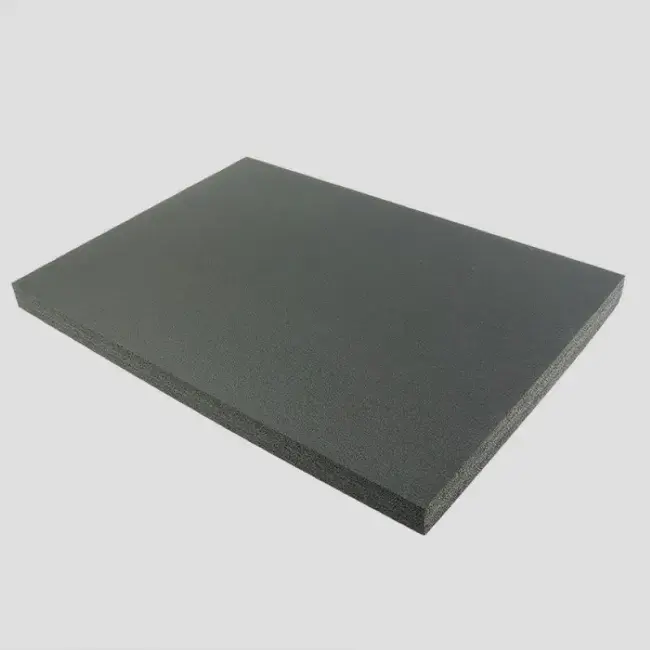
- Material: irradiation cross-linked polyethylene (IXPE) foam, anti-static grade
- Resistance grade range: 10⁶–10⁹ Ω (anti-static / dissipative). The test quantity, electrode geometry, voltage and conditioning must be agreed.
- Expansion ratio: 3–40×
- Single-layer thickness: 0.1–15 mm
- Laminated sections: 15–200 mm
- Width: 500–2000 mm
- Density: 26.8–300 kg/m³, grade-dependent
- Forms: sheet, roll, slit strip, die-cut part, laminated sheet, adhesive-backed part
- Colour: black, grey or as agreed for the selected grade
IXPE anti-static foam is irradiation cross-linked polyethylene foam supplied in a dissipative grade. It is used to bleed static charge away during handling, storage and packaging. It is not a grounding conductor for a live circuit, and it is not an EMI/RFI shield. The factory grade range is 10⁶–10⁹ Ω; confirm the exact grade and test method before approval.
What “anti-static” means in this grade
Anti-static, dissipative and conductive are not three words for the same sheet. In this catalogue, anti-static (dissipative) means a factory grade range of 10⁶–10⁹ Ω, while conductive means 10³–10⁶ Ω. The two ranges answer different questions: a dissipative material slowly bleeds charge so it does not build up on a surface, while a conductive material gives charge a low-resistance path for grounding or contact.
The numbers are supplier grade ranges. They are not a universal ESD classification, and they do not replace the ESD control plan for your assembly. The same nominal grade can read differently under different electrode geometry, applied voltage, conditioning and reading time. State those conditions on the drawing or the purchase specification.
Why IXPE is used for thin anti-static parts
IXPE is cross-linked by an electron beam rather than by a chemical agent. The irradiation route supports a single-layer thickness from 0.1 mm, a fine cell structure and a smooth surface. That matters where the foam is a thin interleaf, a slot liner, a keyboard gasket or a die-cut cushion inside a small enclosure.
The base material range is 3–40× expansion, 0.1–15 mm single layer, 15–200 mm heat-bonded multi-layer and 500–2000 mm width. Density runs from 26.8 to 300 kg/m³ depending on the ratio. Not every IXPE sheet is anti-static: the anti-static compound is a selected grade, so the grade must be named on the order and on the test report.
What to write on the drawing or specification
“Anti-static” alone is not a specification. The following items decide whether two samples are comparable.
| Item | What to state | Why it matters |
|---|---|---|
| Resistance quantity | Surface resistance or volume resistance | The two are different measurements and must not be substituted for each other. |
| Test method | Standard, electrode geometry and specimen size | A reading without its geometry cannot be reproduced. |
| Applied voltage | Test voltage and electrification time | Resistance is not a single fixed value across all test conditions. |
| Conditioning | Temperature, relative humidity and equilibration time | Humidity and temperature affect the reading; agree the conditioning before comparison. |
| Reading time | When the value is recorded after voltage application | Some materials drift during the measurement. |
| Contact face | Moulded face, cut face or laminated face | The exposed surface is the one that touches the device or the tray. |
| Compression | Installed compression and contact pressure | Contact area changes with compression and can change the measured result. |
| Cleaning | Solvents, wipes and cleaning cycles | Cleaning can change the surface; the effect must be tested, not assumed. |
Forms and conversion
We supply the anti-static grade as sheet, roll, slit strip, die-cut part, laminated sheet and adhesive-backed part. Typical converted forms include tray liners, dividers, interleaves, slot inserts, end pads and cushions. Die-cutting, CNC routing, lamination, slitting and adhesive backing are reviewed against the drawing, the base grade and the layer construction.
Product pages for trays, crates, dividers and blister trays are routes for individual review. Foam manufacture does not establish that every rigid crate or injection-moulded carrier is made in-house.
Typical routes, not approvals
Anti-static IXPE is commonly evaluated for electronic packaging, semiconductor handling, PCB and PCBA interleaves, battery-module spacing and control-cabinet padding. Each route has its own ESD plan, contact materials, cleanliness requirements and acceptance tests. A material grade does not approve any of those routes by itself. The customer’s ESD coordinator and the final assembly owner remain responsible for the approval.
Published IXPE base properties
Published factory data are grade- and method-specific. MD means machine direction; TD means transverse direction. Test-sheet values describe the material, not the finished assembly. On a small screen, scroll each table horizontally.
| Ratio | Density (kg/m³) | Tensile MD/TD (MPa) | Elongation MD/TD (%) | Compression set (%) 23±2 °C, 22 h | Water absorption (%) | Thermal conductivity (W/m·K) |
|---|---|---|---|---|---|---|
| 3× | 300±40 | ≥1.6 / ≥1.4 | ≥230 / ≥210 | ≤2 | ≤0.2 | ≤0.095 |
| 5× | 200±30 | ≥1.5 / ≥1.3 | ≥220 / ≥200 | ≤2 | ≤0.2 | ≤0.095 |
| 8× | 125±15 | ≥1.0 / ≥0.9 | ≥170 / ≥150 | ≤3 | ≤0.2 | ≤0.084 |
| 10× | 100±10 | ≥0.8 / ≥0.7 | ≥150 / ≥130 | ≤5 | ≤0.2 | ≤0.073 |
| 15× | 66.7±8 | ≥0.6 / ≥0.5 | ≥150 / ≥130 | ≤7 | ≤0.2 | ≤0.065 |
| 20× | 50±6 | ≥0.5 / ≥0.4 | ≥150 / ≥130 | ≤8 | ≤0.3 | ≤0.055 |
| 25× | 40±4 | ≥0.4 / ≥0.3 | ≥120 / ≥110 | ≤9 | ≤0.3 | ≤0.049 |
| 30× | 33.3±3 | ≥0.25 / ≥0.2 | ≥120 / ≥110 | ≤10 | ≤0.4 | ≤0.045 |
| 35× | 28.6±2 | ≥0.2 / ≥0.15 | ≥110 / ≥100 | ≤11 | ≤0.4 | ≤0.040 |
| 40× | 26.8±3 | ≥0.15 / ≥0.12 | ≥110 / ≥100 | ≤11 | ≤0.4 | ≤0.040 |
Test standards: density GB/T 6343 · tearing strength GB/T 10808 · tensile strength and elongation GB/T 6344 · water absorption GB/T 1034 (method 4) · thermal conductivity GB/T 10297 · compression set GB/T 6669 · dimensional change GB/T 8811. These are material tests; they do not certify a converted part or a package.
What the grade does not establish
Not EMI/RFI shielding. We do not publish shielding effectiveness in dB or by frequency. Conductive or anti-static resistance alone does not demonstrate shielding.
Not a dielectric rating. We do not publish breakdown voltage, comparative tracking index or a dielectric strength value. The foam must not be used as the insulation between a live conductor and a person or a grounded surface.
Not a cleanroom or cleanliness claim. We do not publish particle count, ionic contamination, outgassing or cleanroom class data. Where those requirements exist, they must be agreed and validated for the selected grade and the finished part.
Not a lifetime or humidity-independence promise. Resistance can change with humidity, temperature, cleaning, abrasion and handling. Define the conditioning, the cleaning exposure and the retest interval that your programme requires.
Not food-contact or medical approval. We do not infer food-contact, medical or biocompatibility approval from the polymer or the cross-linking route.
Flame rating is material-level only. A flame-retardant grade can be supplied (LOI 27, GB 8410 A0, UL94 V2), but a material rating does not certify the finished part, the assembly or the end product.
Ordering, MOQ, lead time and samples
Standard rolls and sheets: MOQ 1,000 m². Custom parts: minimum quantity confirmed from the drawing. Standard lead time is 15–20 days from order confirmation; confirm the schedule for the selected grade and construction.
A4 material samples are free with shipping included. Machined samples, tooling and fixtures are quoted separately. Send the application, thickness, ratio or density, dimensions, quantity, resistance target, test method and working environment. If the resistance method is not yet fixed, describe the ESD programme and the contact face first.
Bofeng Foam manufactures XPE, IXPE and IXPP in Zhuhai. Existing grade specifications and available reports can be requested. ISO 9001 and ISO 14001 are management-system certifications, not product approvals.
FAQ
Is anti-static the same as conductive?
No. In this catalogue anti-static (dissipative) is 10⁶–10⁹ Ω and conductive is 10³–10⁶ Ω. Anti-static bleeds charge slowly; conductive gives a lower-resistance path for grounding or contact. Choose by the function, not by the label.
Does a resistance reading prove the part is safe for my device?
No. The reading must be tied to a method, a contact face and a conditioning routine, and the device and package must be assessed under the ESD control plan. Resistance is one input, not an approval.
Can the foam be die-cut to a thin interleaf?
Yes. IXPE single-layer thickness starts at 0.1 mm. The practical minimum depends on the part shape, the die, the adhesive and the handling requirement; confirm the drawing.
Can you supply a flame-retardant anti-static grade?
A flame-retardant grade can be discussed, but the combination of flame rating, resistance grade and thickness must be confirmed for the specific construction. Do not assume every property is available in every combination.