
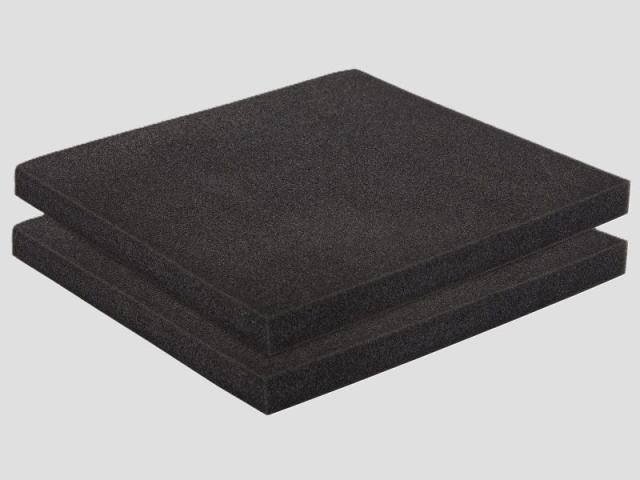
Motors, pumps, compressors, gearboxes and control cabinets are heavy, often rotating, and normally shipped and stored with shock and vibration going through the frame. Foam around them is asked to cushion, seal, absorb sound and fill gaps — often all on one drawing. The four jobs are accepted by four different tests, and the data that answers one does not answer the others.
1. Four jobs, four acceptance tests
- Cushioning is accepted by a pack-level test: the machine in its crate, at the specified drop height, without damage.
- Sealing is accepted by an assembly test: the cabinet, closed, meeting the required ingress or tightness criterion.
- Sound is accepted by an acoustic measurement on the assembled equipment.
- Vibration and gap filling is accepted by the mounted assembly behaving as designed — and, where isolation is a requirement, by a transmissibility measurement we do not provide.
A material datasheet cannot substitute for any of these. It gives inputs; the acceptance happens on the assembly.
2. Cushioning: from mass and drop, not from density
A transit cushion is sized from the equipment mass, the contact area, the drop or shock level in the applicable transport standard, and the allowed compression. The foam’s contribution is a compression set and a load–deflection behaviour. For IXPE we publish compression set (≤2% to ≤11% at 23±2 °C over 22 h, by ratio) but not a full load–deflection curve, so the cushion design has to be checked with the actual foam and the actual crate.
“A few centimetres of foam” is not a cushion specification. Neither is “density 50”. Both leave the deceleration and the residual clearance undefined.
3. Sealing: closed cell is not an IP rating
IXPE is closed-cell and resists water uptake (≤0.2–0.4% by ratio under the published test), which is why it is common on cabinet doors and access panels. What is not published is an ingress-protection or airtightness rating for a finished seal. Sealing depends on strip geometry, compression, frame flatness, adhesive and closing force. If the enclosure must meet an IP rating, the assembled cabinet is what gets tested.
The same applies to oil and coolant: closed-cell foam resists water, but resistance to a specific oil at a specific temperature is a compatibility question that must be checked, not assumed.
4. Sound: a liner, not a measured absorber
Cross-linked PE foam is widely used as an acoustic liner and decoupling layer inside equipment. We do not publish absorption coefficients or transmission loss. Treat the foam as one layer in an acoustic design the equipment maker validates, and do not quote a noise-reduction figure that came from the material rather than from a test.
5. Vibration: the foam is not a structural mount
A foam pad can decouple surfaces, take up gap and prevent rubbing. It is not a structural mount. We do not publish vibration transmissibility, dynamic stiffness or fatigue life for a loaded mount. Where a machine must be held rigidly, or where isolation is a design requirement, the mount is an engineered part and the foam is at most a secondary pad.
6. Temperature at the part, not at the nameplate
Motors and compressors run hot, and the foam near them sees the local temperature, which is not the machine’s rated ambient. Three figures to keep apart:
- High-temperature IXPE grade: 110 °C working environment, shrinkage ≤8%.
- Label-grade IXPE sheet: recommended constant use maximum 70 °C.
- IXPP: up to 140 °C per source data.
Check the temperature at the foam’s location over the duty cycle, including any abnormal or stalled condition the equipment is designed to survive.
7. Flame retardance
A flame-retardant grade is available with LOI 27, GB 8410 A0 and UL94 V2. These are material-level ratings. They do not certify the cabinet, the wiring or the assembly. UL94 V0 is not offered.
8. Specification checklist
- Function: cushion, seal, liner, gap pad or dunnage — one per line item.
- Cushioning: mass, contact area, drop height, allowed compression.
- Sealing: gap, frame flatness, closing force, IP requirement if any.
- Acoustic requirement, if any, and who will measure it.
- Temperature at the part across the duty cycle.
- Oil, coolant and cleaning exposure.
- Adhesive substrate and service temperature.
- Part form, tolerance and annual quantity.
9. Where to go next
Application page: electromechanical equipment foam. Functions: cushioning foam, sealing foam, soundproof foam. Material: IXPE foam. For a part drawing, use the selection request.