
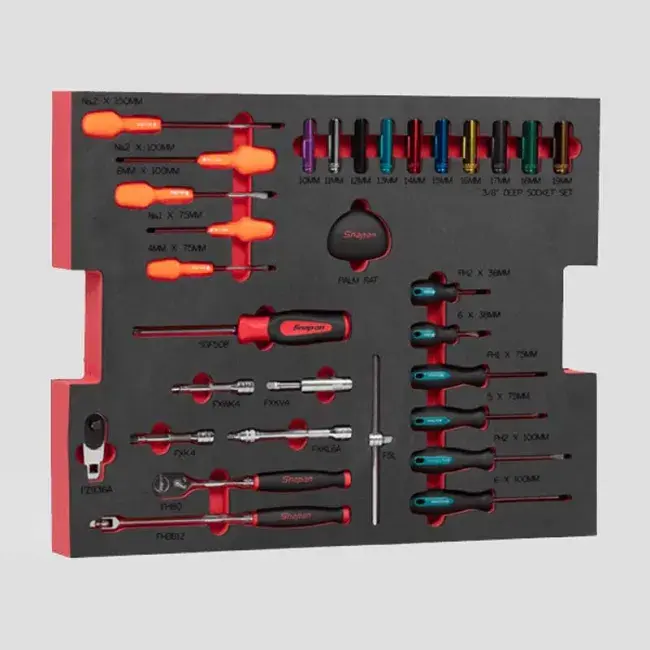
Custom foam inserts are precision die-cut or routed foam shapes that hold a product securely in its case or box. Bofeng Foam designs and manufactures custom foam inserts for tool cases, electronics, medical devices, cosmetics, wine and gift packaging — protecting your product and elevating the unboxing experience.
Bofeng Foam is a direct factory offering design-to-production custom foam insert service with in-house die-cutting, CNC routing, lamination and ESD options.
What We Offer
- Custom die-cut foam inserts — precision-cut XPE/PE foam inserts for tool cases, drone cases, electronics and equipment cases.
- CNC-routed foam inserts — complex 3D shapes routed from high-density XPE foam for camera, medical and industrial equipment.
- Laminated & lined inserts — foam faced with flannelette, non-woven, leather or foil for premium retail and gift packaging.
- ESD-safe inserts — conductive and anti-static foam for electronics and PCBs.
- Prototype & low-volume runs — fast sampling before production.
The Custom Foam Insert Process
- Share your product — send drawings, CAD files or a physical sample.
- Design — our engineers propose foam type, density and cut layout for fit and protection.
- Prototype — we produce a sample insert for your approval.
- Production — die-cutting, lamination, assembly and QC at our Zhuhai factory.
- Delivery — flat-packed or assembled inserts shipped worldwide.
Industries We Serve
Tool manufacturers, consumer electronics, medical devices, cosmetics, wine & spirits, ceramics, glassware, gifts and e-commerce. See our packaging foam and ESD foam hubs for product examples.
Why Bofeng Foam?
As a direct XPE/IXPE/PE foam manufacturer, we control the foam at source — lower cost, shorter lead time and full traceability. Die-cutting and lamination are in-house, so your custom foam insert is made end-to-end by one supplier.
Request a custom foam insert quote →
Custom foam inserts FAQ FAQ
How are custom foam inserts made?
From the part drawing, a physical sample, or a 3D model. We establish the cavity geometry, choose the foam grade and density against the load the insert has to carry, and then cut the part — by die-cutting for repeat production, or by CNC routing for low volumes and complex contours. Multi-layer inserts are built by bonding a cut pocket layer onto a solid base sheet, which gives real pocket depth without using a thick block of foam.
What is the difference between die-cutting and CNC routing?
Die-cutting uses a steel-rule die to stamp the profile, so the tooling is amortised over the run and the unit cost falls with volume; it suits a shape that will be produced repeatedly. CNC routing cuts the contour by moving a cutter through the sheet, which needs no tooling, tolerates design changes between parts, and handles deep pockets and three-dimensional contours that a die cannot form. For a first article or a low volume, CNC is normally the better route.
What is shadow foam?
Shadow foam is a two-layer construction: a coloured top sheet over a contrasting base, with a cavity routed through the top layer around each tool. The result is a visual outline — a shadow — that shows immediately whether an item is missing from the set, which is why it is used for tool control in aviation, maintenance and medical kits as well as for tool boxes.
Which foam is used for a protective insert?
Cross-linked PE foam in the firmer part of the range, because the insert has to hold its pocket geometry under the weight of the product. Where the product is fragile or has a finished surface, a softer IXPE face over a firmer core — laminated in house — gives both the support and the surface protection. For electronic components the conductive and anti-static grades are used instead — conductive 10³ to 10⁶ Ω, anti-static 10⁶ to 10⁹ Ω.
Can the insert be designed from a sample rather than a drawing?
Yes. A physical sample is often the better starting point, because the insert has to fit the real part rather than the nominal drawing. Send the sample with the container dimensions and we will design the cavity and the build-up around it.