
Compare XPE and IXPE polyethylene foams with IXPP polypropylene foam. These cross-linked polyolefin materials differ in base polymer, cross-linking method, thickness and temperature capability. Start with the comparison below, then send your application, dimensions and working conditions to confirm a suitable grade.
Which Foam Should You Choose?
Use the comparison below as a starting point. Available combinations depend on the material and grade. Tell us your application so we can confirm a suitable specification.
On small screens, swipe the table horizontally to see all columns.
| Material | Cross-linking | Single-layer thickness | Temperature resistance | Typical use |
|---|---|---|---|---|
| XPE foam | Chemical | 3–15 mm | Grade-dependent | Packaging, underlayment, yoga mats |
| IXPE foam | Irradiation | 0.1–15 mm | Grade-dependent (same PE base as XPE) | Automotive, baby mats, gaskets |
| IXPP foam | Irradiation | 1–6 mm | Up to approx. 140 °C | High-temperature insulation |
| PE foam | Non-cross-linked available | Made to order | Grade-dependent | General cushioning packaging |
| Silicone foam | — | Made to order | Grade-dependent | Sealing, gaskets |
Choose by requirement
- Very thin layers: start with IXPE, available from 0.1 mm.
- General cushioning and cost-sensitive thicker sheets: start with XPE, with single layers from 3 mm.
- Higher temperature and stiffness: consider IXPP; the manufacturer specifies a maximum service temperature of 140 °C. Confirm suitability for the actual exposure.
- Flame retardance or ESD control: specify the required test and grade; availability depends on the material and dimensions.
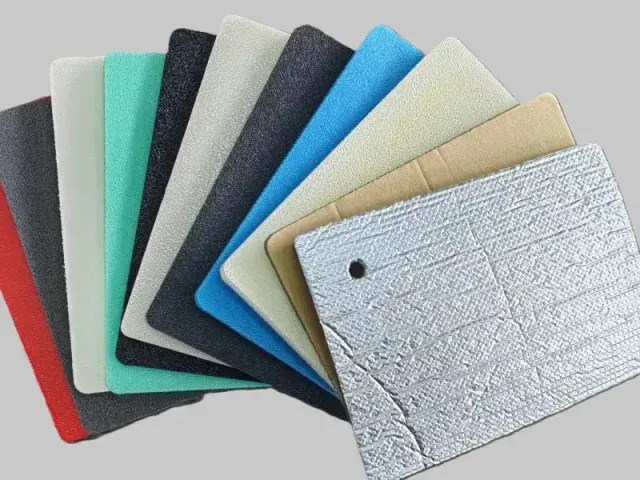
As a direct manufacturer of XPE, IXPE and IXPP foam in Zhuhai, China, Bofeng Foam produces these cross-linked foam families in-house and laminates them with aluminium foil, non-woven fabric, leather, flannelette and more. This page is your starting point for understanding the differences between our foam materials and choosing the right one for your product.
What is Cross-Linked Polyethylene Foam?
Cross-linked polyethylene foam is produced by foaming polyethylene and cross-linking the polymer chains so that the cells close, giving the sheet dimensional stability, resilience and heat resistance that ordinary non-cross-linked PE foam does not have.
- Closed-cell structure: every air pocket is sealed, so the foam absorbs very little water and provides consistent thermal and acoustic insulation.
- Two cross-linking methods: chemical cross-linking (used for XPE) or irradiation cross-linking by electron beam or gamma ray (used for IXPE and IXPP).
Our Cross-Linked Polyolefin Foam Material Family
XPE Foam
Chemically cross-linked polyethylene foam. A strong, cost-effective closed-cell foam in single layers from 3 mm to 15 mm and in multi-layer sheets up to 200 mm. Ideal for packaging, underfloor sound insulation, flotation and yoga mats.
IXPE Foam
Irradiation cross-linked polyethylene foam. The same closed-cell performance as XPE but available much thinner — from 0.1 mm — which makes it the material of choice for automotive interiors, baby play mats and precision cushioning.
IXPP Foam
Irradiation cross-linked polypropylene foam. The most temperature-resistant of the cross-linked family, combining closed-cell insulation with higher heat resistance for automotive and high-temperature applications.
How the foam is supplied
The same grade can leave the factory in several forms. The form is chosen after the grade, and it never changes the grade: density, expansion ratio and cell structure are set by the material table, while the form sets the dimensions and the surface.
On small screens, swipe the table horizontally to see all columns.
| Supply form | XPE | IXPE | IXPP | Notes |
|---|---|---|---|---|
| Single-layer sheet | 3–15 mm | 0.1–15 mm | 1–6 mm | Width 500–2000 mm (XPE, IXPE), 500–1500 mm (IXPP) |
| Multi-layer heat-bonded block | 15–200 mm | 15–200 mm | 6–100 mm | Layers bonded to the requested thickness |
| Roll or slit roll | Yes | Yes | Yes | Slit to the width the line needs |
| Self-adhesive roll | Yes | Yes | Yes | Solvent-based adhesive under a release liner |
| Laminated facing | Yes | Yes | Yes | Aluminium foil, non-woven, PE film, leather or flannelette |
| Die-cut or CNC-routed part | Yes | Yes | Yes | Quoted from a drawing or a sample |
These are supply forms, not separate products. A 5 mm IXPE sheet, a 100 mm IXPE block and a die-cut IXPE tray use the same material table; what changes is how the material is built up and cut.
Other Foam Materials We Produce
- PE foam — lightweight polyethylene foam in low, medium and high density.
- Silicone foam — foamed silicone for high-temperature and sealing applications.
- Laminated foam — foam laminated with aluminium foil, non-woven fabric, leather or flannelette for insulation and decoration.
Why Choose Bofeng Foam as Your Foam Manufacturer?
Bofeng Foam is a direct factory manufacturer of cross-linked polyethylene foam in Zhuhai, China, with more than 10 years of foam-industry experience. Buying from the factory means quality control, custom sizes and competitive pricing without a trading middleman.
- In-house R&D of flame-retardant, high-temperature, permanent anti-static, conductive and open-cell foam series.
- Custom thickness, density, width, colour and surface treatment.
- OEM / ODM service from prototyping to mass production, including die-cutting and lamination.
Get a quote for your foam material →
Ordering information
On small screens, swipe the table horizontally to see all columns.
| Item | What we supply |
|---|---|
| Minimum order | 1,000 m² for standard rolls and sheets; custom parts are quoted individually from the drawing |
| Lead time | 15–20 days from order confirmation |
| Samples | A4 sheet, free of charge, shipping included |
| Supply forms | rolls, sheets, multi-layer blocks, self-adhesive roll, laminated sheet, die-cut parts |
Material Identity and Processing Scope
LDPE means low density polyethylene, a resin description rather than a complete foam specification. State the required cross-linking, grade, thickness and supply form as well as the polymer name. For a customer-specified material outside our core foam families, send its grade or supplier sheet and the required operation so processing feasibility and material sourcing can be confirmed before quotation. A request for converting does not mean that we manufacture that base foam.
Cross-linked foam FAQ
Which cross-linked foam should I choose: XPE, IXPE or IXPP?
Start from the thinnest part the application allows and from the temperature it will see. XPE is chemically cross-linked polyethylene and is the general-purpose grade — firm, resilient and economical, with single layers from 3 mm. IXPE is irradiation cross-linked, so it forms a finer and more uniform cell, which allows single layers down to 0.1 mm with a smoother surface; it is the grade for precision gaskets, thin laminates and electronics. IXPP is irradiation cross-linked polypropylene, stiffer than PE foam and serviceable up to 140 °C, which is why it is used where the part sits near heat.
What expansion ratio and density do I need?
Expansion ratio is the single lever that sets density, hardness and stiffness together. For XPE and IXPE, the standard expansion range is 3× to 40×, with nominal densities from 26.8 to 300 kg/m³. IXPP has a separate 5× to 25× range; use its own grade table. A high ratio removes more polymer and leaves a lighter, softer foam that deflects under a light load; a low ratio leaves a dense, firm sheet that carries a heavy or pointed load without bottoming out. Tell us the load, the deflection you can accept and the thickness available, and we will propose a ratio.
Are flame retardant, conductive and anti-static grades available in every material?
No. These are grade-specific options, and availability depends on the base material, thickness and density. Send the functional requirement and test criteria so we can confirm a feasible combination before quotation. The following values describe the corresponding functional grades, not every material or specification. The flame-retardant grade has a limiting oxygen index of 27 and meets the requirements of GB 8410 A0 and UL94 V2; the heat-resistant grade is rated to 110 °C with shrinkage of 8% or less; and the anti-static grade is specifiable from 10⁶ to 10⁹ Ω and the conductive grade from 10³ to 10⁶ Ω. Because conduction runs through the volume of the foam rather than as a coating, a cut edge protects as well as the original surface.
Do you also supply non-cross-linked PE foam and silicone foam?
Yes. Alongside the three cross-linked families we supply non-cross-linked PE foam for general cushioning and void fill, and silicone foam for applications where the operating temperature sits outside the range that polyethylene can survive. These are separate material families with their own properties, so they are quoted on their own specification rather than as an alternative grade of XPE.
Can I get a sample before committing to production?
Yes — material samples are available for evaluation. Send the application, the thickness and density you have in mind, and the environment the part will work in, and we will supply material to test against your own requirement rather than against a datasheet alone.