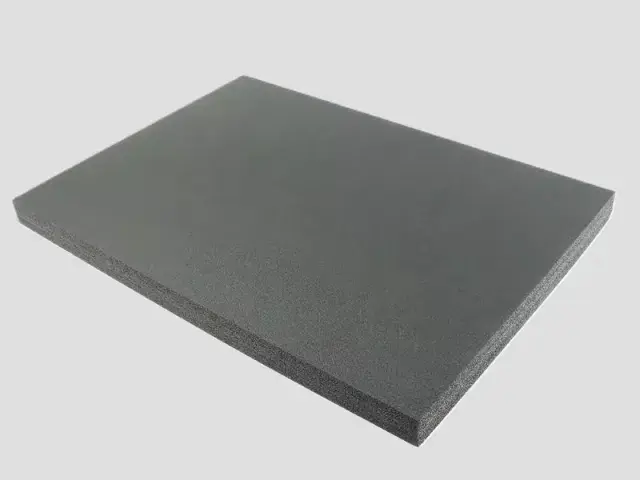
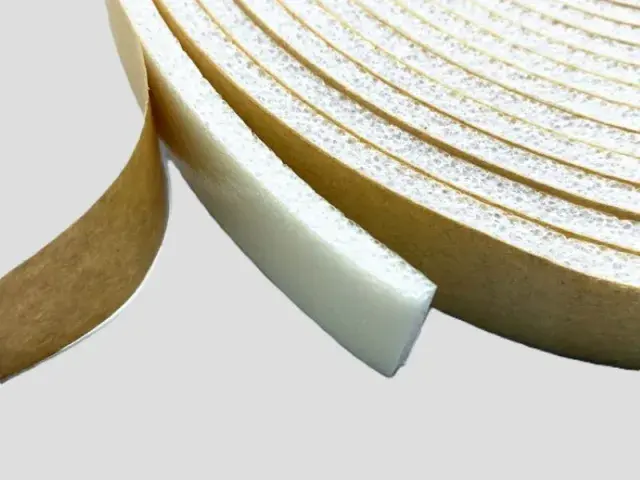
- Material: XPE foam, IXPE foam
- Expansion ratio: 25 times (40 kg/m³), 30 times (33 kg/m³)
- Thickness: 50 mm, 80 mm, 100 mm (thickness can be customized)
- Colour: black, white (colour can be customized)
- Flame retardant grade: UL94 HF-1
Customization
Made to order: density, thickness, colour and shape to your drawing. Die-cutting, CNC routing, lamination to film or fabric, slitting and adhesive coating all run in-house, so the part we quote is a finished part, not just a sheet. How a custom part is cut and routed explains what to send with the drawing.
Regular material: MOQ 1,000 m², lead time 15–20 days from order confirmation. Custom parts are quoted from the drawing. A4 samples are free, shipping included.
Ceramic fails all at once. A hairline crack from a single impact is enough to write off a piece that survived every other stage of production and finishing. Bofeng cuts ceramic packaging foam inserts from XPE and IXPE foam in thick sections, so the energy of a drop is absorbed before it reaches the piece, and the cavity supports the whole form rather than a few contact points.
Features
- Thick cushioning – 50–100 mm sections absorb the energy of a drop before it reaches the ceramic.
- Full-contact support – cavities shaped to the piece, so pressure is spread across the form instead of concentrating.
- Vibration damping – closed-cell foam isolates pieces from the continuous vibration of long-haul freight.
- Moisture resistant – will not hold damp against glaze or unglazed surfaces.
- Clean cutting – smooth, non-abrasive edges that will not mark a finished surface.
- Custom density and colour – 25× (40 kg/m³) and 30× (33 kg/m³) grades, black or white as standard.
Applications
- Homeware and tableware – dinner sets, vases and decorative pieces for retail and export.
- Art and antiques – one-off pieces that need a fitted, single-item pack.
- E-commerce – ceramics sold online and shipped through parcel networks.
- Sanitary ware and tiles – flat and heavy items protected at edges and corners.
- Industrial ceramics – precision components that must arrive dimensionally intact.
Specifications for ceramic packaging foam
A ceramic foam insert is a die-cut part, so the sheet has to hold a cavity, keep its thickness and cut cleanly.
| Foam | Expansion | Apparent density | Single-layer thickness | Why this grade |
|---|---|---|---|---|
| XPE | 10–20× | 50–100 kg/m³ | 3–15 mm (heat-bonded 15–200 mm) | Use this XPE range as a starting point for shaped supports. Check contact on the actual ceramic profile, including glazed surfaces, and assess separation and deformation in the tested carton after the planned handling sequence. |
| IXPE | 20–30× | 33.3–50 kg/m³ | 0.1–15 mm | Fine-cell sheet for the lid liner and for thin interleaving between parts, where a firmer sheet would not close. |
Base material specifications are on the XPE, IXPE and IXPP material pages; finished products are on the XPE foam and IXPE foam pages. Tell us the load, the space available and the service temperature and we will confirm the grade against your drawing.
Why Choose Bofeng Foam
- 50 / 80 / 100 mm sections as standard, other gauges on request.
- Flame-retardant grade available – UL94 HF-1.
- Black and white as standard, other colours on request.
- Die-cut to your piece from a drawing or a physical sample.
- Samples and specification sheets available before production.
How an insert is laid out so a fragile part is carried by the foam rather than resting on the box floor is set out in our custom foam insert design guide.
Ceramic Inserts: Follow the Strong Body, Not the Most Convenient Outline
Identify Fragile Projections
Handles, rims, feet and decorative features may not be suitable support points. Mark permitted contacts on the drawing and use the actual piece to assess dimensional variation. An insert traced around the widest silhouette can still load a thin handle when the carton is closed. Record which surfaces carry mass in each expected orientation.
Review Hollow Forms Separately
An internal support is not automatically beneficial: it can introduce a new concentrated contact inside a hollow vessel. Ask the packaging designer to define whether it is needed and how it is located. Trial insertion and removal to ensure packing does not load a fragile opening or leave a loose support moving inside the part.
Check Finish and Layer Construction
Glazed, unglazed and decorated surfaces can have different contact requirements. Inspect for rubbing, debris and local pressure marks with the intended facing and foam. Distinguish a through-cut cavity, a retained bottom and a multilayer build; they provide different support paths. Do not infer a complete cushioning design from nominal density.
Agree the Transport Assessment
Define the actual carton, pack-out and relevant distribution test with acceptance criteria for breakage and appearance. Keep sample identity and photographs so a result can be traced to the construction tested. Low foam water uptake is not approval for every moisture exposure, and an environmental claim needs its own evidence. We quote the specified component rather than guaranteeing a breakage-free shipment.
For sample identity, dimensions and the acceptance record, use the first-article review checklist with the application-specific checks above.
Designing a ceramic pack around the finished article
Describe the fragile details
A ceramic packaging brief should include the finished article with its actual handles, spouts, feet, lids and decorative details. Overall dimensions do not show which projections can tolerate contact. Mark the parts that the product designer permits the pack to support and those that must remain clear. Where the product is glazed, printed or otherwise finished, include an example of that finish in the sample review. A cavity tested against an unfinished shape does not answer the surface protection question.
List every item in the retail or transport set. A cup with a saucer, a lidded vessel and a group of separate ornaments require different layouts. Give each loose part an identified position. If a lid is packed separately, describe how it is contained and removed. If it remains fitted, ask the product owner to review that arrangement rather than assuming the foam can prevent every interaction between the parts. The approved configuration should be visible in a packing drawing or a clear set of photographs.
Choose support points before adjusting tightness
During the first fit trial, check where the weight of the article is carried. The intended support may be a broad part of the body, an approved base region or another surface identified by the designer. A handle or narrow rim should not become an accidental support merely because it is the first feature to touch the cavity. Record the actual contact positions and inspect them when the pack is closed, not just while the article is resting in an open tray.
If the part can rock, investigate the geometry of the supports before simply making the whole cavity tighter. If removal is difficult, identify the obstruction and provide an approved grip route. Avoid asking the user to pull on a fragile decorative projection to overcome friction elsewhere. The insert should be reviewed with any wrapping, tissue or bags that form part of the intended pack because these affect both fitting and handling. Keep that layer description with the cavity drawing.
Separate the packing operation from the transit assessment
Run through the intended packing sequence using the complete set. Identify the order in which the article, dividers and top pieces are installed and confirm that the operator can see whether each part is seated. For a multi piece kit, consider how an incorrect orientation would be recognised before closure. Mark the relevant layers or positions where that improves repeatability. The purpose is to make the approved arrangement reproducible, not to claim that operator errors are impossible.
Inspect the article after the handling trial and record any marks before starting a distribution evaluation. This distinguishes damage introduced during packing from damage associated with the subsequent route simulation. The final assessment must use the intended outer box, closures and packed quantity. A foam data sheet cannot establish an acceptable breakage rate or a universal shipping guarantee. The package owner should set the criteria and retain the evidence for the actual product and package combination.
Control variants and repeat orders
Ceramic ranges often contain related shapes that look similar in photographs. Identify which article codes each layout is approved to carry. If a cavity is intended for more than one version, evaluate the relevant versions rather than treating them as equivalent by appearance. Record differences in attached parts, overall profile and the permitted support surfaces. An insert revision should make clear whether it is a replacement for an existing layout or an additional configuration.
For repeat orders, retain the material grade, cutting drawing, layer order and an approved sample with the package description. Review changes to the article, its surface finish, wrapping or the outer carton before accepting them as routine substitutions. If a damaged shipment is investigated, request photographs of the pack before it is rearranged, together with the item and layout identification. A useful investigation starts with the complete packed system and the handling record rather than a general claim that the foam was too soft.
Keep the unpacking instructions with the sample review, particularly where the upper support must be removed before lifting the article. Ask a person unfamiliar with the layout to follow the intended sequence and record any ambiguous step. If the article is intended to be displayed in part of the packaging, identify that arrangement separately from the closed transit pack. A presentation layout and a shipping arrangement should not be treated as equivalent without review. Identify the unpacking direction in the approved packing instructions.
Conclusion & Inquiry
Packaging foam covers the wider range of custom inserts and trays, and glass packaging foam solves the same problem for flat fragile goods. Contact us with your piece dimensions and we will quote a cut layout.