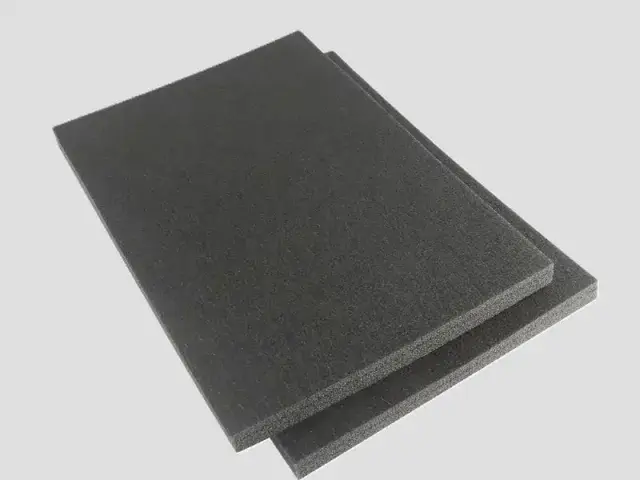
- Material: XPE or IXPE foam, flame-retardant grades available
- Expansion ratio: XPE 3–40×, IXPE 3–40×
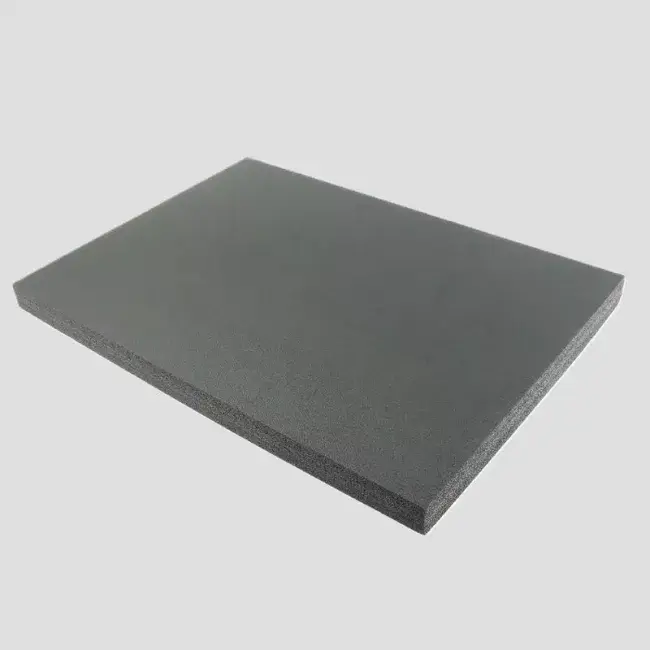
- Thickness: XPE single layer 3–15 mm, IXPE single layer 0.1–15 mm; laminated multilayer 15–200 mm
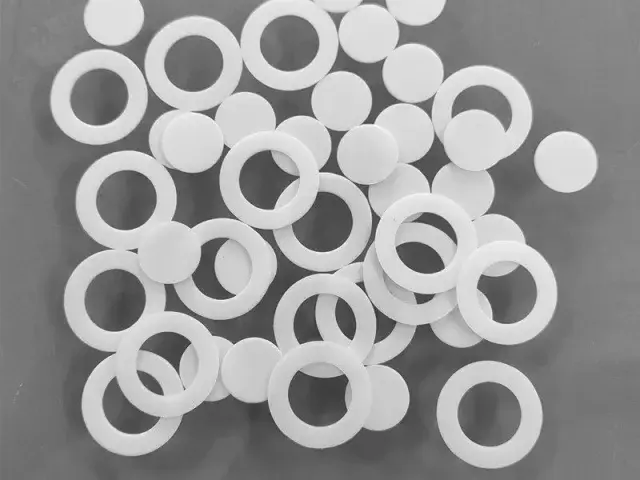
- Form: die-cut panel, pad, gasket, slit strip or laminated sheet
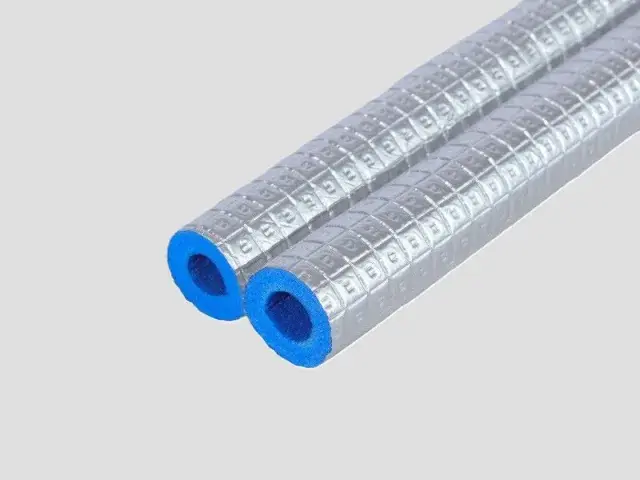
- Lamination: fabric, film, aluminium foil, pressure-sensitive adhesive
- Flame-retardant grade: LOI 27, GB 8410 A0, UL94 V2 (grade-dependent)
Customization
Made to order: density, thickness, colour and shape to your drawing. Die-cutting, CNC routing, lamination to film or fabric, slitting and adhesive coating all run in-house, so the part we quote is a finished part, not just a sheet. How a custom part is cut and routed explains what to send with the drawing.
Regular material: MOQ 1,000 m², lead time 15–20 days from order confirmation. Custom parts are quoted from the drawing. A4 samples are free, shipping included.
Automotive interior foam is a supporting layer. It sits behind a fabric, a film or a trim panel and does one of four jobs: fill a gap, soften a hard surface, absorb sound, or block heat. It is not the visible surface, and it is not the structural part. The visible skin and the carrier panel are designed by the interior supplier; the foam is specified underneath them.
This page covers XPE and IXPE foam in the cabin: headliner backing, door panel padding, pillar and trim gaps, seat-back and trunk trim, and the acoustic layers behind them. It does not cover the PU foam in the seat cushion, and it does not cover exterior or under-hood parts.
What Interior Foam Has to Do
- Fill and soften. Take up the gap between a trim panel and the body, and stop the panel from feeling hard or rattling.
- Absorb noise. Add a porous or flexible layer behind a trim panel to reduce airborne noise and squeaks.
- Block heat. Reduce heat flow through the floor, the firewall area or a door skin.
- Prevent squeaks and rattles. Separate two hard parts that would otherwise rub.
- Carry other layers. Act as the substrate for a fabric, film or adhesive in a laminated trim.
One part can do several of these. A headliner backing, for example, is mostly a substrate and a soft-touch layer; a floor pad is mostly a heat and noise barrier. Specify the dominant job first, or the foam will be chosen on price alone and fail on the one property that mattered.
Where the Foam Goes
| Location | Job | Material usually considered | Form |
|---|---|---|---|
| Headliner | Substrate for the fabric, soft-touch layer, some acoustic absorption | XPE or IXPE, often laminated | Die-cut panel or laminated sheet |
| Door trim panel | Padding behind the armrest and insert, anti-rattle layer | XPE, IXPE for thin sections | Die-cut pad |
| Pillar and sill trim | Gap filling, anti-squeak, clip backing | XPE | Die-cut gasket or strip |
| Seat back and under-seat | Padding, trim backing, heat separation | XPE | Die-cut panel |
| Trunk and load floor | Noise absorption, load cushioning, heat separation | XPE, sometimes foil-faced | Die-cut pad |
| Floor and firewall trim | Heat and noise barrier behind carpet | XPE with foil or heavy film | Laminated sheet, die-cut |
Why PE Foam, Not PU
The seat cushion and seat back are usually PU foam: it is soft, breathable and cheap in moulded shapes. XPE and IXPE are different: closed-cell, tougher, more dimensionally stable, and easy to die-cut or laminate. They are used where the part needs to hold a shape, resist repeated compression, or carry a facing — not where the part has to be a deep, soft cushion.
That distinction matters in a quote. If a drawing calls for a moulded seat cushion, XPE sheet is the wrong material. If the drawing calls for a flat or gently curved backing pad behind a trim panel, XPE is often the right one.
Material Choice
| Material | Single-layer thickness | Where it fits | Watch |
|---|---|---|---|
| XPE | 3–15 mm | Headliner backing, door padding, floor and trunk pads | Rougher surface; check the facing adhesion |
| IXPE | 0.1–15 mm | Thin door inserts, tight gaps, smooth visible edges | Higher cost; not a structural panel |
| Flame-retardant XPE / IXPE | As base material | Parts that must meet an interior flammability requirement | Confirm the grade and the test standard before tooling |
| Foil-faced XPE | As base material | Floor, firewall and trunk heat barriers | Foil must face an air space; cut edges leak heat |
Headliner Construction
A headliner is a sandwich: a carrier or substrate, a foam layer, and a fabric skin. The foam's job is to give the fabric a soft touch, hide the carrier's surface, and add a little acoustic absorption. The foam must bond to both the carrier and the fabric, and it must survive the headliner's forming process and the cabin's heat.
Two practical points. First, the foam has to be flat and consistent; a thickness variation shows through the fabric. Second, the adhesive has to be compatible with both the foam and the fabric, and it has to hold at the top of the cabin's temperature range. A headliner that sags in summer is usually an adhesive or carrier problem, not a foam density problem.
Door Panels, Pillars and Trim
Door trim and pillar trim use foam for three reasons: to soften the surface behind the armrest or insert, to fill the gap between the trim and the body, and to stop the trim from squeaking against the sheet metal or another plastic part. In these parts the foam is usually die-cut to the trim's inner contour and fixed with adhesive or captured by the trim's clips.
Thin sections are common. IXPE is the usual choice below 3 mm, because XPE is not made thinner than 3 mm in a single layer. If the gap is uneven, a slightly compressible foam is better than a stiff one: it conforms, fills the gap and does not push the trim out of position.
Noise, Vibration and Heat
PE foam is a moderate acoustic absorber and a moderate heat barrier. It is not a replacement for a dedicated acoustic felt or a mass layer. In a door or a floor, the foam usually works as part of a stack: carpet, mass layer, foam, and sometimes a foil facing. Removing one layer and thickening the foam does not give the same result.
For heat, a foil facing helps against radiant heat, but the foil must face an air space and the edges must be closed. A foil-faced pad pressed flat against a metal panel is mostly a conduction path, not a barrier. If the requirement is a specific temperature drop, test the stack, not just the foam.
Flammability, Odour and VOC
Interior parts are subject to flammability requirements, and the requirements differ by market and by location in the vehicle. Our flame-retardant grades are specified at LOI 27, GB 8410 A0 and UL94 V2. Those are material-level results, not a vehicle-level approval.
Odour and VOC are separate from flammability. We can discuss low-odour grades, but we do not hold an automotive OEM VOC approval or a material certification for a specific vehicle programme. If the programme requires a customer-specific material approval, that has to be agreed before tooling.
Die-Cutting and Lamination
Interior parts are usually die-cut, sometimes CNC-routed for prototypes, and often laminated. The common laminations are fabric, film, aluminium foil and pressure-sensitive adhesive. The choice follows the assembly:
- Adhesive-backed foam for flat panels that are applied at the trim supplier.
- Fabric- or film-faced foam where the foam is the visible soft surface or needs protection.
- Foil-faced foam for heat barriers behind carpet or trim.
- Multi-layer foam where one thickness cannot meet both the gap and the softness requirement.
Send the drawing, the facing material, the assembly method and the service temperature. A sample first is cheaper than a tool that produces the wrong part.
Specifications We Can Supply
| Property | XPE | IXPE |
|---|---|---|
| Expansion ratio | 3–40× | 3–40× |
| Single-layer thickness | 3–15 mm | 0.1–15 mm |
| Laminated multilayer | 15–200 mm | 15–200 mm |
| Apparent density | Grade-dependent, 26.8–300 kg/m³ | |
| Water absorption | 0.2% or less to 0.4% or less, GB/T 1034 method 4 | |
| Thermal conductivity | 0.040–0.095 W/(m·K), grade-dependent | |
| Flame retardancy | LOI 27, GB 8410 A0, UL94 V2 (flame-retardant grades) | |
| Lamination | Fabric, film, aluminium foil, pressure-sensitive adhesive | |
What We Do Not Claim
- No OEM or tier-one approval. We are a foam supplier. We do not hold a PPAP, an OEM material approval or a qualification for a named vehicle programme.
- No vehicle-level flammability approval. LOI 27, GB 8410 A0 and UL94 V2 are material results; the vehicle interior test is the customer's.
- No VOC or odour certification. Low-odour grades can be discussed, but we do not provide a cabin-air certification.
- No structural claim. XPE and IXPE are padding and barrier materials, not structural panels or crash components.
Ordering, MOQ, Lead Time and Sample
- MOQ: 1,000 m² for standard roll or sheet. Die-cut parts are quoted against the drawing and annual volume.
- Lead time: 15–20 days from order confirmation for standard material; a new die-cut part includes sample approval and tooling.
- Sample: an A4 piece is free; we pay the freight.
- What to send: the drawing, facing material, assembly method, service temperature, flame requirement and annual quantity.
FAQ
Can XPE replace the PU foam in a car seat?
No, not for the cushion itself. Seat cushions are moulded PU foam because they need deep, soft, breathable shapes. XPE and IXPE are used for backing pads, trim padding, gap filling and heat or noise barriers around the seat, not as the cushion.
Is the foam suitable for a headliner?
Yes, as the backing or soft-touch layer in a laminated headliner. The foam has to be flat, bond to both the carrier and the fabric, and hold at the cabin's temperature. The complete headliner still has to be tested by the interior supplier.
Does the foam meet automotive flammability requirements?
Flame-retardant grades meet LOI 27, GB 8410 A0 and UL94 V2 at material level. Whether that satisfies a specific vehicle programme depends on the market and the location in the vehicle; the vehicle-level test is the customer's.
Can you supply low-odour foam?
We can discuss low-odour grades, but we do not hold a cabin-air or VOC certification. If the programme has a VOC limit, tell us before quoting.
Can the foam be laminated with fabric or film?
Yes. Fabric, film, aluminium foil and pressure-sensitive adhesive are the common laminations. Send the facing specification and the assembly method so the adhesive and the foam grade can be matched.
Related Applications
Automotive foam · Soundproof foam · Automotive tape foam · Laminated foam · Cross-linked PE foam materials