
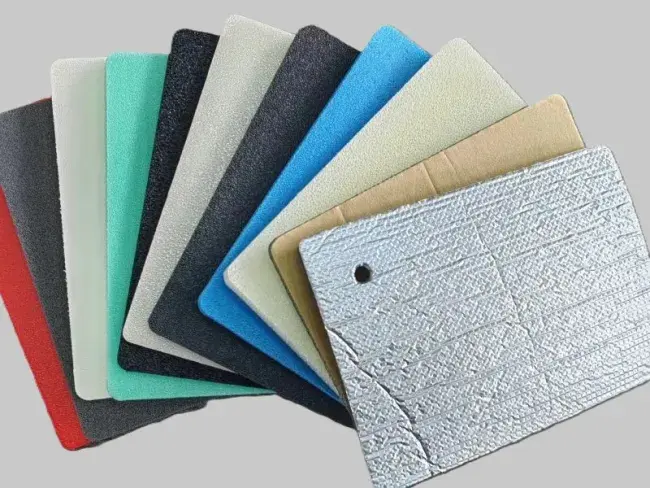
- Cross-linking: radiation (electron-beam / irradiation) cross-linking
- Expansion ratio: 3–40 times
- Density: 26.8–300 kg/m³ (see table below)
- Width: 500–2000 mm
- Thickness: single layer 0.1–15 mm; heat-bonded multi-layer 15–200 mm
- Surface treatment: calendering, embossing or corona treatment
- Colour: black, white, gray, custom colours
Physical properties by expansion ratio
Ratio | Density (kg/m³) | Tearing strength MD/TD (kN/m) | Water absorption (%) | Thermal conductivity (W/m·K) |
|---|---|---|---|---|
3x | 300±40 | ≥13 / ≥11 | ≤0.2 | ≤0.095 |
5x | 200±30 | ≥12 / ≥10 | ≤0.2 | ≤0.095 |
8x | 125±15 | ≥6.5 / ≥6.0 | ≤0.2 | ≤0.084 |
10x | 100±10 | ≥6.0 / ≥5.0 | ≤0.2 | ≤0.073 |
15x | 66.7±8 | ≥4.0 / ≥3.5 | ≤0.2 | ≤0.065 |
20x | 50±6 | ≥3.5 / ≥3.0 | ≤0.3 | ≤0.055 |
25x | 40±4 | ≥2.5 / ≥2.0 | ≤0.3 | ≤0.049 |
30x | 33.3±3 | ≥1.3 / ≥1.1 | ≤0.4 | ≤0.045 |
35x | 28.6±2 | ≥1.3 / ≥1.1 | ≤0.4 | ≤0.040 |
40x | 26.8±3 | ≥1.2 / ≥1.1 | ≤0.4 | ≤0.040 |
Shore hardness and sheet thickness
IXPE hardness depends on how thin the sheet is rolled. For sheets over 3 mm: 65–75 (3x), 60–70 (5x), 50–60 (8x), 45–50 (10x), 35–45 (15x), 30–35 (20x), 25–30 (25x), 18–25 (30x), 13–20 (35x), 13–20 (40x) Shore C. For sheets of 3 mm and under the typical ranges are 55–65 (5x), 45–55 (8x), 35–45 (10x), 25–35 (15x), 20–25 (20x and 25x) and 15–20 (30x to 40x) Shore C — thin sheet reads harder because the surface skin is a larger share of the total.
Ratio | Tensile strength MD/TD (MPa) | Elongation at break MD/TD (%) | Compression set (%) 23±2 °C, 22 h | Dimensional change MD/TD (%) 70±2 °C, 22 h |
|---|---|---|---|---|
3x | ≥1.6 / ≥1.4 | ≥230 / ≥210 | ≤2 | ≤6 / ≤4 |
5x | ≥1.5 / ≥1.3 | ≥220 / ≥200 | ≤2 | ≤6 / ≤4 |
8x | ≥1.0 / ≥0.9 | ≥170 / ≥150 | ≤3 | ≤6 / ≤4 |
10x | ≥0.8 / ≥0.7 | ≥150 / ≥130 | ≤5 | ≤6 / ≤4 |
15x | ≥0.6 / ≥0.5 | ≥150 / ≥130 | ≤7 | ≤6 / ≤4 |
20x | ≥0.5 / ≥0.4 | ≥150 / ≥130 | ≤8 | ≤8 / ≤6 |
25x | ≥0.4 / ≥0.3 | ≥120 / ≥110 | ≤9 | ≤8 / ≤6 |
30x | ≥0.25 / ≥0.2 | ≥120 / ≥110 | ≤10 | ≤8 / ≤6 |
35x | ≥0.2 / ≥0.15 | ≥110 / ≥100 | ≤11 | ≤8 / ≤6 |
40x | ≥0.15 / ≥0.12 | ≥110 / ≥100 | ≤11 | ≤8 / ≤6 |
Test standards: density GB/T 6343 · hardness GB/T 2411 · tearing strength GB/T 10808 · tensile strength and elongation GB/T 6344 · water absorption GB/T 1034 (method 4) · thermal conductivity GB/T 10297 · compression set GB/T 6669 · dimensional change GB/T 8811. MD is the machine direction and TD the transverse direction. Compression set at 23±2 °C for 22 hours runs from ≤2% at 3x to ≤11% at 40x; dimensional change at 70±2 °C for 22 hours is within 4% transversely and 6% longitudinally up to 15x, widening to 6% and 8% above that.
Optional functional grades
The standard grades above can be supplied in functional versions for applications that need fire, heat or static control:
- Fire retardant: oxygen index 27, meeting GB 8410 A0 and UL94 V2 (a low-smoke grade is also available)
- Heat resistant: withstands a 110 °C service environment with shrinkage of 8% or less
- Conductive / anti-static: permanent conductivity — conductive 10³–10⁶ Ω, anti-static 10⁶–10⁹ Ω
Conversion available on these grades: heat lamination of multiple layers up to 100 mm thick, adhesive coating with a solvent adhesive and release liner, die cutting and embossing.
IXPE foam is irradiation cross-linked polyethylene foam. The sheet is passed under an electron beam, which forms the cross-links without a chemical agent. The result is a closed-cell material that behaves partly like a plastic and partly like a rubber — light, soft, and slow to react to chemicals.
Features
- Lightweight. IXPE is less dense than conventional fillers, which cuts freight cost on volume shipments.
- Elastic, and quick to recover. The foam returns to its original thickness after compression, so it keeps working as a cushion instead of taking a permanent set.
- Thermal and electrical insulation. The closed-cell structure blocks heat flow and current alike, so the sheet suits parts that need dielectric separation as well as insulation.
- Water and moisture resistant. The same closed cells keep water out, so the sheet does not swell or distort when it gets wet.
- Non-toxic. No harmful additives are used in production, and the finished foam is odourless.
- Easy to convert. IXPE can be cut, laminated and bonded into finished shapes without special tooling.
Applications
- Packaging
- Inner lining or outer packaging for electronics, precision instruments and other valuables.
- Lining for insulated food and beverage boxes.
- Building and decoration
- Laid under flooring to cut impact noise.
- Roof insulation layer, to raise the building’s overall energy efficiency.
- Automotive
- Padding behind door panels and dashboard backs.
- Seat cushioning, for comfort and safety.
- Sports and leisure
- A main component of swim floats and yoga mats.
- Tent groundsheets, for warmth and to isolate ground moisture.
- Healthcare
- Surgical bed coverings, for patient support and safety.
- Base material for medical dressings.
Why Choose Bofeng Foam as Your IXPE Foam Manufacturer?
Bofeng Foam is a direct factory manufacturer of IXPE foam in Zhuhai, China, with more than 10 years of foam-industry experience. We produce ultra-thin and multi-layer IXPE in-house with strict quality control and custom sizes.
- In-house R&D of flame-retardant, high-temperature, permanent anti-static, conductive and open-cell foam series.
- Ultra-thin IXPE from 0.1 mm for gaskets, tapes and precision cushioning.
- OEM / ODM service, including lamination and printing.
IXPE Foam FAQ
What is the difference between XPE and IXPE foam?
XPE is chemically cross-linked; IXPE is irradiation (electron-beam) cross-linked. IXPE can be produced much thinner — from 0.1 mm — and has a smoother, more uniform surface. It is commonly used in automotive interiors, baby play mats and precision cushioning.
How thin can IXPE foam be made?
As thin as 0.1 mm single layer. Ultra-thin IXPE is a key advantage for gaskets, automotive tapes and precision packaging.
Is IXPE foam safe for baby and medical products?
IXPE foam is produced without harmful substances, is odourless and non-toxic, and is safe for direct skin contact. For certified baby or medical applications, ask our engineers about available certifications.
Can you laminate or print IXPE foam?
Yes. IXPE accepts corona treatment, printing and lamination with foil, non-woven fabric and other facings.
What thickness and width ranges do you supply?
Single layer from 0.1 mm to 15 mm, multi-layer from 15 mm to 200 mm, and widths up to 2000 mm.
What are your lead times and how is pricing calculated?
Lead time and price both depend on the foam specification and the order volume, so we quote per project rather than publish a fixed figure. Send us the material, thickness, density, sheet size and quantity you need, and our engineers will confirm the lead time and issue a quotation.