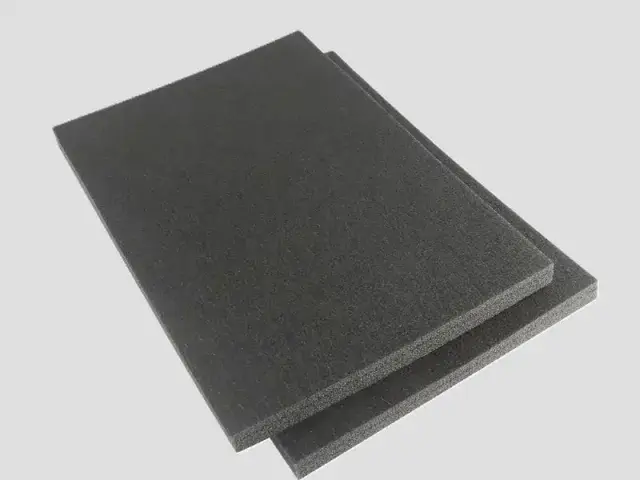
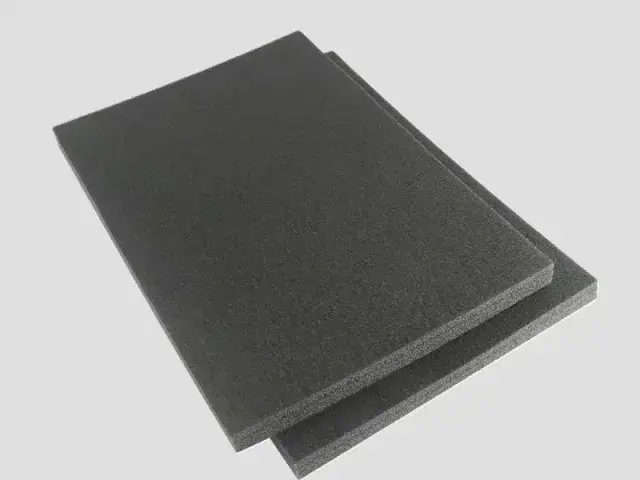
- Material: XPE + PVC artificial leather
- Expansion ratio: 25 times (40 kg/m³), 30 times (33 kg/m³)
- Size: 1 m × 2 m (width can be customized)
- Thickness: 20 mm, 25 mm, 30 mm (thickness can be customized)
- Colour: white (colour can be customized)
- Flame retardant grade: UL94 HF-1, GB8624-B1
Customization
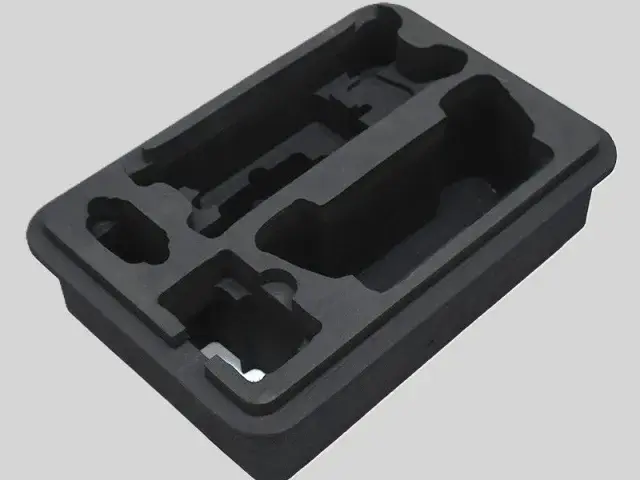
Made to order: density, thickness, colour and shape to your drawing. Die-cutting, CNC routing, lamination to film or fabric, slitting and adhesive coating all run in-house, so the part we quote is a finished part, not just a sheet. How a custom part is cut and routed explains what to send with the drawing.
Regular material: MOQ 1,000 m², lead time 15–20 days from order confirmation. Custom parts are quoted from the drawing. A4 samples are free, shipping included.
Wall impact foam is a cushioned wall covering that absorbs the energy of a body or an object striking the wall. Bofeng Foam produces it as an XPE core laminated to PVC artificial leather, which gives a soft, wipe-clean surface over a resilient foam backing. It is specified wherever walls sit inside the fall zone – kindergartens, gymnasia, care homes and sports halls.
Features
- Impact absorption: the XPE core deforms under load and returns to shape, spreading the force of a collision over a larger area and a longer time, which is what reduces injury.
- PVC artificial leather facing: a tough, wipe-clean surface that resists scuffing and is easy to keep hygienic in schools and care settings.
- Resilience: cross-linked polyethylene recovers its thickness after repeated impact, so the panel does not flatten or lose cushioning with use.
- Simple fixing: supplied with self-adhesive backing for direct application to clean, smooth walls, or fixed mechanically where a stronger hold is needed.
- Made to size: panels are cut to the required height and length so coverage is continuous with the minimum number of joints.
- Flame retardant grades: UL94 HF-1 and GB8624-B1.
Applications
- Kindergarten and primary school corridors, classrooms and play areas
- Gymnasia and sports halls, on walls behind and beside equipment
- Care homes, hospitals and rehabilitation rooms
- Interview and holding rooms in police and justice facilities
- Indoor climbing centres and trampoline parks
- Home playrooms and furniture edges
Specifications for wall impact foam
Wall impact protection is a compromise: soft enough to absorb an impact, firm enough not to be crushed by it.
| Foam | Expansion | Apparent density | Single-layer thickness | Why this grade |
|---|---|---|---|---|
| XPE | 10–20× | 50–100 kg/m³ | 3–15 mm (heat-bonded 15–200 mm) | Tear strength of 2.5–6 kN/m in this band, so the facing resists being pulled apart by a repeated impact. Heat bonding builds the thicker pads. |
| IXPE | 20–30× | 33.3–50 kg/m³ | 0.1–15 mm | A softer facing layer over a firmer backing, which is how the padded wall panels are usually built. |
Base material specifications are on the XPE, IXPE and IXPP material pages; finished products are on the XPE foam and IXPE foam pages. Tell us the load, the space available and the service temperature and we will confirm the grade against your drawing.
Why Choose Bofeng Foam
We foam the XPE core and laminate the PVC artificial leather facing in-house, at 25× (40 kg/m³) or 30× (33 kg/m³) foaming and in thicknesses of 20 mm, 25 mm and 30 mm. Panels are supplied at 1 m × 2 m as standard, with width, thickness and colour made to order, and to UL94 HF-1 and GB8624-B1 flame retardant grades. Where a different surface is needed, the same core can be laminated to other facings, and for police and custody settings the same construction is used for police anti-collision foam.
Which density band holds up under repeated impact, and how to read the compression-set figure, is covered in our high density XPE foam guide.
Wall Impact Pads: Approve the Facing, Core and Retention Together
Map Contact and Exposed Edges
Mark the surfaces needing padding, the expected contact locations and every surrounding hard edge. The core supplies deformable thickness, while the face controls touch and cleaning and the fixing retains the panel. Specify these as a construction. A soft centre sample cannot demonstrate the safety of a corner, seam or exposed fastener.
Inspect the Full Panel
Evaluate a panel with its actual facing and backing. Check local compression, edge integrity, bond and the transitions around sockets or access panels. For a multilayer core, inspect the cut perimeter as well as the centre. Increasing core thickness alone does not prove an impact-protection rating; the whole pad and the support affect the outcome.
Define Cleaning and Service Checks
Use the intended cleaner on a representative face-and-bond sample, then inspect appearance, tack and separation. Identify how damaged covers or loose panels are reported and replaced. Water-absorption data on the core do not demonstrate cleaner resistance or a hygienic finished construction. Agree any applicable public-space or sports requirement separately.
Approve a Replaceable Installation
Keep the layout, retention details, grade, facing and first sample with the acceptance record. Check that access for removal does not leave exposed projections. We can supply foam and converting to the agreed drawing, but material flammability or recovery figures do not approve a complete wall-padding system or establish an injury limit.
For sample identity, dimensions and the acceptance record, use the first-article review checklist with the application-specific checks above.
Use a Full Edge Sample When Comparing Wall Pads
A centre-only swatch can show face texture and approximate feel, but it cannot demonstrate the perimeter, cut-out or fixing. Request a representative sample that includes the proposed edge restraint and the actual support. Mark where contact is expected and which neighbouring hard features remain exposed. If the pad ends at a door, socket or change in wall direction, include that detail in the review rather than treating the main panel as the whole installation.
Record what happens when the face, core or attachment is damaged. A replaceable cover and a permanently bonded face create different maintenance arrangements. Identify who can inspect and replace the component and how the approved retention detail is restored. A replacement should not leave a new exposed fixing or an unsupported edge merely because its core thickness matches the old piece.
Appearance, cleaning and mechanical retention each need a decision. Agree which face marks are cosmetic, which indicate a damaged construction and which require assessment before continued use. Use the intended cleaning product on the complete sample and retain its identity with the result. Low core uptake cannot determine whether a cover, seam or adhesive tolerates that process.
Keep the sample, drawing and evidence requirements together when ordering. Specify any fire requirement for the actual faced construction, not just for an unrelated raw sheet. If an impact or protective classification is required, identify the applicable finished-system test. We do not assign that classification from a hand-squeeze sample, a foam hardness range or a material flame result. The purpose of the sample review is to define a reproducible component and its boundaries before the wall is lined.
Photograph the agreed edge and corner details on the sample installation. This makes later comparisons useful when a reported impact mark occurs beside a fixing or panel transition.
Conclusion & Inquiry
Tell us the wall dimensions, the impact energy you are designing for and the finish you want, and we will confirm the density and thickness. See the XPE foam page for the base material data, or contact us for samples and a quotation.