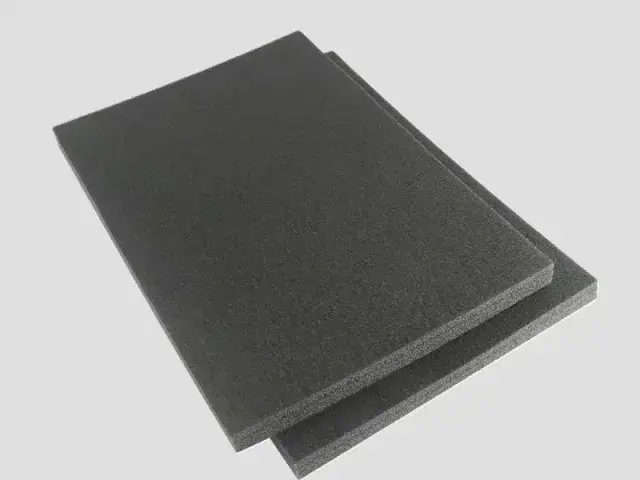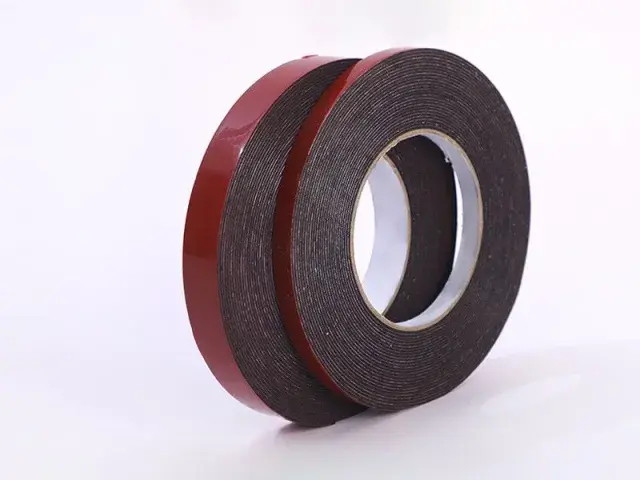

- Material: XPE (polyethylene foam)
- Expansion ratio: 30 times (33 kg/m³)
- Width: 1–1.5 m (width can be customized)
- Thickness: 3 mm, 5 mm, 10 mm (thickness can be customized)
- Colour: black, gray, black-white-black (colour can be customized)
- Flame retardant grade: UL94 HF-1, GB8624-B1
Customization
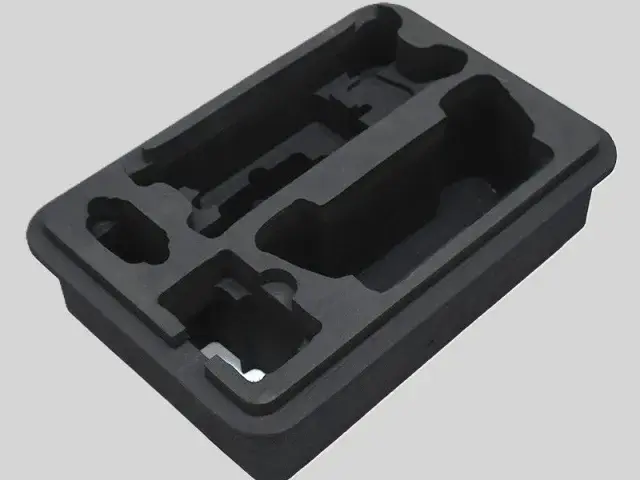
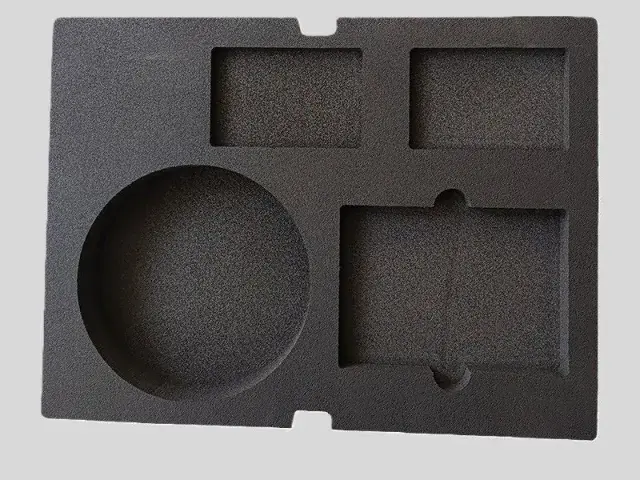
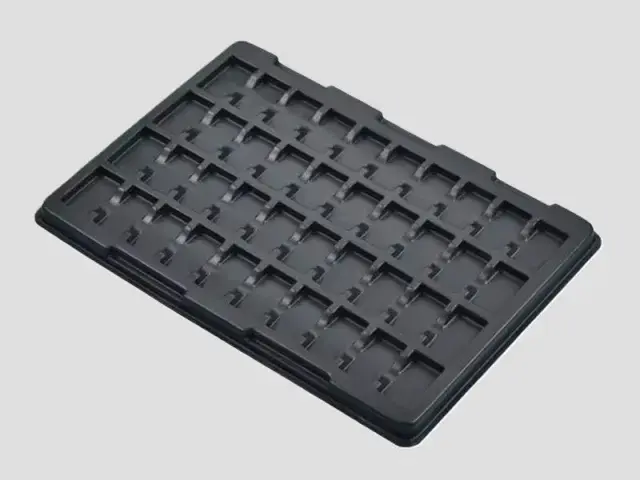
Made to order: density, thickness, colour and shape to your drawing. Die-cutting, CNC routing, lamination to film or fabric, slitting and adhesive coating all run in-house, so the part we quote is a finished part, not just a sheet. How a custom part is cut and routed explains what to send with the drawing.
Regular material: MOQ 1,000 m², lead time 15–20 days from order confirmation. Custom parts are quoted from the drawing. A4 samples are free, shipping included.
Wall acoustic foam here means an XPE component proposed for a defined wall interface or construction. Identify whether the requirement is sealing, contact isolation or an acoustic function supported by testing. Closed-cell PE is not automatically a porous sound absorber or proof of a wall sound rating.
Features
- Acoustic performance must be demonstrated for the actual material and wall construction; no absorption rating is declared from cell structure alone.
- Light and flexible: at 33 kg/m³ the sheet is easy to cut to size on site and to fix with adhesive, so it can be worked around sockets, pipework and irregular wall geometry.
- Thermal conductivity is a separate material property and does not establish acoustic performance.
- Flame retardant grades: supplied to UL94 HF-1 and GB8624-B1.
- Dimensions and deformation must be checked under the specified grade, temperature and loading conditions; no indefinite stability is implied.
- No fibre release: unlike mineral wool, XPE does not shed fibres, which matters in occupied buildings and clean environments.
Applications
- Party walls and stud partitions in apartments and houses, where privacy matters
- Hotel guest rooms, corridors and lift lobbies
- Offices, meeting rooms and open-plan partitions
- Classrooms, libraries and study rooms
- Hospital wards and clinics
- Plant rooms and factory floors with continuous machinery noise
Specifications for wall acoustic foam
Acoustic wall foam is chosen for how it behaves against sound and how it looks, so cell structure and surface finish both matter.
| Foam | Expansion | Apparent density | Single-layer thickness | Why this grade |
|---|---|---|---|---|
| XPE | 20–30× | 33.3–50 kg/m³ | 3–15 mm | The general-purpose acoustic grade: closed-cell, dimensionally stable and easy to cut into panels, with a thermal conductivity of 0.055 W/m·K in this band. |
| IXPE | 30–40× | 26.8–33.3 kg/m³ | 0.1–15 mm | The lowest-density sheet in the range, so it takes up little weight on a feature wall while keeping a uniform surface. |
Base material specifications are on the XPE, IXPE and IXPP material pages; finished products are on the XPE foam and IXPE foam pages. Tell us the load, the space available and the service temperature and we will confirm the grade against your drawing.
Why Choose Bofeng Foam
We produce the XPE sheet ourselves in 3 mm, 5 mm and 10 mm at 30× foaming (33 kg/m³), in widths from 1 m to 1.5 m and in black or gray, with width, thickness and colour made to order. Sheets are supplied to UL94 HF-1 and GB8624-B1 flame retardant grades. Because we laminate and convert in-house, acoustic wall foam can be supplied plain, or combined with an aluminium foil or non-woven facing where additional thermal or decorative performance is wanted.
What thickness does and does not buy in a sound-critical layer is discussed in our underlayment guide.
Wall Acoustics: Identify the Sound Path Before Specifying Foam
Distinguish the Acoustic Objective
State whether the complaint concerns room reverberation, sound passing between rooms or vibration at an interface. These objectives require different evidence. A decorative foam facing is not automatically a tested absorber, and closed-cell PE should not be substituted for a specified porous absorber solely because both are called acoustic foam. Request the required assembly or absorption data before making that substitution.
Draw the Whole Wall
Include board layers, framing, cavities, doors, glazing, sockets and service penetrations. A small leakage path or a rigid structural connection may bypass the material. The wall designer should detail sealing and isolation; there is no universal cavity-fill proportion established by our foam specification. Do not infer a room or partition rating from the density of the infill.
Define the Interface Part
Foam may be proposed as a strip, pad or separation layer at a defined contact. Specify its installed compression, retained dimensions and fixing arrangement. Too much local compression or an unplanned fastener can change the intended interface. Check compatibility with adjacent sealants and finishes on the actual construction rather than relying on a generic material name.
Approve Evidence for the Installed Build
Keep the construction, material and test method with the result. A change in boards, fixings, cavities or junctions requires review of whether the evidence still applies. Send the wall section, room use, sound problem and target requirement with the enquiry. We quote the foam component; an acoustic rating needs evidence for the relevant tested system.
For sample identity, dimensions and the acceptance record, use the first-article review checklist with the application-specific checks above.
A Wall Acoustic Enquiry Needs the Leak and Flanking Detail
Start with a wall section and identify what is being heard and where. A proposed foam strip at the perimeter, a material inside a cavity and a decorative face are different requests. Mark doors, glazing, sockets, cable entries and connections to the floor and ceiling. Without those details, a discussion of a thicker sheet may leave the dominant transmission path unchanged.
Ask whether the proposal changes a tested construction or introduces a new one. Keep the original material, position and fixing in the comparison. If a specified porous absorber is to be replaced by closed-cell PE, request the required system review instead of treating both products as interchangeable because their labels include acoustic. The component supplier should identify what it can actually document, while the responsible wall designer decides what evidence the proposed substitution needs.
For an interface strip, define its contact width, installed compression, continuity and fixing. Check corners and penetrations on a representative detail. If a fastener crosses the separation or a gap remains beside the strip, record that condition rather than attributing the whole result to the foam grade. Retain photographs before the wall is closed.
An acoustic report should stay associated with its test method, construction and conditions. A material quotation is not a room rating, and a subjective impression in one space is not a transferable result for another partition. Keep any unverified target explicitly open until the relevant assembly evidence is available.
Conclusion & Inquiry
Tell us the wall area, the substrate and the noise problem you are solving, and we will recommend a thickness and density. See the acoustic foam range for the wider product family, or the XPE foam page for the base material specification. Contact us for samples or a quotation.