
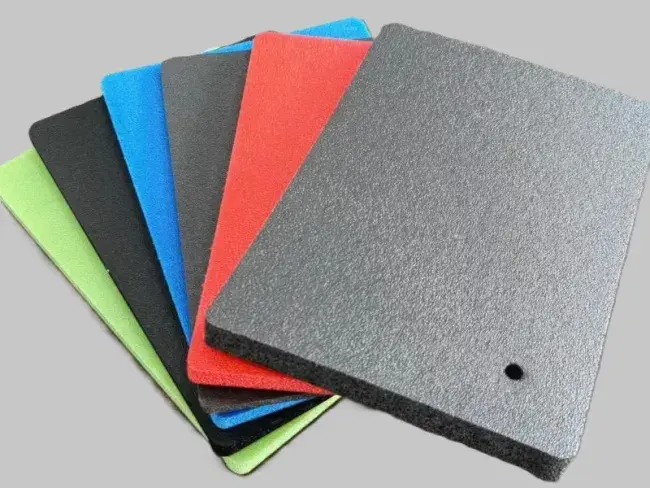
- Cross-linking: chemical (peroxide) cross-linking
- Expansion ratio: 3–40 times
- Density: 26.8–300 kg/m³ (see table below)
- Width: 500–2000 mm
- Thickness: single layer 3–15 mm; heat-bonded multi-layer 15–200 mm
- Surface treatment: calendaring or corona treatment available
- Colour: black, white, grey, custom colours
Physical properties by expansion ratio
Ratio | Density (kg/m³) | Shore hardness (C) | Tearing strength (kN/m) | Water absorption (%) | Thermal conductivity (W/m·K) |
|---|---|---|---|---|---|
3x | 300±40 | 65–75 | ≥12 | ≤0.2 | 0.095 |
5x | 200±30 | 60–70 | ≥12 | ≤0.2 | ≤0.095 |
8x | 125±15 | 50–60 | ≥9 | ≤0.2 | ≤0.084 |
10x | 100±10 | 45–50 | ≥6 | ≤0.2 | ≤0.073 |
15x | 66.7±8 | 35–45 | ≥4.5 | ≤0.3 | ≤0.065 |
20x | 50±6 | 30–35 | ≥2.5 | ≤0.3 | 0.055 |
25x | 40±4 | 25–30 | ≥2 | ≤0.4 | ≤0.049 |
30x | 33.3±3 | 18–25 | ≥1.2 | ≤0.4 | ≤0.045 |
35x | 28.6±2 | 13–18 | ≥1.2 | ≤0.4 | 0.040 |
40x | 26.8±3 | 13–18 | ≥1.1 | ≤0.4 | ≤0.040 |
Test standards: density GB/T 6343 · hardness GB/T 2411 · tearing strength GB/T 10808 · water absorption GB/T 1034 (method 4) · thermal conductivity GB/T 10297 · tensile strength and elongation GB/T 6344 (values on the grade data sheet) · compression set GB/T 6669 · dimensional change GB/T 8811. Compression set at 23±2 °C for 22 hours is ≤10%; dimensional change at 70±2 °C for 22 hours is about 2% or less for most grades.
Optional functional grades
The standard grades above can be supplied in functional versions for applications that need fire, heat or static control:
- Fire retardant: oxygen index 27, meeting GB 8410 A0 and UL94 V2
- Heat resistant: withstands a 110 °C service environment with shrinkage of 8% or less
- Conductive / anti-static: permanent conductivity in the range 10³–10⁹ Ω
Conversion available on these grades: heat lamination of multiple layers up to 100 mm thick, adhesive coating with a solvent adhesive and release liner, die cutting and embossing.
XPE foam, known as Cross-Linked Polyethylene Foam, is a high performance closed cell foam. It is made by chemical cross-linking or radiation cross-linking and has excellent physical and chemical properties.
Features
- Light weight and high strength
- XPE foam is low density and lightweight, but has high compressive and tear strength.
- Suitable for applications that require weight reduction but still need to maintain a certain level of strength.
- Excellent thermal and acoustic insulation.
- Due to its closed cell structure, XPE foam has excellent thermal and acoustic insulation.
- It is widely used in building thermal insulation, automobile sound insulation and other fields.
- Water and chemical resistance
- XPE foam is not easy to absorb water, even if it is soaked in water for a long time, it can maintain its original physical properties.
- It has good resistance to most chemicals and is suitable for packaging and protection in chemical environments.
- Environmentally friendly and non-toxic
- No harmful substances are used in the production process, and the finished product does not contain any toxic ingredients.
- It is recyclable and meets modern environmental requirements.
- Easy to process
- XPE foam can be processed by thermoforming, cutting and other methods, which makes it easy to be customised into different shapes.
- The surface is smooth and even, easy to adhesive, printing and other secondary processing.
Application
- Packaging industry
- As a cushioning material to protect fragile items from damage during transport.
- Used for lining packaging of high-end goods such as electronic products and glass products.
- Construction industry
- Used as thermal insulation for walls and roofs to improve the energy efficiency of buildings.
- Used as an underfloor matting layer to provide comfortable footing and reduce noise transmission.
- Automotive industry
- Used as acoustic insulation in automotive interiors to reduce interior noise levels.
- Used in seat padding to increase ride comfort.
- Sports & Leisure
- To make yoga mats, fitness mats and other sporting goods, providing good support and non-slip properties.
- Used as core material for outdoor activities equipment such as water flotation boards and life jackets.
- Healthcare
- Used to make wheelchair cushions, mattresses and other medical equipment, providing a soft and supportive surface.
- Used as a base material for medical supplies such as disposable surgical sheets and dressing backings.
Why Choose Bofeng Foam as Your XPE Foam Manufacturer?
Bofeng Foam is a direct factory manufacturer of XPE foam in Zhuhai, China, with more than 10 years of foam-industry experience. Buying directly from the factory means strict quality control, custom sizes and competitive pricing without a trading middleman.
- In-house R&D of flame-retardant, high-temperature, permanent anti-static, conductive and open-cell foam series.
- Custom thickness, density, width and colour to your specification.
- OEM / ODM service, including die-cutting, lamination and printing.
XPE Foam FAQ
Is XPE foam waterproof?
Yes. XPE foam has a closed-cell structure, so every air pocket is sealed and the sheet does not absorb water. It keeps its physical properties even after long exposure to moisture, which is why it is used in flotation equipment, humid environments and outdoor applications.
What thickness, density and width can you produce?
Single-layer XPE foam from 3 mm to 15 mm, and heat-bonded multi-layer sheets up to 200 mm. Foaming times range from 3 to 40 times — the higher the foaming ratio, the lower the density. Widths up to 2000 mm. All values can be customized.
Can XPE foam be cut, laminated or printed?
Yes. XPE foam can be die-cut, thermoformed, laminated with aluminium foil or non-woven fabric, and printed. The surface can be corona-treated to improve adhesion.
What is the difference between XPE and IXPE foam?
Both are cross-linked polyethylene foam. XPE is chemically cross-linked, while IXPE is irradiation (electron-beam) cross-linked. IXPE can be produced much thinner (from 0.1 mm) and has a smoother, more uniform surface, which is why it is preferred for automotive interiors and baby products.
What is your MOQ?
For standard sheets the MOQ is flexible. Custom sizes and colours can be discussed with our engineers — contact us with your specification.