
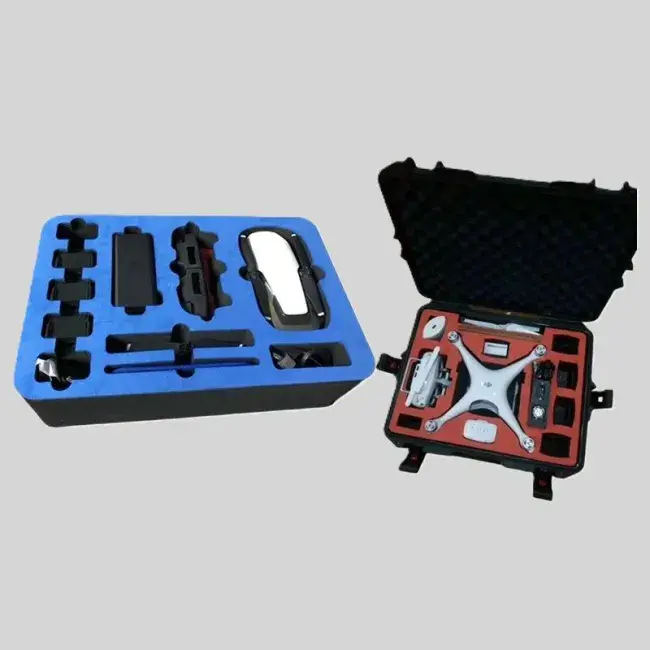
Protective packaging starts from the product, container and handling route. Compare foam inserts, dividers and laminated liners against contact loads, removal access and the required package tests.
Map the product contact and clearance
Send product dimensions, mass, fragile or cosmetic surfaces, protrusions and permitted contact areas. Include the actual case or carton and all accessories. Decide how the product is inserted, retained and removed; a close-fitting pocket alone does not establish cushioning performance.
Choose density with a package test
Density and expansion ratio are inputs, not a selection rule based only on product weight. Required thickness and contact area depend on load, drop or vibration conditions and allowable product response. We do not prescribe a universal half-thickness deflection or promise repeated-impact life without evidence. Validate the complete package against the agreed handling test.
Choose the conversion route from geometry
Die-cut inserts, CNC-routed pockets, layered constructions and dividers address different geometries. Review pocket depth, corner shape, critical fits, quantity and tooling together. A facing can change friction, abrasion and edge behaviour; approve it using the actual product finish rather than assume it cannot scratch.
Separate ESD and cold-chain requirements
For electronics, specify the required ESD properties and complete packaging system; colour alone does not identify a conductive grade. For temperature-controlled shipping, specify the payload, refrigerant, route and exposure profile. Thermal hold time requires validation of the loaded shipper. These foams are not supplied for direct food contact.
Approve and retain a packing standard
Agree the drawing revision, material grade, layer order, critical dimensions and representative loaded sample. Record accessory positions, closures, inspection points and the trigger for replacement or revalidation. Repeat orders should reference that approval record; a first sample does not guarantee unchanged performance after every future change.
Project FAQ
Can product weight alone determine foam density?
No. Include contact area, available cushion thickness, fragile features and the handling test. Approve the loaded package rather than a density number alone.
Is a free material sample the same as a prototype insert?
No. The free A4 sample is for material review. Converted prototypes, tooling and fixtures require a separate quotation and a defined drawing.
Ordering and approval
Standard rolls and sheets: MOQ 1,000 m². Custom parts: minimum quantity and route confirmed from the drawing. Standard lead time is 15–20 days from order confirmation; confirm the schedule for the selected construction. A4 material samples are free with shipping included; converted samples, dies and fixtures are quoted separately.
Agree material grade, drawing revision, critical dimensions, measurement conditions and required tests before production. Bofeng Foam manufactures XPE, IXPE and IXPP in Zhuhai; available grade specifications and reports can be requested. ISO 9001 and ISO 14001 are management-system certifications, not product approvals.
Application routes and further reading
Applications and converted parts
- Tea packaging foam inserts
- Drone packaging foam inserts
- Tool box foam inserts
- Wine packaging foam
- Cosmetic packaging foam
- Electronic product packaging foam
- Hardware packaging foam
- Glass packaging foam
- Ceramic packaging foam
- Gift box packaging foam
- Shadow foam (tool drawer liners)
- Fruit & food foam trays
- see ESD foam
- Cold-chain packaging foam
- Custom foam inserts service