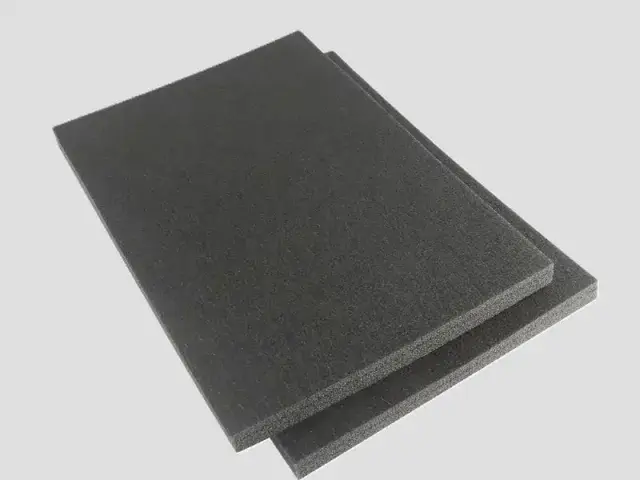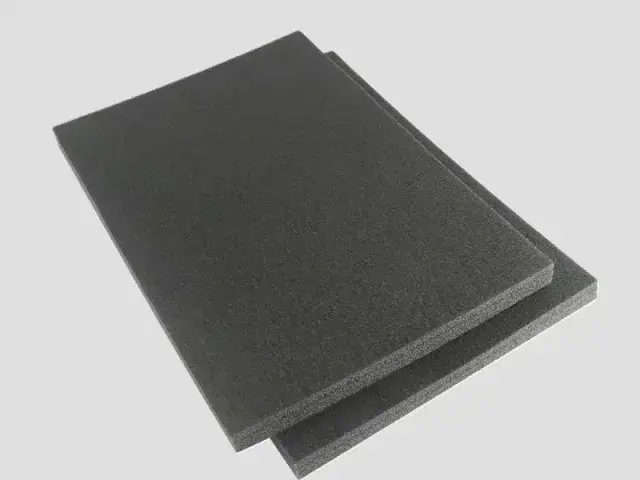
- Material: XPE foam / IXPE foam
- Expansion ratio: 25 times (40±4 kg/m³), 30 times (33.3±3 kg/m³)
- Thickness: XPE single layers 3–15 mm; IXPE single layers 0.1–15 mm; thermally laminated multilayers 15–200 mm. Confirm the finished construction.
- Colour: black, gray (customizable)
- Flame retardant: UL94 HF-1
Customization
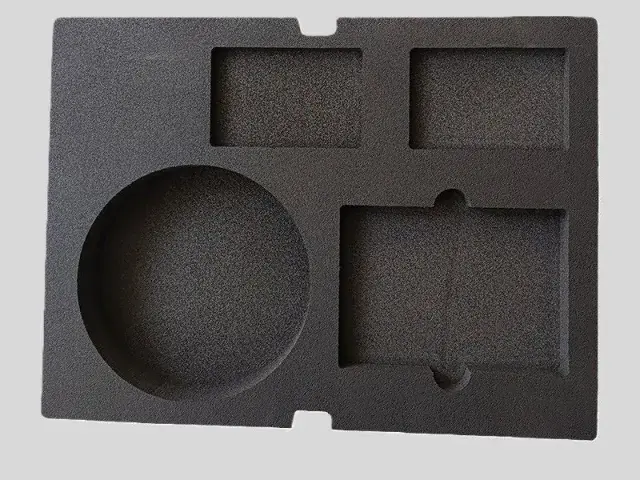
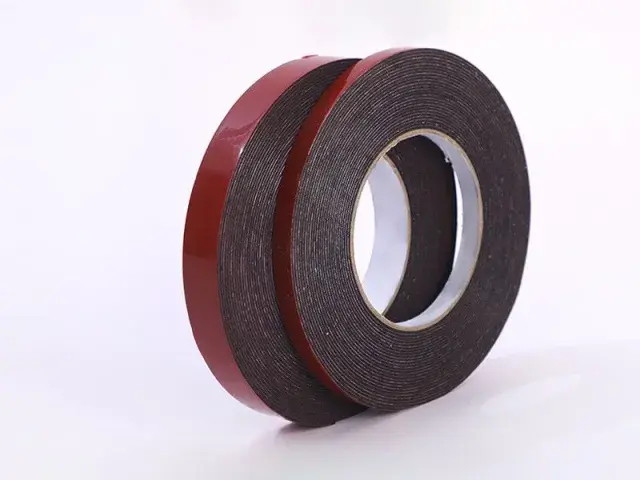
Made to order: density, thickness, colour and shape to your drawing. Die-cutting, CNC routing, lamination to film or fabric, slitting and adhesive coating all run in-house, so the part we quote is a finished part, not just a sheet. How a custom part is cut and routed explains what to send with the drawing.
Regular material: MOQ 1,000 m², lead time 15–20 days from order confirmation. Custom parts are quoted from the drawing. A4 samples are free, shipping included.
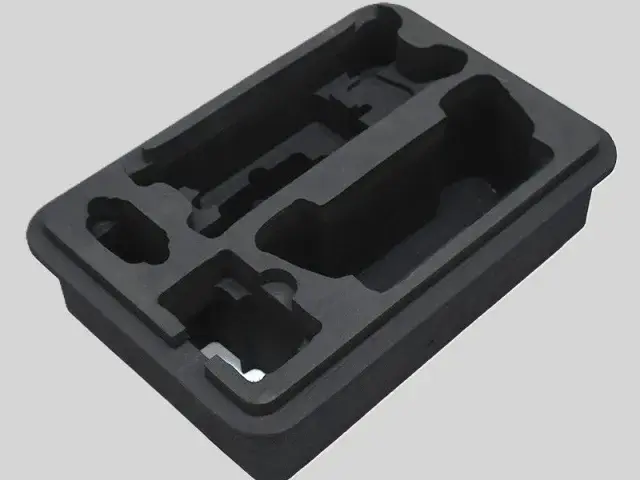
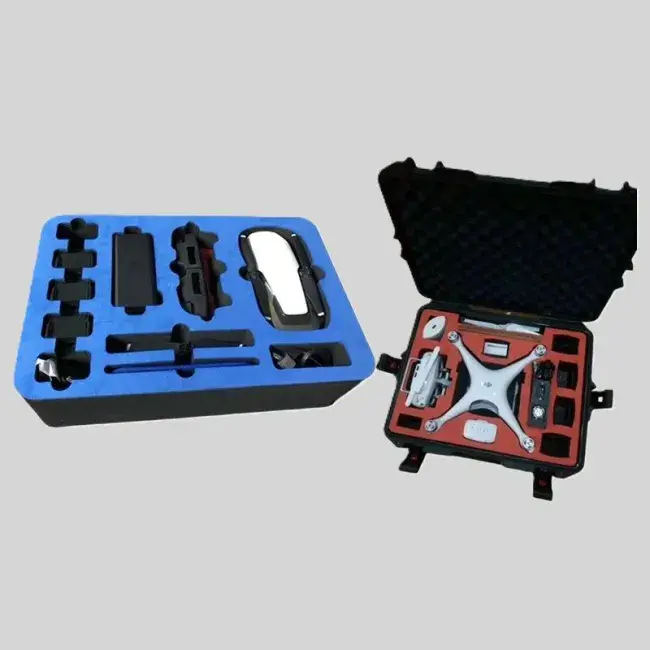
A drone is only as safe as its packaging. A drone packaging foam insert cradles the aircraft and its accessories inside the case, absorbing vibration and impacts during shipping and handling so the drone arrives ready to fly. Custom-cut from XPE or IXPE foam, each insert is matched to the exact model and internal layout of the drone.
Features
- Excellent cushioning – absorbs and disperses impact energy around the airframe, gimbal and accessories.
- Lightweight – adds little weight to the package, keeping shipping costs down.
- Custom fit – precision die-cut to match specific drone models and component positions.
- Anti-static option – prevents static discharge from damaging sensitive electronics.
- Moisture resistant – holds up well in humid transit and storage conditions.
- End-of-life claims require a confirmed route for the complete foam, adhesive and facing construction in the destination market.
Applications
Individual users
- Hobbyists protecting expensive equipment during daily handling.
- Travelers keeping their drone safe during trips.
Commercial use
- Professional service providers such as film crews and surveying firms.
- Rental companies moving drones between bookings.
Logistics
- Drone courier services shipping goods safely.
- Warehouse storage that prevents stacking damage.
Education and training
- Schools protecting teaching aids and small drone models.
Military and research
- Military transport requiring high protection standards.
- Research organizations moving test equipment.
Specifications for drone packaging foam
A drone foam insert is a die-cut part, so the sheet has to hold a cavity, keep its thickness and cut cleanly.
| Foam | Expansion | Apparent density | Single-layer thickness | Why this grade |
|---|---|---|---|---|
| XPE | 25–30× | 33.3–40 kg/m³ | 3–15 mm (heat-bonded 15–200 mm) | Use this XPE range as a starting point for airframe supports and accessory pockets. Keep loads away from the gimbal and camera. Check clearance, retention and cavity condition after the intended vibration and handling sequence in the packed case. |
| IXPE | 25–30× | 33.3–40 kg/m³ | 0.1–15 mm | Fine-cell sheet for the lid liner and for thin interleaving between parts, where a firmer sheet would not close. |
| IXPE, conductive grade | 25–30× | 33.3–40 kg/m³ | 0.1–15 mm | A conductive or anti-static grade for the electronics bay of a drone case, with a surface resistance of 10³–10⁶ Ω (conductive) or 10⁶–10⁹ Ω (anti-static). It is the same IXPE base as the grade above with a conductive filler added, so the expansion range is unchanged. |
Base material specifications are on the XPE, IXPE and IXPP material pages; finished products are on the XPE foam and IXPE foam pages. Tell us the load, the space available and the service temperature and we will confirm the grade against your drawing.
Why Choose Bofeng Foam
- UL94 HF-1 flame-retardant grade available.
- XPE single layers: 3–15 mm. IXPE single layers: 0.1–15 mm. Thermally laminated multilayers: 15–200 mm. Confirm the finished thickness and clearances in the case.
- Fast prototyping and volume production for OEM orders.
How an insert is designed around a product's mass and its drop requirement is set out in our custom foam insert design guide.
Drone Case Inserts: Keep the Airframe, Batteries and Accessories Distinct
Map Delicate Features
Provide the actual drone configuration, folded or unfolded arrangement, controller and accessories. Mark arms, propellers, antennas, gimbals and other features that must not carry the packing load. Support the approved structural contact areas instead of merely tracing the outside silhouette. Check the closed case so its lid does not push an accessory onto the airframe.
Design for Repeated Packing
Try insertion and removal with the intended operator sequence. Finger access should not require pulling a fragile part. Check that loose accessories cannot migrate after the case is handled. For a reusable case, agree how pocket deformation, damaged edges or loosened bonds will be assessed after the required handling evaluation.
Keep Electrical and Battery Requirements Separate
Identify any ESD-sensitive contents and the required packaging function, rather than assuming all foam must be conductive. A mechanical insert does not provide battery transport approval, thermal-runaway containment or permission to ship a battery. Battery handling and transport requirements belong to the responsible shipment and product parties.
Retain the Approved Case Configuration
Record the case, payload revision, material, cavity layout, base support and any laminate. Changes to batteries, cameras or accessories can change both mass and contact geometry. Test the complete pack for its intended distribution conditions. Recycled content or local recyclability must be documented separately; neither follows from the appearance of the insert.
For sample identity, dimensions and the acceptance record, use the first-article review checklist with the application-specific checks above.
Defining a drone case from the packed flight kit
List the flight kit before drawing the cavities
Start with a packing list that identifies the aircraft configuration and each accessory that will travel in the case. State whether the arms are folded, whether the propellers remain fitted and whether a gimbal restraint or lens cover is installed. Include the controller, charger, cables, spare propellers and other items actually required for that kit. An attractive layout that omits an accessory can force the operator to place loose parts over a protected surface.
Provide representative parts or dimensional models, then identify any surfaces that must not carry load. Mark the camera, gimbal, antennas and connectors explicitly on the layout review. The cavity should locate the intended structure without using a sensitive projection as a stop. Where the equipment maker specifies a transport configuration, use it as an input to the case design rather than assuming the arrangement shown in a promotional photograph is suitable.
Review removal as well as storage
Show how each part is lifted out of the case. Finger openings, removable layers and access to handles should be reviewed with the actual equipment. A cavity can hold the aircraft securely yet require the user to pull on a delicate arm or camera assembly to remove it. During the sample review, record where the operator grips the part and whether neighbouring accessories obstruct that movement. Keep extraction observations separate from package protection results.
Close the intended case on the complete first article. Check which components contact the lid and whether any lid foam pushes on a control or moves the aircraft from its seated position. Mark the layer order if the insert is built from more than one piece. A drawing of the lower cavity does not describe the closed package, and a change to lid foam can invalidate a previously comfortable fit.
Keep battery transport decisions outside the foam claim
If batteries are included, identify their individual positions and the arrangement proposed by the equipment owner. Foam cushioning does not demonstrate compliance with battery transport rules and must not be presented as fire containment. The shipper remains responsible for the applicable transport requirements and the battery packaging arrangement. Avoid replacing this review with a general statement that a fitted drone case is safe to ship.
Approve the finished case through the distribution evaluation relevant to the intended route. Retain the case model, equipment configuration and insert revision in the record. A different aircraft generation or battery shape is a new configuration even when the overall case size remains unchanged. Reorders should identify the approved kit and drawing so an apparently small accessory change is not overlooked.
For shared fleet cases, identify the equipment version on the case or packing record. A clear configuration reference helps prevent a later aircraft revision being forced into a cavity approved for an earlier model.
Conclusion & Inquiry
A well-designed foam insert turns a fragile drone into a shippable product. For more protection solutions, see packaging foam & custom foam inserts. Contact us to get samples or a custom insert design.