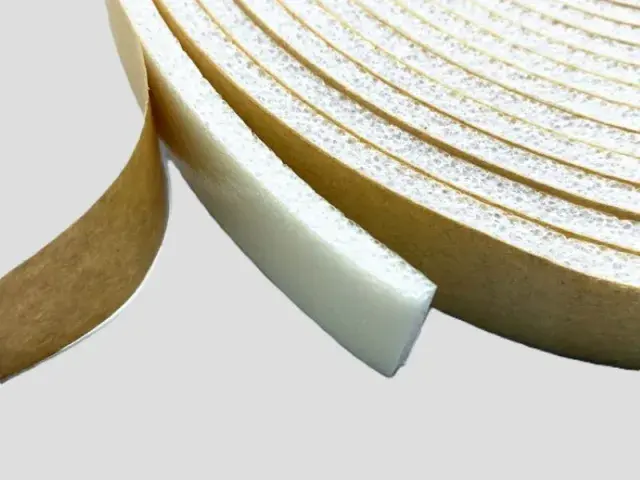
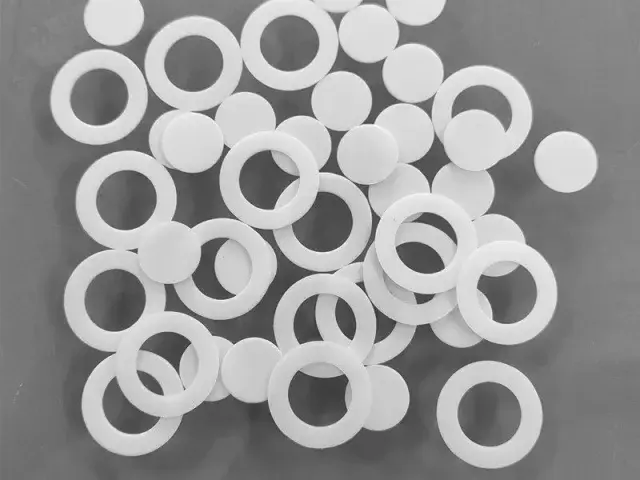
- Material: IXPE foam
- Expansion ratio: 20 times (50±6 kg/m³), 25 times (40±4 kg/m³), 30 times (33.3±3 kg/m³)
- Thickness: 1 mm, 2 mm, 3 mm (thickness can be customized)
- Colour: white, skin tone (colour can be customized)
- Flame retardant grade: UL94 HF-1
Customization
Made to order: density, thickness, colour and shape to your drawing. Die-cutting, CNC routing, lamination to film or fabric, slitting and adhesive coating all run in-house, so the part we quote is a finished part, not just a sheet. How a custom part is cut and routed explains what to send with the drawing.
Regular material: MOQ 1,000 m², lead time 15–20 days from order confirmation. Custom parts are quoted from the drawing. A4 samples are free, shipping included.
Medical tape foam is the foam layer in a medical adhesive product – the backing behind a dressing, a fixation tape or a device attachment pad. It has to do three things at once: stay comfortable against skin for days at a time, come away without leaving fibre debris, and hold its position without the adhesive failing.
Features
- Comfortable in long wear: the foam core is soft and conformable, so the tape does not pull or pinch over a joint or a curved surface.
- Closed-cell, so it does not absorb or wick: the cells are sealed, so liquid cannot enter and the foam does not become a reservoir for contamination.
- Conformable at 1 mm to 3 mm: thin enough to follow a contour, thick enough to cushion and to absorb the movement of the skin underneath.
- Three densities: 20× (50±6 kg/m³), 25× (40±4 kg/m³) and 30× (33.3±3 kg/m³), so firmness and conformability can be balanced for the application.
- Clean converting: the sheet cuts, punches and laminates predictably, which suits automated converting lines.
- Flame retardant grade: UL94 HF-1 available.
Closed-cell XPE and IXPE are not intrinsically breathable. Any ventilation feature and adhesive or textile layer must be specified and evaluated in the finished construction. Material water uptake does not establish antimicrobial action or complete-product moisture management.
Applications
- Wound dressings and fixation tapes
- Catheter and cannula fixation
- Wearable device attachment pads
- Electrode backing and monitoring patches
- Orthopaedic padding and strapping
Specifications for medical tape, where the backing has to be soft against skin and clean at the edges
Tape foam is a backing material: the sheet has to be uniform in thickness, hold an adhesive coat and conform to the surface it is applied to.
| Foam | Expansion | Apparent density | Single-layer thickness | Why this grade |
|---|---|---|---|---|
| IXPE | 20–30× | 33.3–50 kg/m³ | 0.1–15 mm | The usual backing grade, because the fine cell structure gives a uniform thickness across a wide web and single layers down to 0.1 mm. |
| XPE | 20–30× | 33.3–50 kg/m³ | 3–15 mm | Firmer backing where the tape also has to fill a gap or take a compression load. |
Base material specifications are on the XPE, IXPE and IXPP material pages; finished products are on the XPE foam and IXPE foam pages. Tell us the load, the space available and the service temperature and we will confirm the grade against your drawing.
Why Choose Bofeng Foam
We supply the IXPE backing at 20×, 25× or 30× foaming in 1 mm, 2 mm and 3 mm, in white or skin colour, to UL94 HF-1 where required. The foam is supplied as the backing material for a converter to coat; the choice of adhesive and the finished product's regulatory position are set by the converter and the adhesive system, not by the foam alone. We will confirm the foam grade, the gauge tolerance and the batch documentation that accompanies it against the requirement you state. The base material is on the IXPE foam page, and skin-contact considerations are discussed under medical grade foam.
Medical Tape Carriers: Specify the Component Without Device Claims
Identify the Complete Construction
Provide the foam role, thickness, adhesive, facing and finished-product requirements. This is a component supply description, not a cleared-device claim. Material identity alone does not establish suitability for every skin-contact condition. The responsible finished-product party must define intended use and the evidence needed before approving a material.
Describe Ventilation Accurately
Standard XPE and IXPE are closed-cell. An air path needs a specified construction such as deliberate openings, not a claim that plain foam is breathable. Changes to perforations, adhesive or textile need assessment on the full product. Low uptake does not demonstrate antimicrobial or moisture-management performance.
Request Applicable Documentation
Biocompatibility, cleanliness, sterilisation if relevant and regulatory requirements must be defined for the intended finished product. Colour, softness and management-system certification cannot establish them. Match available material documentation to the selected construction rather than seeking a generic medical-grade approval from this page.
Control Converting and Changes
Specify critical dimensions, contact orientation, liner removal and permitted debris. Review the finished sample in the intended assembly process and retain material, adhesive and drawing revisions for repeat orders. This component page offers no treatment advice, device certification, sterile-product claim or patient-suitability conclusion.
For sample identity, dimensions and the acceptance record, use the first-article review checklist with the application-specific checks above.
Preparing a medical tape component enquiry
Define contact and intended use precisely
Identify the device or assembly in which the foam tape will be used and describe what each surface contacts. Distinguish contact with a device housing from contact with skin or another body interface. The word medical in an application name does not establish biocompatibility, a regulatory status or suitability for a particular exposure. The device owner should state the intended use and the evidence required before a material is approved.
Provide the complete proposed construction, including covers, adhesives and liners. If the material is converted into a finished part elsewhere, describe those later steps and identify the organisation responsible for final release. A report for the base foam does not automatically cover the adhesive, colourant or converted assembly. Ask for available documents against a defined construction rather than requesting a generic medical certificate.
Review conversion and handling
Show the part outline, apertures and any features used to position or remove the tape. If the part is handled with gloves or a fixture, include that arrangement in the sample trial. Observe whether liner removal distorts the piece or exposes adhesive before it is ready to be placed. The first article should represent the intended conversion and packaging format, not only a hand cut piece of the same nominal foam.
If the product will undergo cleaning, disinfection or sterilisation, provide the actual process for compatibility assessment by the device owner. Do not assume a material is sterile or suitable for a process merely because it can be used in a medical assembly. Keep process compatibility, contact safety and dimensional fit as separate approval questions. Retain the selected construction and the relevant evidence with the device development record.
State whether any supplied packaging has a defined cleanliness or barrier role and identify who establishes that requirement. Ordinary component packaging should not be described as a sterile barrier without relevant evidence. Keep packaging approval separate from the evaluation of the foam tape's dimensions and bonding performance. Keep contact documentation linked to the confirmed material construction.
Conclusion & Inquiry
Tell us the skin-contact duration, the adhesive system and the converting process, and we will confirm the backing grade and gauge. Contact us for samples.