
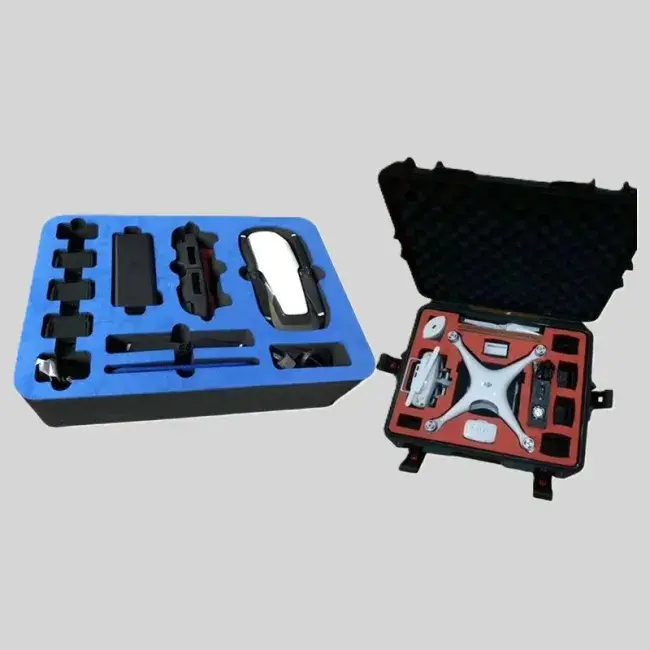
Packaging foam is a family of lightweight closed-cell polyethylene foams used to cushion, protect and present products during storage, transit and unboxing. From custom die-cut foam inserts to laminated presentation boxes, Bofeng Foam supplies XPE, PE and laminated foam packaging that replaces loose-fill and reduces damage rates.
As a direct manufacturer of XPE, IXPE, IXPP and PE foam in Zhuhai, China, Bofeng Foam supplies die-cut, laminated and fabricated foam packaging with short lead times and flexible MOQs.
What is Packaging Foam?
Packaging foam is a closed-cell cross-linked polyethylene (XPE) or polyethylene (PE) sheet that is die-cut, routed or laminated into protective packaging. It absorbs impact, resists moisture, keeps components in place and adds a premium feel to retail unboxing. Typical forms are custom foam inserts, cushioning pads, corner protectors and foam-lined gift or tool boxes.
Foam Materials for Packaging
XPE Foam
Chemically cross-linked polyethylene foam — firm, resilient and easy to die-cut into precise inserts. Ideal for tool box liners, drone cases, electronics packaging and reusable transit containers.
PE Foam
Non-cross-linked polyethylene foam — soft, lightweight and cost-effective for cushioning, dunnage and low-cost protection. Widely used for general cargo and e-commerce packaging.
PE foam is a supporting material in our range — see the materials hub for how it compares.
Laminated Foam
XPE or PE foam laminated with non-woven fabric, flannelette, leather or aluminium foil — used for premium gift packaging, cosmetic inserts, jewellery liners and heat-sealed presentation boxes.
View laminated foam products →
Packaging Foam Products We Make
These application pages cover the specific packaging products Bofeng Foam manufactures every day:
- Tea packaging foam inserts
- Drone packaging foam inserts
- Tool box foam inserts
- Wine packaging foam
- Cosmetic packaging foam
- Electronic product packaging foam
- Hardware packaging foam
- Glass packaging foam
- Ceramic packaging foam
- Gift box packaging foam
- Shadow foam (tool drawer liners)
- Tool foam
- Fruit & food foam trays
Common Packaging Foam Applications
Custom foam inserts are used across consumer electronics, power tools, glassware, ceramics, cosmetics, food, wine and medical devices — anywhere a fragile, valuable or presentation-critical product needs reliable protection. Bofeng Foam also supplies ESD-safe foam packaging for electronics (see ESD foam).
Why Choose Bofeng Foam as Your Packaging Foam Manufacturer?
Bofeng Foam is a direct factory manufacturer of cross-linked polyethylene foam with more than ten years of production experience. We offer in-house die-cutting, CNC routing, lamination and custom insert design, so a single supplier covers your whole foam packaging requirement — from prototype to production runs.
Request a custom foam packaging sample or quote →
Packaging foam FAQ FAQ
What foam is best for protective packaging?
It depends on how much the product weighs and how much space there is around it. Cross-linked PE foam is the usual choice because it is closed-cell, so it does not absorb water in a damp warehouse or a humid container and it does not fatigue the way an open-cell foam does. Within that family the expansion ratio does the work: a high ratio gives a light soft cushion for a light product, and a low ratio gives a firm block for a heavy one.
How do I choose the density for a packaging insert?
Work from the product mass, the drop height it must survive, the contact area available and the number of impacts it has to take. As a starting point the foam should be able to deflect by roughly half its thickness without the product touching the outer wall. Light products normally sit in the 25–40× range, heavier and pointed loads move to 10–20×, and dense load-bearing blocks come from the low end of our 26.8–300 kg/m³ density range.
Can packaging foam be supplied in a specific colour?
Yes. Standard colours are black, white and grey, and custom colours are available across the XPE, IXPE and IXPP range. Where the insert is also the visible presentation surface, a colour matched to the product or the brand is a common request, and it does not change the mechanical grade underneath.
Is foam packaging suitable for food contact?
Production trays and packaging are used for food and produce. Whether a specific grade is suitable depends on the food-contact regime that applies in your market, so tell us the application and we will confirm what we can supply rather than assume it. Our food-grade foam article sets out the general considerations.
Can the insert be designed for us?
Yes. Send the product dimensions, the weight and the container, and we will propose a dunnage or insert design — density, thickness and cut geometry — rather than quote a plain sheet. Because the foam is made and cut in the same factory, the density the design calls for is the density the finished part is produced from.
Related Reading
See also: Custom foam inserts service · All foam materials · Is XPE foam food safe? · How to choose foam density & thickness
New guide: Ultra-thin IXPE foam from 0.1 mm for precision electronics