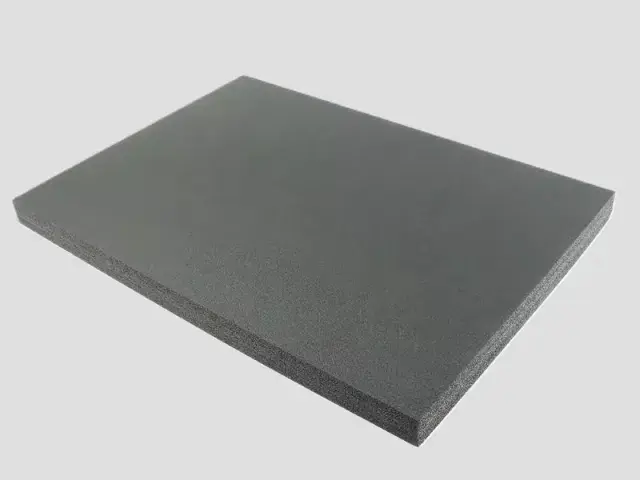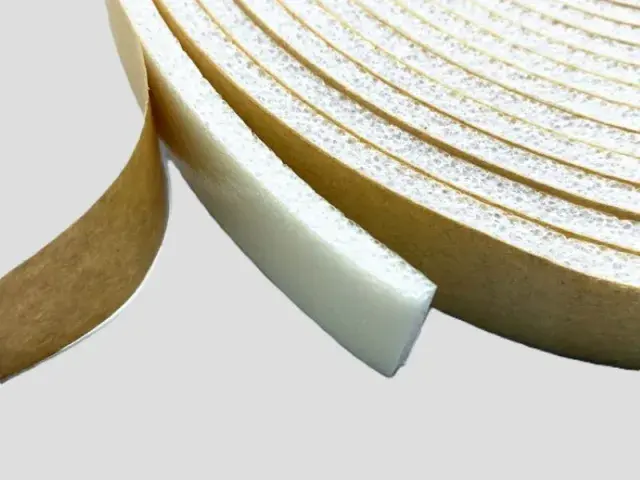

- Material: IXPE foam
- Expansion ratio: 8 times (125±15 kg/m³), 10 times (100±10 kg/m³), 15 times (66.7±8 kg/m³)
- Thickness: 0.5 mm, 1 mm, 2 mm (thickness can be customized)
- Colour: black, white, skin tone (colour can be customized)
- Flame retardant grade: UL94 HF-1
Customization
Made to order: density, thickness, colour and shape to your drawing. Die-cutting, CNC routing, lamination to film or fabric, slitting and adhesive coating all run in-house, so the part we quote is a finished part, not just a sheet. How a custom part is cut and routed explains what to send with the drawing.
Regular material: MOQ 1,000 m², lead time 15–20 days from order confirmation. Custom parts are quoted from the drawing. A4 samples are free, shipping included.
Automotive tape foam is a carrier for a specified joint and adhesive system. Substrate finish, curvature, movement and environmental testing must be identified; the generic foam name does not establish years of bond durability. Bofeng Foam supplies the confirmed IXPE material and converting to the agreed drawing.
Features
- Conformable – takes up the curvature and surface texture of the panel it is applied to.
- Bonds on uneven surfaces – soft enough to reach into a rough or slightly irregular surface.
- Vibration and noise damping – the foam layer isolates the two panels it joins.
- Service temperature matched to the location – IXPE 8×/10×/15× for interior trim at in-cabin temperatures; a heat-resistant IXPE grade (110 °C, shrinkage ≤8%) where the joint runs hotter; and IXPP (up to 140 °C) for under-bonnet and wheel-arch positions. The material is chosen by location, not by making the backing thicker.
- Water and dust resistant – the closed-cell structure does not wick moisture along the joint.
- Flame-retardant option – UL94 HF-1 available where the specification calls for it.
Applications
- Interior trim fixing – door cards, dashboard and console components located and held.
- Exterior trim – badges, mouldings and trim strips.
- NVH damping – wheel-arch and under-bonnet layers that reduce transmitted noise, where IXPP covers the higher temperatures.
- Sealing – window and sunroof gaps, where a compressible foam closes the joint.
- Wire and harness protection – foam layers that keep looms off hard surfaces.
Specifications for automotive tape, where the backing has to conform to a body panel and hold through thermal cycling
Tape foam is a backing material: the sheet has to be uniform in thickness, hold an adhesive coat and conform to the surface it is applied to.
| Foam | Expansion | Apparent density | Single-layer thickness | Why this grade |
|---|---|---|---|---|
| IXPE | 8–15× | 66.7–125 kg/m³ | 0.1–15 mm | The usual backing grade, because the fine cell structure gives a uniform thickness across a wide web and single layers down to 0.1 mm. |
| XPE | 8–15× | 66.7–125 kg/m³ | 3–15 mm | Firmer backing where the tape also has to fill a gap or take a compression load. |
Base material specifications are on the XPE, IXPE and IXPP material pages; finished products are on the XPE foam and IXPE foam pages. Tell us the load, the space available and the service temperature and we will confirm the grade against your drawing.
Why Choose Bofeng Foam
- 0.5 / 1 / 2 mm as standard, other gauges on request.
- Flame-retardant grade available – UL94 HF-1.
- 8× (125±15 kg/m³), 10× (100±10 kg/m³) and 15× (66.7±8 kg/m³) grades.
- Black, white and skin colour as standard, other colours on request.
- Samples and specification sheets available before production.
In-house conversion. The carrier is only half the product; the other half is the adhesive system. We coat solvent adhesive and apply a release liner, slit the foam to the tape width, and laminate a film or fabric facing where the tape needs one. Regular material starts at 1,000 m²; coated and slit rolls are quoted from the construction.
The carrier is the part doing the sealing, and which carrier suits which job is compared in our foam tape guide.
Automotive Tape Foam: Qualify the Painted Surface and Joint Duty
Locate the Joint
Provide the part, surface finish, curvature and joint movement. A painted panel and moulded trim present different bonding surfaces. Identify what actually touches the adhesive, not just the base material below a coating. A tape thickness alone does not describe how the carrier will be used or retained.
Assess Installed Compression
The assembly defines the required gap, force and movement. Include adhesive and facing in the total build. Hardness and compression set do not replace a force-deflection assessment or repeated-movement test. Trial the complete joint and retain its geometry with the result.
Review Environment and Ageing
State material temperature, cleaner exposure and the relevant environmental sequence. A resistant carrier does not establish the same behaviour for the bond. Vehicle-specific ageing, odour, fogging and substance requirements need applicable evidence; they cannot be inferred from the generic foam family.
Retain the Approved Combination
Keep foam, adhesive, substrates, drawing and tests together. Changed paint or release agent can require adhesion review even with unchanged tape. We quote the component and converting without vehicle approval, a service-life promise or an unprovided OEM qualification. Send the actual clause and construction with the enquiry.
For sample identity, dimensions and the acceptance record, use the first-article review checklist with the application-specific checks above.
Linking an automotive tape sample to the vehicle part
Locate the tape on the actual component
Supply the vehicle component drawing and identify the tape path, mating surface and intended function. An anti rattle spacer, a seal and an attachment pad need different criteria. Include the production surface finish and any coating or moulding residue relevant to adhesion. A sample prepared on a clean generic panel does not reproduce every automotive substrate, and a foam family name does not define an approved vehicle component.
Show the compressed or fitted condition where the tape acts as a gap filler. Identify local interruptions, corners and points where the part is located by other hardware. If the design depends on a specific gap, ask the assembly owner to provide its tolerance and acceptance method. This prevents the tape from being selected solely by the appearance of an uncompressed sample.
Reproduce assembly and review changes
Trial the proposed liner removal, positioning and pressure application on representative parts. Record the preparation process and the adhesive construction used. If the tape is installed before storage or another production operation, include that sequence in the review. Evaluate failure locations separately so an adhesive release is not confused with foam damage or a dimensional mismatch.
The vehicle or component owner should define the relevant environmental, emissions, flammability and durability requirements. A result for the foam alone cannot establish approval of the bonded assembly. Retain the part revision, tape construction and assembly method with the qualification evidence. Changes to the coating, cleaner, adhesive or geometry need review even when the tape's colour and nominal thickness remain the same.
Identify the approved sample and component revision on the procurement record so production can distinguish an exact repeat from a proposed substitution.
Conclusion & Inquiry
Automotive foam covers the wider interior, sealing and NVH range, and industrial tape foam applies the same carrier material outside the vehicle. Contact us with your tape specification and we will quote a foam supply.