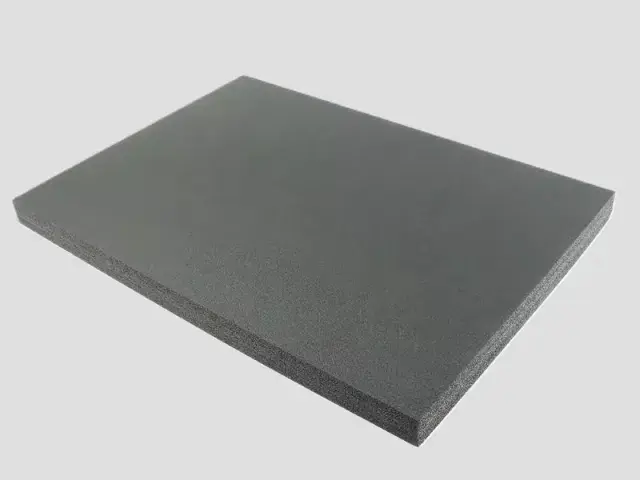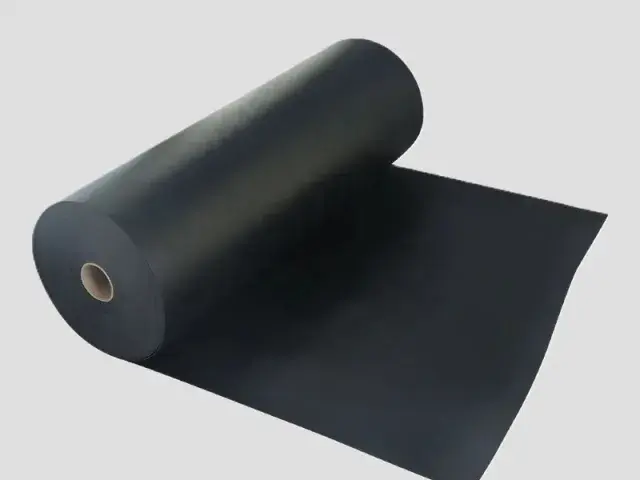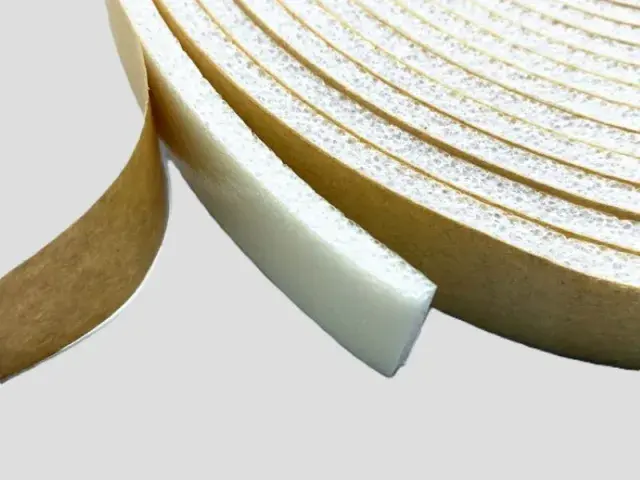
- Materials: IXPE (irradiation cross-linked PE) and IXPP (irradiation cross-linked PP) foam
- IXPE range: 3–40× expansion; 26.8–300 kg/m³; single layer 0.1–15 mm; laminated 15–200 mm
- IXPP range: 5–25× expansion; 40–140 kg/m³; single layer 1–6 mm; laminated 6–100 mm; up to 140 °C service per source data
- Thermal conductivity: IXPE ≤0.040–0.095 W/m·K; IXPP lower than PE foam per source data
- Flame-retardant grade: LOI 27, GB 8410 A0, UL94 V2 (material level)
- High-temperature grade: 110 °C working environment, shrinkage ≤8%
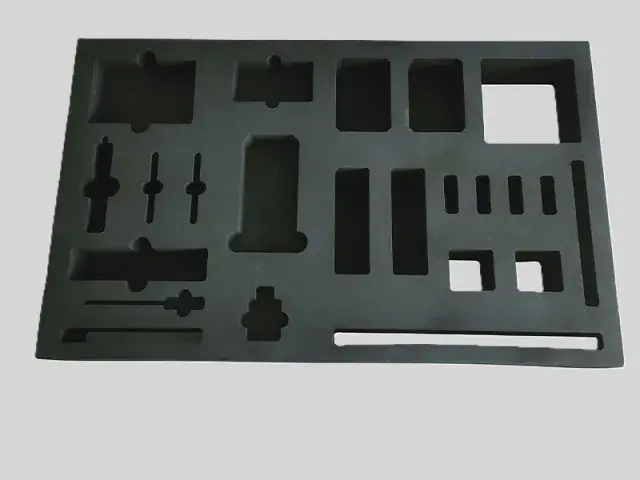
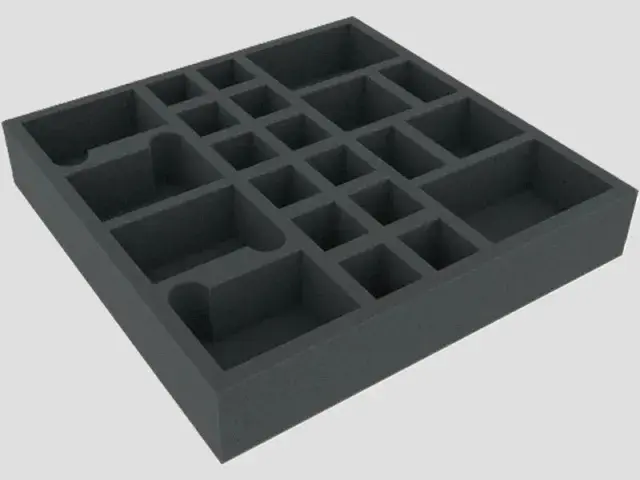
- Forms: cell cushion, module end pad, gap filler, enclosure liner, tray insert, dunnage
- Conversion: die-cutting, CNC routing, lamination, slitting, adhesive backing, embossing
Customization
Made to order: density, thickness, colour and shape to your drawing. Die-cutting, CNC routing, lamination to film or fabric, slitting and adhesive coating all run in-house, so the part we quote is a finished part, not just a sheet. How a custom part is cut and routed explains what to send with the drawing.
Regular material: MOQ 1,000 m², lead time 15–20 days from order confirmation. Custom parts are quoted from the drawing. A4 samples are free, shipping included.
In a battery module or pack, foam usually does three separate jobs, and they are often confused in a specification. It can manage compression between cells or between a module and the enclosure. It can act as a thermal barrier between parts that should not exchange heat freely. And it can be supplied in a flame-retardant grade. What it cannot do is stand in for an electrical insulation rating or for a pack-level safety validation. This page sets out what we publish, and what stays with the pack designer.
Request a quote · Request A4 samples · Ask for selection help
Where the foam sits
- Cell-to-cell and cell-to-module cushions. Pads that take up tolerance and apply a controlled compression, so cells are held without over-constraining them.
- Module end pads and side pads. Foam at the ends or sides of a module that absorbs stack tolerance and shock.
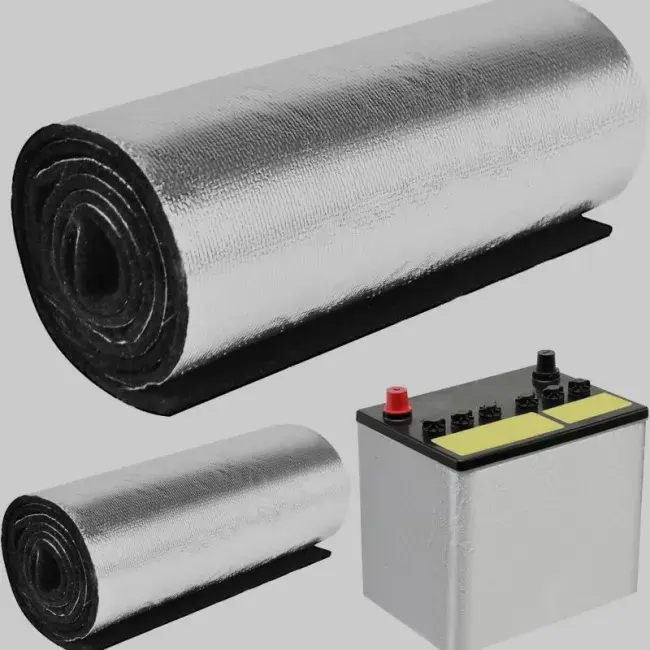
- Thermal barriers. Foam between areas where heat transfer should be limited — for example between a module and a low-temperature compartment, or as part of a multi-layer barrier.
- Enclosure liners and gap fillers. Foam between the module and the pack enclosure, taking up gap and preventing abrasion.
- Transport trays and dunnage. Cell and module handling trays, slot dividers and end cushions for inbound and outbound logistics.
Compression has to be specified, not assumed
A cell cushion is only useful if the compression at assembly is defined. Two properties matter, and they answer different questions:
- Compression set — how much thickness is lost after a defined compression, temperature and time. We publish ≤2% to ≤11% at 23±2 °C over 22 h, depending on the IXPE ratio.
- Compression force at a given deflection — how much load the pad develops at the installed compression. For IXPE we publish compression set but not a full stress–strain curve, so the installed force must be measured on the selected grade and thickness.
State the installed thickness, the free thickness, the compression ratio, the expected temperature and the allowed relaxation over service life. A pad specified only by density leaves the assembly force undefined.
Thermal insulation
Thermal conductivity is a published material property: IXPE ≤0.040–0.095 W/m·K depending on ratio, and IXPP is stated in the source data as lower than PE foam with better insulation. For a barrier, the part thickness, the number of layers and the interfaces matter as much as the material value. A single foam sheet is an insulator, not a certified fire barrier or a thermal-runaway barrier.
Flame-retardant grade
A flame-retardant grade is available with LOI 27, GB 8410 A0 and UL94 V2. These are material-level ratings under the named test methods. They do not certify the finished pad, the module or the pack, and they are not a statement about behaviour in a thermal-runaway event. We do not supply UL94 V0 and will not describe the material as V0.
Temperature
A high-temperature grade is available for a 110 °C working environment with shrinkage ≤8%. For standard grades, confirm the continuous service temperature against the selected grade; the label-grade IXPE sheet states a recommended constant use maximum of 70 °C. IXPP source data gives up to 140 °C. Do not carry one material’s temperature limit onto another.
Choosing between IXPE and IXPP
| Consideration | IXPE | IXPP |
|---|---|---|
| Thin single layer | From 0.1 mm | From 1 mm |
| Compression set | ≤2–11% (ratio-dependent) | Not published for IXPP |
| Stiffness | Softer at the same ratio | Stiffer; compression strength published at 25% deflection (transverse) |
| Temperature | Grade-dependent; high-temp grade 110 °C | Up to 140 °C per source data |
| Thermal conductivity | ≤0.040–0.095 W/m·K | Stated lower than PE foam |
| Typical use | Thin cushions, liners, dividers | Stiffer pads, higher-temperature areas |
The IXPP compression-strength figure is published for the transverse direction only; the longitudinal row is blank in the source table and must not be filled by extrapolation.
What this page does not claim
No dielectric strength or breakdown voltage. We do not publish dielectric strength, breakdown voltage or a comparative tracking index. The foam must not be treated as the insulation between a live conductor and a person or a grounded surface on the strength of this page.
No thermal-runaway propagation claim. We do not claim that a foam barrier prevents or delays propagation between cells. That is a pack-level design and validation question.
No pack-level certification. We do not hold UN38.3, UL 2580, IEC 62619 or equivalent pack certifications, and a material data sheet is not a substitute for them.
No cell-maker approval. Use of a foam in a specific cell or module design requires the cell maker’s and the pack owner’s approval.
No lifetime or humidity-independence promise. Compression, dimensions and thermal behaviour can change with temperature, time and humidity. Define the service conditions and test the installed pad.
Conversion
Cell cushions, end pads and liners are die-cut or CNC-routed to the drawing; adhesive backing, film lamination and multi-layer bonding are available. Where a design needs a formed shape, note that we do not thermoform finished parts. Embossing or printing can identify a part or a batch.
Ordering, MOQ, lead time and samples
Standard material: MOQ 1,000 m². Custom cut parts: minimum quantity confirmed from the drawing. Standard lead time is 15–20 days from order confirmation. A4 material samples are free with freight included; machined samples and tooling are quoted separately.
Send the cell or module drawing, the installed and free thickness, the compression ratio, the expected temperature, the flame-retardant requirement, the quantity per year and the documentation the receiving inspection needs.
FAQ
Can your foam be used as the insulation between a cell and the enclosure?
It can be supplied as a physical separator and a gap filler, but we do not publish a dielectric rating, so it must not be relied on as electrical insulation unless the pack designer validates that use separately.
Is the flame-retardant grade UL94 V0?
No. The available rating is UL94 V2, together with LOI 27 and GB 8410 A0. We do not claim V0.
Do you publish a compression force curve?
For IXPE we publish compression set, not a full stress–strain curve. The installed force must be measured on the selected grade and thickness. IXPP source data gives compression strength at 25% deflection, transverse only.
Which material for a hot area?
IXPP is stated up to 140 °C in the source data, and a high-temperature IXPE grade covers a 110 °C working environment. Confirm the actual temperature profile and the allowed shrinkage before choosing.