
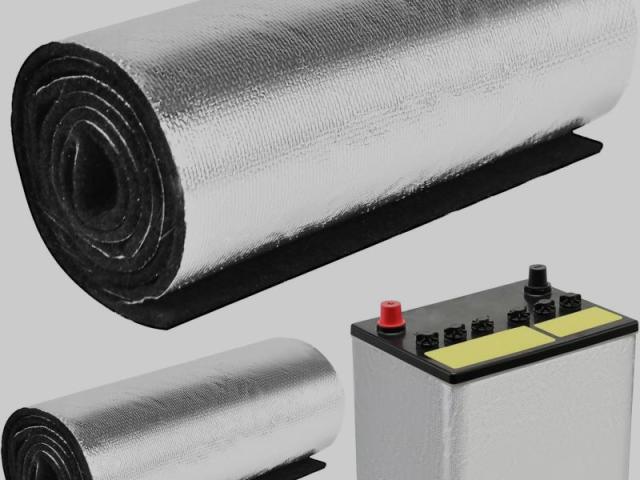
A foam pad inside a battery module is usually asked to do three things at once, and specifications tend to blur them into one line: “flame-retardant IXPE, 10 mm, density 50 kg/m³”. That line says nothing about compression, nothing about the thermal job and nothing about which flame test was run. This article separates the three jobs and shows what each one actually needs.
1. Three jobs, three specifications
- Compression management. The pad takes up stack tolerance and applies a controlled load to the cell or module. The questions are: at what compression, with what force, and how much does it relax over life?
- Thermal insulation. The pad limits heat flow between regions. The questions are: through what thickness, at what temperature, and as part of what multi-layer build?
- Flame retardance. The material is a flame-retardant grade. The question is: which test, at material level, and what does the pack design require beyond it?
One material can serve more than one job, but the three answers come from different data and are checked by different people.
2. Compression: the number that is usually missing
A cell cushion is defined by its installed compression, not by its density. Two quantities matter:
- Compression set — the thickness lost after a defined compression, temperature and time. For IXPE we publish ≤2% to ≤11% at 23±2 °C over 22 h, depending on expansion ratio.
- Compression force at the installed deflection — the load the pad develops. For IXPE we publish compression set but not a full stress–strain curve, so the installed force has to be measured on the selected grade and thickness.
Write the free thickness, the installed thickness, the compression ratio, the expected temperature at the pad, and the relaxation allowed over service life. A pad specified only by density leaves the assembly force undefined — and the assembly force is what the cell actually feels.
3. Thermal insulation: material value plus build
Thermal conductivity is published: IXPE ≤0.040–0.095 W/m·K depending on ratio; IXPP source data states a lower value than PE foam with better insulation. But insulation is a build, not a material. The thickness, the number of layers, the interfaces and the compression all change the result. A single foam sheet is an insulator; it is not a certified fire barrier and not a thermal-runaway barrier.
4. Flame retardance: the test matters
The flame-retardant grade available from Bofeng Foam carries LOI 27, GB 8410 A0 and UL94 V2. Three points follow:
- These are material-level ratings under the named methods. They do not certify the finished pad, the module or the pack.
- UL94 V0 is not offered. Do not write V0 into a specification and assume it will be met.
- A material rating is not a statement about behaviour in a thermal-runaway event. Propagation is a pack-level design and validation question.
If the pack design requires a specific test — a burn-through test, a propagation test, an OEM standard — say so explicitly and plan the validation at pack level. The material sheet will not substitute for it.
5. Temperature: three different numbers
At least three temperature figures circulate in battery foam discussions, and they are not interchangeable:
- The high-temperature grade: 110 °C working environment, shrinkage ≤8%.
- The label-grade IXPE sheet: recommended constant use maximum 70 °C.
- IXPP: up to 140 °C per source data.
Pick the figure that belongs to the material you are actually buying, and check it against the temperature at the pad’s location — not the pack’s rated ambient.
6. Electrical insulation is not the foam’s job
We do not publish dielectric strength or breakdown voltage, and the foam must not be relied on as the insulation between a live conductor and a person or a grounded surface. It can be a physical separator and a gap filler. If the pack design needs an insulation rating, that rating has to come from a part designed and validated for it.
7. IXPE or IXPP
IXPE starts at 0.1 mm single layer and is the usual choice for thin cushions and liners. IXPP starts at 1 mm, is stiffer, publishes compression strength at 25% deflection (transverse only), and covers higher temperatures. The IXPP longitudinal compression-strength row is blank in the source table and must not be filled by extrapolation.
8. Specification checklist
- Function at this location: compression, insulation, flame, or more than one?
- Free and installed thickness; compression ratio; allowed relaxation.
- Compression force — measured, not assumed.
- Temperature at the pad and the temperature figure for the selected grade.
- Flame test required, at which level, by which standard.
- Any pack-level validation the design requires.
- Part form, tolerance and quantity.
- Documentation for receiving inspection.
9. Where to go next
Application page: energy storage battery foam. Materials: IXPE foam, IXPP foam, fire-retardant foam and thermal insulation foam. To discuss a module drawing, use the selection request.