
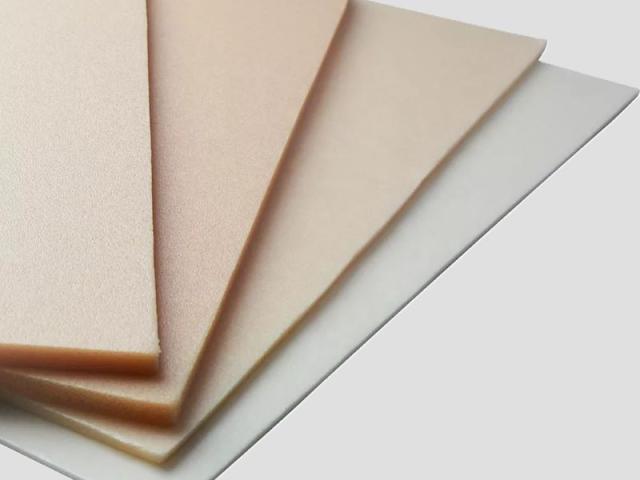
“PP foam” is not a product. It is a family name, and a supplier quoting it may mean a bead-moulded EPP part, an extruded uncross-linked PP sheet, or an irradiation cross-linked IXPP sheet. The structure, working temperature, processing route and price of those three are not on the same scale. Bofeng Foam makes the third.
This page separates the three first, then sets out IXPP’s own limits and how to choose. The item-by-item comparison with IXPE is on the IXPP foam page and is not repeated here.
The three members of the family
EPP: bead foaming, steam-chest moulding
Polypropylene beads are first impregnated with a blowing agent under pressure, then expanded individually with steam and fused together inside a mould. The result is a moulded three-dimensional part, not a sheet. You can see the seams where beads have joined. Density is low, rebound is good and impact absorption is strong, which suits complex energy-absorbing shapes — crash cores behind automotive bumpers, returnable crates, helmet liners.
Its strength is three-dimensional forming; its weakness is the surface. The interfaces between beads are always there, so a smooth finish is not achievable, and printing or laminating onto it is limited.
Uncross-linked PP foamed sheet
Polypropylene resin plus a blowing agent, extruded or moulded into sheet. This is the cheapest of the three: the process is simple and the material can be remelted and pelletised. But there are no chemical bonds between the molecular chains, so dimensional stability under heat is poor. It softens and distorts as temperature rises, which is why it is used for cushioning and filling where temperature is not a requirement.
IXPP: irradiation cross-linked PP foamed sheet
After extrusion to sheet and before foaming, an electron beam ties the polypropylene chains into a three-dimensional network, and the sheet is then heated and expanded. The network does the same job as the one inside XPE — it lets the material hold itself together while foaming at temperature, and keeps it from collapsing afterwards.
So IXPP is the only one of the three that combines sheet form, dimensional stability at high temperature, and a smooth surface that can be laminated. That is the material we make, and every figure on the rest of this page is IXPP.
How to tell them apart quickly
- Look at the form. Sheet, or a three-dimensional moulded part? A moulded part is almost always EPP.
- Look at the surface. Visible bead seams means EPP; fine, even cells and a smooth face means a sheet material, either IXPP or uncross-linked PP.
- Ask about temperature. Can it be thermoformed, pass a high-temperature process, survive boiling water? Then it is IXPP. Softens as soon as it is warmed? Uncross-linked PP.
- Ask about cross-linking. This one question separates the three: neither EPP nor uncross-linked PP has a cross-linked network.
IXPP’s limits
IXPP’s heat resistance comes from the base polymer. Polypropylene melts higher than polyethylene, so the maximum service temperature reaches 140 °C and it resists boiling water. By comparison, the heat-resistant grades in the polyethylene system reach 110 °C. That single difference decides where IXPP sits: parts that are near a heat source and still need the lightness and give of foam.
Supply range and grades
Measured values from our technical data, in five grades. Read the warnings below the table before using it.
| Item | 7× | 10× | 15× | 20× | 25× |
|---|---|---|---|---|---|
| Apparent density (kg/m³) | 140±20 | 100±15 | 66±7 | 50±5 | 40±5 |
| Tensile strength, cross (MPa) | >1.9 | >1.4 | >0.9 | >0.6 | >0.5 |
| Tensile strength, machine (MPa) | >2.4 | >2.0 | >1.5 | >1.0 | >0.6 |
| Elongation at break, cross (%) | >250 | >250 | >250 | >250 | >200 |
| Compression strength, cross, 25% (kPa) | >270 | >200 | >100 | >60 | >50 |
Warning one: only these five grades have measured data. The expansion range is written as 5× to 25×, but there are no measured values for the 5× grade. We do not fill the column in and we do not extrapolate to it. If a project needs 5×, it is a separate confirmation.
Warning two: IXPP is tested to JIS-K6767 (1999) while XPE and IXPE follow the GB/T series. Values from the two methods cannot be compared across. To compare across materials, ask the supplier to retest by the same method.
The remaining parameters: single-layer thickness 1–6 mm, heat-laminated multi-layer 6–100 mm, width 500–1500 mm. Colour is natural, black or custom, and the surface can be corona treated or embossed.
Where IXPP is used
- Automotive interiors. Door panel liners, seat padding layers, insulation and damping parts close to the engine bay — heat resistant and light.
- Construction and flooring. Underlayment, wall acoustic layers, roof insulation. Thermal conductivity is lower than polyethylene foam of the same density; that is a directional conclusion, and the figure is given per grade.
- Packaging. Reusable trays and dividers, where the part has to pass a high-temperature process or be washed repeatedly.
- Thermoformed parts. IXPP can be heated and formed into curved liners — a second forming route alongside bead EPP.
How to choose
Two questions are enough.
- A three-dimensional moulded part that absorbs large deformation (bumper energy absorbers, helmet liners) — EPP.
- Sheet, 140 °C resistance, and the ability to laminate or thermoform — IXPP.
- Ordinary cushioning with no temperature requirement — uncross-linked PP sheet is cheaper, and is worth exactly that.
If the comparison is against the polyethylene system (XPE and IXPE) the logic is different: choose IXPP where high temperature and high stiffness are required, IXPE where very thin and soft is required. The item-by-item comparison is on IXPP foam.
Common questions
Is PP foam the same as IXPP?
No. PP foam is the family name and covers EPP, uncross-linked PP foamed sheet and IXPP. IXPP is the irradiation cross-linked member, and the one we supply. Confirm which one a quotation means before comparing prices, or the comparison is meaningless.
EPP or IXPP?
Look at the part. An integrally moulded three-dimensional part with curvature, ribs and large energy absorption needs EPP. Sheet that will be cut, laminated and needs 140 °C needs IXPP. They do not substitute for each other.
How hot can IXPP go?
Maximum service temperature 140 °C, and it resists boiling water; it stays dimensionally stable and smooth at temperature. The reason is that polypropylene melts higher than polyethylene. The heat-resistant grades in the polyethylene system reach 110 °C.
Which densities does IXPP come in?
The grades with measured values are 7, 10, 15, 20 and 25×, corresponding to apparent densities of 140±20, 100±15, 66±7, 50±5 and 40±5 kg/m³. Lower ratios such as 5× fall inside the expansion range but have no measured data and have to be confirmed per project.
Can the compression-strength figures be compared with XPE?
No. IXPP is measured to JIS-K6767 (1999), XPE to the GB/T series. Different polymers and different methods; the numbers are not comparable.
What Bofeng Foam supplies
Bofeng Foam is a manufacturer of cross-linked polyolefin foam, with a 10,000 m² plant, five production lines and 5,000 tonnes of annual capacity in Zhuhai, Guangdong. We supply irradiation cross-linked IXPP sheet: 5× to 25×, width 500–1500 mm, single layer 1–6 mm, multi-layer heat lamination to 100 mm, corona treatable, embossable, laminable.
We do not supply EPP bead-moulded parts. If your part needs three-dimensional moulding, that is not on our product line, and it is better to say so at the start.
See the IXPP specification · Ask about a grade
See also XPE, IXPE and IXPP compared, the types of foam material, how foamed plastic is made, IXPE foam and all foam materials.