
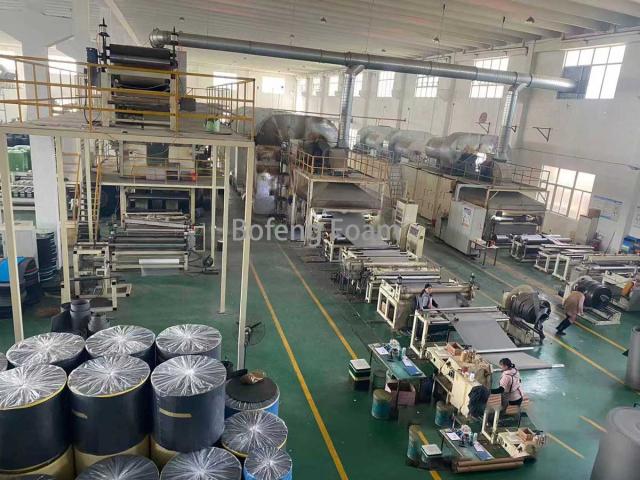
Every foam supplier's website says the same things: years of experience, advanced equipment, strict quality control. None of that separates one supplier from another. What separates them is whether they make the foam themselves or buy it, whether the numbers on their data sheet have a test method behind them, and what happens when a delivery arrives out of tolerance. These nine questions get to those differences quickly — and the answers are things a supplier either has or does not have.
1. Do you foam the material yourselves, or buy blocks and convert them?
This is the question that determines how much of the rest can be trusted. A converter who buys blocks takes the density, the cell structure and the grade from someone else, and can only pass them on. A manufacturer controls the expansion ratio, the cross-linking and the thickness at the point where they are set.
We foam in-house on five production lines, around 5,000 tonnes a year, at a plant established in 2011. That matters to a buyer in a specific way: when a lot comes out at the wrong density, we can find out why and correct it, instead of filing a claim with a block supplier and waiting.
2. What test method is behind each number on the data sheet?
A data sheet that says "compression set 5 %" is not a specification. A specification says compression set ≤5 % measured to GB/T 6669 at 23 ± 2 °C over 22 hours. The method is what makes the number reproducible, and reproducibility is what lets you reject a lot that does not meet it.
Ask for the standard on every mechanical and thermal figure — compression set, water absorption, thermal conductivity, tensile strength. If the supplier cannot name the method, the number came from somewhere other than a test.
3. Is the converting done in the same place?
Foam is rarely sold as a plain sheet. It is cut, routed, laminated, coated with adhesive, or combined with film and fabric. If the foaming and the converting happen in different companies, the specification has two owners and a defect has none: the converter blames the foam, the foam maker blames the cutting.
We do the whole sequence under one roof — foaming, lamination, die-cutting, CNC routing, adhesive coating. When a part is out of tolerance, there is one place to look.
4. What tolerance will be quoted, and where is it written?
Tolerance is the part of a quote that people skip. Ask explicitly: is it on the drawing, on the quotation, or nowhere? A part that is 0.3 mm over thickness is scrap for one assembly and fine for another, and the difference only shows up when someone has to pay for it.
Send the drawing with the critical dimension marked. A supplier who answers "whatever you need" without asking which dimension matters has not understood the part.
5. What is the minimum order, and what is it a minimum of?
"MOQ 1,000 m²" can mean 1,000 m² of one grade, or 1,000 m² across an order made of five grades — which for you may be unworkable. Ask per grade, per thickness and per colour, because those are usually separate minimums in production.
Our standard: 1,000 m² for standard rolls and sheets. Custom sizes, colours and die-cut parts are quoted individually, because the minimum for a custom part depends on the tooling and the material run.
6. What does the lead time include?
15–20 days from order confirmation is a normal production lead time for standard material. The question is what sits on either side of it: is the raw material in stock or does it have to be foamed, and does the figure include converting and packing?
Ask for the lead time in the same units you will be measured on — days from PO to goods leaving the factory — and ask what happens to it when the order is a custom colour.
7. Where does the sample come from?
A sample proves something only if it is cut from production material. A lab-made sample, or one from a different grade, proves that the supplier can make a good piece once.
We send an A4 sheet free of charge, shipping included, cut from the material we would ship. Test it the way your process will use it — compress it, glue it, cut it, put it in the oven — before the order, not after.
8. What is the scope of the quality certificate?
ISO 9001 and ISO 14001 certificates carry a scope statement, and the scope is the part that matters. A certificate covering trading and warehousing is not a certificate covering foaming and converting. Ask for the scope page, not the logo.
We hold ISO 9001 and ISO 14001. Ask us for the current certificates and read the scope line before you read anything else.
9. Who handles the export documents?
If you import, the paperwork is part of the product. Ask who prepares the commercial invoice, packing list and certificate of origin, and what Incoterm the quote is based on. A price without an Incoterm is not comparable to another price.
We export worldwide. State the destination port and the Incoterm you buy on, and the quote will be built on that basis rather than adjusted afterwards.
Red flags worth acting on
- A data sheet with numbers but no test methods.
- "We can make any density you want" — without a grade list and a tolerance.
- A certificate shown as an image, with no scope and no certificate number.
- A quote with no tolerance, no Incoterm and no lead time.
- No clear answer to question 1. This is the one that is never vague by accident.
A sensible first order
Start with an A4 sample and test it against your own process. Then a trial quantity of the actual grade, at the actual thickness, in the actual colour. Then production. The sequence costs a few weeks and removes almost all of the risk that a first order carries — and any supplier who resists step two is telling you something.
FAQ
Should I buy from a manufacturer or a trading company?
A trading company can be efficient for small mixed orders. For a part with a tolerance, a test requirement or a colour match, you need the manufacturer, because those are production decisions rather than commercial ones.
How do I compare two quotes properly?
Put grade, density, thickness, tolerance, quantity, Incoterm and lead time in the same columns for both. A quote that leaves any of those out is not comparable — it is a number.
Do you supply free samples?
Yes — an A4 sheet, free of charge, with shipping included.
Related reading
XPE foam specifications · IXPE foam · IXPE vs PE foam · About Bofeng Foam
Send your drawing, grade and quantity and we will answer all nine questions in writing, with the test methods attached.