
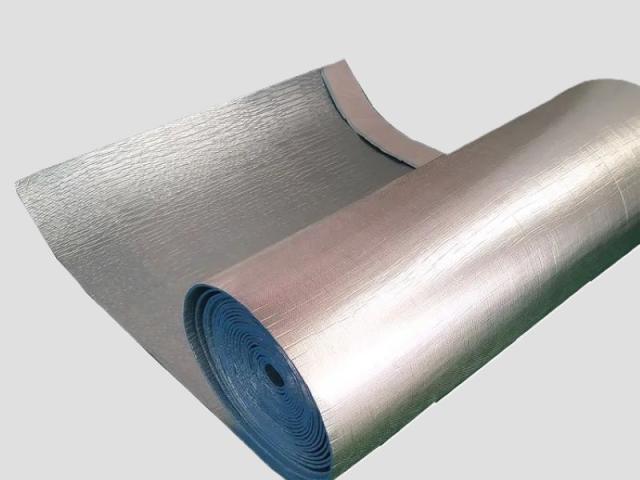
Aluminium foil thermal insulation foam is a laminate: a polyethylene foam core with one or more layers of aluminium foil bonded to one or both faces. The two layers act on different heat paths. The foil surface has low emissivity, so it reflects radiant heat instead of absorbing it; the closed-cell core has low thermal conductivity and stops the air inside it from circulating. Between them they close all three routes — radiation, conduction and convection.
That combination is why one roll does more than insulate. The foil facing is also a continuous vapour barrier, and the foam core adds sound damping and cushioning.
Features of aluminium foil thermal insulation foam
- Reflective facing plus insulating core. The foil turns radiant heat back at the surface, while the foam slows conduction and blocks convection. Because each layer works on a different path, the laminate outperforms either layer on its own at the same thickness.
- Moisture and vapour barrier. Aluminium foil has no pores, so water vapour cannot pass through it. In a roof, wall or duct this keeps the foam dry — and a dry foam insulates better than a wet one, because water conducts heat far more readily than the gas in the cells.
- Light and easy to install. Supplied in rolls, cut with a knife, and formed around curved ducts, tanks and irregular frames without special tooling. The foil facing doubles as the vapour barrier, so no separate membrane is needed and one trade can close the detail instead of two.
- Fire behaviour. The foam core can be specified in flame-retardant functional grades with an oxygen index of 27, meeting GB 8410 A0 and UL94 V2; low-smoke grades are also available. The aluminium facing does not feed a flame.
- Recyclable core. The polyethylene core is a thermoplastic and can be reground and re-used once the foil is separated. The energy case is different and simpler: a thin foam layer does the work of a much thicker solid material, so less material has to be made, shipped and installed.
- More than insulation. The same laminate damps sound, cushions impact, and the core resists water, sea water, oils, greases and dilute acids and alkalis.
Applications of aluminium foil thermal insulation foam
- Buildings
- Roof, wall and ceiling insulation: foil-faced roll under metal roofing, between rafters, or on the warm side of a wall, to block radiant gain in summer and hold heat in winter.
- Underfloor heating: laid beneath the screed as insulation and vapour barrier in one.
- Pipe and duct insulation: wrapped on hot and chilled water pipes and ventilation ducts to cut heat loss and stop condensation forming on the surface.
- Industry
- Process equipment: boilers, reactors and storage tanks are lagged to hold process temperature and to protect staff from hot surfaces.
- HVAC and refrigeration: duct wrap, cold-room panels and refrigerated transport linings keep temperatures stable.
- Pipelines: oil, chemical and power installations wrap lines carrying hot or cold media.
- Transport
- Vehicles: roof, floor and engine-compartment linings cut the heat and noise reaching the cabin.
- Cold chain: linings for refrigerated trucks and containers hold the load temperature.
- Agriculture and outdoor use
- Greenhouses: foil-faced roll reflects radiant heat back into the house overnight.
- Camping and outdoor gear: sleeping mats and tent linings use the same reflective layer.
The core is our own cross-linked polyethylene sheet, so the foil-faced roll can be specified in the same expansion ratios, thicknesses and widths as the unfaced grades. See laminated foam for the other facing and lamination options, or contact us for a quote.