
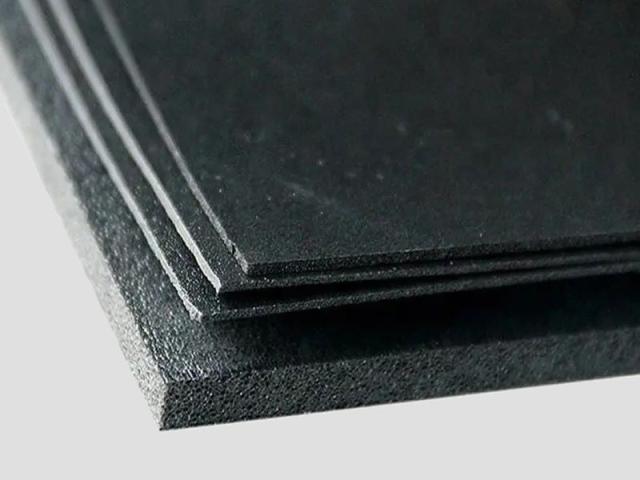
“PE foam” is the general name for expanded polyethylene, and the decision that actually matters is whether it has been cross-linked. Uncross-linked, the chains can still slide past one another, and the material is simply called PE foam. Cross-linked, the chains are tied into a three-dimensional network, and the material becomes XPE (chemical cross-linking) or IXPE (electron-beam cross-linking). Different names, and a difference of an order of magnitude in the thickness and density that can be reached.
How PE foam is made
Low-density polyethylene is melted, a blowing agent is mixed into the melt under pressure, and the pressure is released at the die so the gas expands the polymer into cells. This step changes the form but not how the molecular chains are connected — they can still slide.
Chains that slide mean the cell walls are drawn thinner and thinner during expansion. Once density is pushed far enough the thin walls cannot hold, and cells merge or collapse. So uncross-linked PE foam has coarser cells, thicker walls, and a single layer that cannot be made thin. How thin it can go depends on the capability of the extrusion line, not on a number that can simply be set lower.
What uncross-linked material gives you
Light. Most of the volume is gas, so a part of a given shape is far lighter than solid polyethylene.
Cushioning. The cells deform under load and spread a short impact over a longer distance, which lowers the peak force reaching the packed item.
Water resistance. The closed-cell structure forms no capillary path, so shape and properties hold in damp conditions.
Chemical resistance. At room temperature polyethylene resists most acids and alkalis.
Thermoforming. With the chains untied, the material can be softened again, reshaped, heat welded or laminated.
Remelting. Uncross-linked PE foam can go back into a melt stream; cross-linked material cannot be melted and is recovered by grinding.
PE foam, XPE and IXPE
One material family; the dividing line is whether the chains were tied before expansion.
| PE foam (uncross-linked) | XPE | IXPE | |
|---|---|---|---|
| Cross-linking | None | Chemical, peroxide | Electron beam, no cross-linking agent |
| Cells | Coarser, thicker walls | Fine and uniform | Finest, still uniform at low density |
| Thinnest single layer | Set by the extrusion line | 3 mm | 0.1 mm |
| Expansion we supply | — | 3× to 40× | 3× to 40× |
| Density at 40× | — | 26.8±3 kg/m³ | 26.8±3 kg/m³ |
| Melt recyclable | Yes | No | No |
What cross-linking changes is the limit. The chains are tied into a network before expansion, and the network stops the cell walls thinning as the gas forms. So at the same density a cross-linked grade keeps complete, uniform cells; at the same cell quality it can be pushed to a lower density and a thinner single layer.
Choosing by the part
The criterion is the part, not the material.
- A one-off protective pad. Die-cut, used, discarded, with no tight requirement on dimension or thickness — uncross-linked PE foam is enough, and it can be remelted.
- A 0.5 mm gasket. Uncross-linked material cannot be made at that thickness. Only IXPE, which starts at 0.1 mm, gets there.
- Thickness that must survive repeated point loads. Chains that slide creep, and creep does not hold long-term compression. Holding thickness needs a cross-linked grade.
- A foil facing, or a heat-bonded 200 mm board. Cross-linked grades can be heat bonded into multi-layer board; facings and converting are covered in laminated foam.
- Narrow bridges in a die-cut part. Tear strength at the edge decides it, and the cross-linked grades carry far more per unit width than uncross-linked material.
Common questions
Is PE foam the same material as XPE foam?
Same base, different process. PE foam means expanded polyethylene whose chains are not cross-linked; XPE is the same family cross-linked with a peroxide before expansion. So XPE has finer, more uniform cells and reaches a thinner single layer, at the cost of not being melt-recyclable. IXPE changes the method to electron-beam irradiation, introduces no cross-linking agent, and reaches 0.1 mm.
Can cross-linked PE foam be recycled?
Not by melting. Cross-linking forms a three-dimensional network that does not flow when heated, so it cannot re-enter a melt stream; the industry practice is to grind it into granules for filler or low-grade backfill. Uncross-linked PE foam can be remelted. So “is it recyclable” is a question about the grade, not about the category.
Why can’t uncross-linked foam be made thin?
Because the chains slide, the cell walls are continuously drawn thinner as the material expands, and the thinner the sheet the more readily they rupture. Cross-linking ties the chains first, so the walls stop being drawn indefinitely and a single layer can be pressed to the 0.1 mm order. It is a structural limit, not a question of process quality.
Can both types be foil faced?
Both can, but the thin end is only reachable with a cross-linked grade. A foil facing adds a reflective and vapour-blocking layer, and is common on the thin layers used in underfloor heating, pipe wrap and roofs. Facing and adhesive coating are done in our plant — see laminated foam.
What Bofeng Foam supplies
Bofeng Foam is a manufacturer of cross-linked polyolefin foam, with a 10,000 m² plant, five production lines and 5,000 tonnes of annual capacity in Zhuhai, Guangdong. We work on the cross-linked side of that line: XPE, IXPE and IXPP, expansion 3× to 40× (5× to 25× for IXPP), thinnest single layer IXPE 0.1 mm and XPE 3 mm, width 500–2000 mm, multi-layer heat lamination to 200 mm for XPE and IXPE and 100 mm for IXPP.
See the types of foam material · Ask for samples
See also XPE foam, what XPE foam is, IXPE material, what foam is made of, foamed plastic and all foam materials.