
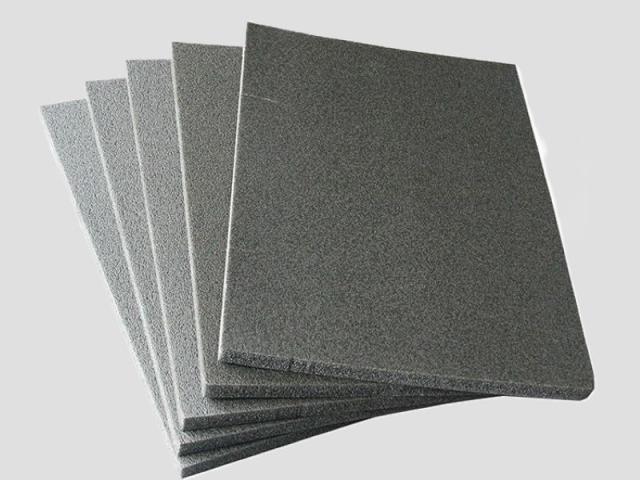
IXPE is irradiation cross-linked polyethylene foam. The sheet is passed under an electron beam; the energy breaks carbon–hydrogen bonds, and the free radicals that result bond neighbouring polymer chains to each other. XPE is chemically cross-linked polyethylene foam. A peroxide is compounded into the polyethylene and decomposes under heat, and the reaction links the chains the same way — but by chemistry rather than by radiation.
Both are closed-cell polyethylene foams, and both are made at expansion ratios from 3× to 40×. Everything that differs between them follows from the cross-linking route.
How the two cross-linking routes differ
- The cross-linking agent. XPE needs a peroxide, mixed into the compound and decomposed at high temperature to start the reaction. IXPE needs no cross-linking agent at all: the electron beam supplies the energy directly. Our IXPE grades are recorded on the data sheet as electron-beam irradiation with no cross-linking agent.
- What stays in the sheet. XPE starts from a compounded peroxide, so the finished sheet carries the residue of that reaction. IXPE starts from polyethylene alone, so there is nothing to leave behind. Where a part will sit against skin, against food, or inside a sensitive electronics assembly, this is usually the deciding argument.
- How evenly the sheet is cross-linked. An electron beam is applied from outside at a set dose, so the cross-linking is even across the width and through the thickness of the sheet. Peroxide cross-linking depends on heat reaching the core of the sheet before the blowing agent decomposes, and that balance gets harder to hold as the sheet gets thicker.
- Minimum thickness. This is the difference that decides most projects. Chemically cross-linked XPE sheet is produced from 3 mm up. Irradiation cross-linked IXPE goes down to 0.1 mm. Where the part is thin — a gasket, a tape, a liner inside a phone — XPE is not available and IXPE is the only route.
- Surface finish. IXPE is produced with a smooth, even skin on both faces, which takes printing, adhesive and lamination directly. XPE has a slightly more open surface, so where a decorative finish is needed it is normally laminated or skived first.
- Cost. XPE runs on conventional foaming lines. IXPE needs an electron accelerator, which raises the equipment investment and the price per kilogram. For a thick, simple part, XPE is the cheaper route; for a thin or tightly toleranced part, IXPE is the only one.
XPE and IXPE compared
| Property | XPE | IXPE |
|---|---|---|
| Cross-linking | Peroxide, heat-activated | Electron beam, no agent |
| Expansion ratio | 3–40× | 3–40× |
| Single-layer thickness | 3–15 mm | 0.1–15 mm |
| Heat-bonded multi-layer | 15–200 mm | 15–200 mm |
| Width | 500–2000 mm | 500–2000 mm |
| Colour | Black, white, grey, custom | Black, white, grey, custom |
| Water absorption | ≤0.2% to ≤0.4% | ≤0.2% to ≤0.4% |
| Thermal conductivity | 0.095 to ≤0.040 W/(m·K) | ≤0.095 to ≤0.040 W/(m·K) |
| Flame-retardant grades | LOI 27, GB 8410 A0, UL94 V2 | LOI 27, GB 8410 A0, UL94 V2 |
Where each one is used
- XPE goes into thick, cost-sensitive, high-volume parts: packaging inserts and corner protectors, wall and underfloor insulation, exercise mats and gym tiles, automotive door and floor padding, and ground cover fabric in horticulture.
- IXPE goes into thin or tightly toleranced parts: automotive interior facings, appliance and electronics cushioning, tape and gasket substrates, medical and hygiene padding, and sports protection and buoyancy products.
Tell us the thickness, expansion ratio and surface finish you need, and we will quote the route that fits.
See XPE foam and IXPE foam for the two material specifications.