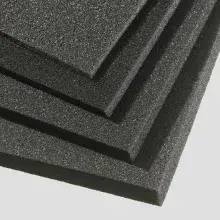
Conductive foam is cross-linked polyethylene foam compounded with carbon so that it conducts, giving static charge a direct path to ground instead of letting it build. Bofeng Foam manufactures conductive foam in Zhuhai, China, with surface resistance specifiable from 10³ to 10⁶ Ω, and converts it into trays, dividers, tote liners and interleaves.
Conductive foam sits on the protective side of the ESD question. Where dissipative foam bleeds charge away slowly enough not to disturb a sensitive device, conductive foam moves charge quickly and is used for the containers, trays and dividers that surround the device rather than touch it directly.
What is conductive foam?
Making a foam conductive means giving the polymer a continuous path for electrons. We do it by compounding conductive carbon into the polyethylene before expansion, so the finished foam conducts through its thickness and across every cut face.
The alternative — coating a finished foam with a conductive layer — is cheaper and is common in the market, but it has two weaknesses that matter in a factory. The coating can be worn away where the tray is handled most, and it can be attacked by cleaning solvents. Because the failure is gradual and invisible, a coated tray may sit in service long after it has stopped protecting anything. Volume-conductive foam degrades gracefully and predictably instead.
- Volume conductive — carbon compounded throughout, so resistance is manufacturing.
- Specifiable surface resistance — from 10³ to 10⁶ Ω, chosen to match the ESD control plan.
- Cut faces stay conductive — a die-cut divider or a CNC-contoured insert protects on every surface, not only the original one.
- Solvent and wear resistant — there is no coating to rub off or dissolve.
- Cushioning retained — the foam still absorbs shock and holds parts in place, so protection and grounding are one layer.
Foam materials used for conductive foam
Conductive grades are produced on the same XPE, IXPE and IXPP base materials as standard foam, so thickness and stiffness options are unchanged.
- XPE foam — chemically cross-linked polyethylene foam. Closed-cell, produced at 3–40× expansion with a density range of 26.8–300 kg/m³, in single layers of 3–15 mm. The general-purpose grade for most industrial work. View XPE foam →
- IXPE foam — radiation (electron-beam) cross-linked polyethylene foam. The finer cell structure allows single layers down to 0.1 mm with a smoother, more uniform surface. View IXPE foam →
- IXPP foam — radiation cross-linked polypropylene foam. Stiffer and more heat resistant than PE foam, with a maximum service temperature up to 140 °C. View IXPP foam →
| Material | Cross-linking | Expansion ratio | Width | Single-layer thickness | Heat-bonded multi-layer |
|---|---|---|---|---|---|
| XPE foam | Chemical (peroxide) | 3–40× | 500–2000 mm | 3–15 mm | 15–200 mm |
| IXPE foam | Radiation (electron beam) | 3–40× | 500–2000 mm | 0.1–15 mm | 15–200 mm |
| IXPP foam | Radiation (electron beam) | 5–25× | 500–1500 mm | 1–6 mm | 6–100 mm |
Thin IXPE becomes interleaves and liners that slip between boards; thicker XPE becomes trays, dividers and stackable tote inserts that hold their shape under load. Where the part also runs warm, IXPP extends the service ceiling to 140 °C.
Conductive foam products we manufacture
- Conductive foam tray — trays for handling and shipping ESD-sensitive devices
- Conductive foam divider — dividers separating boards in transit
- Anti-static crates — conductive and dissipative crate liners
- Anti-static injection molded trays — moulded trays for automated handling
- ESD foam — conductive and anti-static foam overview
- Electronic product packaging liner foam — liners for electronic product packaging
Typical applications
- PCB transport and storage containers
- Divider systems for board and panel handling
- Trays feeding automated assembly lines
- Component storage in ESD-protected areas
- Instrument and device shipping containers
- Work-in-progress handling and transfer
Why choose Bofeng Foam?
Bofeng Foam is a direct factory manufacturer of cross-linked polyethylene foam in Zhuhai, China, with more than 10 years of experience in the foam industry. We run both chemical and radiation cross-linking in house, which means the material grade, density and surface finish can all be matched to your application rather than picked from a fixed catalogue.
- Both cross-linking routes in house — chemical (XPE) and electron-beam radiation (IXPE, IXPP), so you are not pushed towards one material for supply reasons.
- Wide grade coverage — expansion ratios from 3× to 40× and densities from 26.8 to 300 kg/m³, with single-layer thickness from 0.1 mm and heat-bonded multi-layer stock up to 200 mm.
- Converting under the same roof — die-cutting, CNC contouring, lamination, adhesive coating and slitting, so a finished part arrives instead of a roll.
- Functional grades when the application demands it — flame retardant (limiting oxygen index 27, meeting GB 8410 A0 and UL94 V2 requirements), heat resistant (110 °C, shrinkage ≤8%) and conductive (10³–10⁶ Ω) or anti-static (10⁶–10⁹ Ω).
- Engineering-led specification — send a drawing or a sample and our team will recommend the material, density, thickness and surface treatment that fit the load case, then confirm it against the GB/T test standards published on our material pages.
Request a quote for conductive foam →
Give us the target resistance from your ESD control plan and the container or insert the foam has to fill, and we will confirm the grade, thickness and cut. Because conduction runs through the material rather than sitting on it, the parts keep protecting after the cutting, trimming and handling that would wear through a coated foam.
Conductive foam FAQ
What is conductive foam used for?
It is used wherever static charge has to be moved away from a static-sensitive device — PCB transport and storage trays, divider systems, tote and crate liners, component trays for automated lines, and shipping containers for instruments and devices. The foam both cushions the part and provides the conductive path.
How is conductive foam different from anti-static foam?
Both are made from carbon-compounded cross-linked PE foam and both are sold by surface resistance. Anti-static or dissipative foam has the higher resistance and bleeds charge away slowly, which is what is used where the foam contacts a sensitive device directly. Conductive foam has lower resistance and gives a faster path to ground, and is used for the tray or container around the device. Which one is right depends on your ESD control plan.
Does conductive foam lose its properties over time?
The conduction comes from carbon compounded through the polymer, not from a surface coating, so it does not wear off with handling and it is not removed by solvents. The resistance is a property of the material and is maintained at cut edges as well as on the original surface.
Can conductive foam be CNC-cut or die-cut into complex shapes?
Yes. We die-cut and CNC-contour conductive foam into trays, dividers, stackable inserts and tote liners, and can laminate it to a stiffer substrate for parts that have to carry a stack. All cut faces remain conductive.
What thicknesses are available?
The same range as our standard cross-linked foam: IXPE from 0.1 mm single layer for interleaves and liners, XPE from 3 mm for trays and dividers, and heat-bonded multi-layer stock up to 200 mm where a thick block is needed.
Related reading
See also: Conductive foam and ESD guide · IXPE foam for electronics · Electronic product packaging liner foam · How to choose foam density and thickness.