
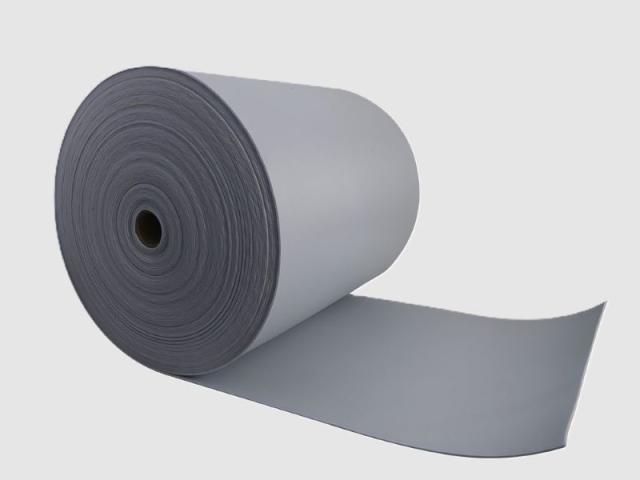
A foam material is the combination of two things: what the cell walls are made of, and whether the cells are sealed off from one another. The first decides what the material is called, the temperature it tolerates and the chemicals it resists. The second decides whether it blocks heat and vapour, or absorbs sound and lets air through.
That is the whole framework. Everything else on this page is the consequences.
Two questions sort most of it
Faced with the word “foam”, ask two questions and the material is largely classified.
- What are the cell walls made of? Polyethylene, polypropylene, polyurethane, polystyrene, EVA — the name comes from this. The base polymer sets the working temperature, the hardness and the chemical resistance.
- Are the cells closed or connected? In closed-cell foam each bubble is separate; in open-cell foam the bubbles are linked. This decides whether it keeps water vapour out or lets it pass.
There is a second dividing line as well: whether the polymer chains were cross-linked before expansion. Cross-linking ties the chains into a three-dimensional network, the cell walls no longer collapse at temperature, and that is what allows finer, more uniform cells and thinner single layers.
The five base materials
| Base | Cells | Character | Typical use |
|---|---|---|---|
| Polyethylene (PE / XPE / IXPE) | Mostly closed | Flexible, chemically resistant, does not absorb water; cross-linked single layer down to 0.1 mm | Packaging liners, underlayment, tape backing, buoyancy parts |
| Polypropylene (IXPP) | Closed | Stiffer than polyethylene, higher temperature, maximum service 140 °C | Automotive and electronic thin layers that must resist heat |
| Polyurethane (PU) | Open or closed | Very wide range from soft to rigid, broad density span | Mattresses, furniture padding, car seats |
| Polystyrene (PS / EPS / XPS) | Closed | Light, stiff, moulds well | Building insulation board, moulded packaging |
| EVA | Closed | Soft with a rubbery feel, thermoforms well | Yoga mats, footwear, sports protection |
The row that cuts across this table is cross-linking. The same polyethylene, uncross-linked, can be remelted; once cross-linked into XPE or IXPE it cannot be melt-recycled, only ground. What that buys is finer cells and thinner single layers. The trade-offs between the three cross-linked polyethylene grades are on PE foam and the cross-linked grades.
Cross-linked or not: the second dividing line
An extruder melts the polyethylene, mixes in the blowing agent and releases the pressure at the die, and the gas expands the polymer into cells. That step does not change how the chains are connected — they can still slide past one another. Chains that slide mean the cell walls are drawn thinner and thinner as the gas expands, so once density is pushed low the cells collapse or merge. That is why uncross-linked PE foam has coarser cells and cannot be made thin.
Cross-linking ties the chains together before expansion: XPE uses a peroxide for chemical cross-linking, IXPE uses an electron beam, and IXPP is likewise irradiation cross-linked. The network holds the cell walls, so the material stays intact at lower density, and single layers reach the 0.1 mm of IXPE and the 3 mm of XPE.
Closed cell or open cell
A closed-cell foam is a row of separate little rooms. Gas cannot get out and water vapour cannot get in, so thermal conductivity is low and water uptake is low. Measured to GB/T 1034, our cross-linked polyethylene grades absorb 0.2% or less in the 3–10× range and 0.4% or less in the 25–40× range. For insulation, vapour control or buoyancy, choose closed cell.
In an open-cell foam the bubbles are connected. Air passes through the cell walls and friction generates heat, which is how acoustic energy is dissipated — so absorption work uses open-cell structure. For sound absorption, breathability or filtration, choose open cell. One sheet cannot do both jobs at once, which is why acoustic and thermal products are frequently not the same foam. The distinction is covered in closed-cell vs open-cell foam.
Density, thickness and form follow the application
Density and expansion ratio are two ways of writing one number. For our XPE grades the authoritative table gives the following correspondence (GB/T 6343 and GB/T 10297).
| Expansion | 3× | 10× | 20× | 30× | 40× |
|---|---|---|---|---|---|
| Apparent density (kg/m³) | 300±40 | 100±10 | 50±6 | 33.3±3 | 26.8±3 |
| Thermal conductivity (W/(m·K)) | ≤0.095 | ≤0.073 | ≤0.055 | ≤0.045 | ≤0.040 |
Thickness and width come from the same table. Single layer: XPE 3–15 mm, IXPE 0.1–15 mm, IXPP 1–6 mm. Anything thicker is multi-layer heat lamination: XPE and IXPE to 200 mm, IXPP to 100 mm. Width is 500–2000 mm, and 500–1500 mm for IXPP. Cutting a roll into sheets or die-cutting it into parts is only the difference of a final operation.
Common questions
Is foam the same as sponge?
No. Sponge means natural sponge or flexible polyurethane foam, usually open cell; foam is the general term for expanded polymers, and covers both closed and open cell. The words are used loosely in everyday speech, but asking about the cell wall material and the cell structure separates them. We make closed-cell polyethylene and polypropylene foam, not polyurethane sponge.
Can foam material be recycled?
It depends whether it is cross-linked. Uncross-linked thermoplastic foam can be remelted; cross-linking forms a three-dimensional network that cannot be melt-recycled and can only be ground for filler or low-grade backfill. So “is it recyclable” is a question about the grade, not about foam as a category.
How do I judge how much density I need?
Look at the load and compression requirement first, then the weight limit. 3× (300±40 kg/m³) takes sustained compression, screws and concentrated loads; 40× (26.8±3 kg/m³) is light, soft and conformable. Most designs take the lightest grade that passes the load test — see high-density XPE foam.
How much heat can foam take?
Heat-resistant grades of polyethylene foam withstand a 110 °C working environment with shrinkage of 8% or less; polypropylene foam (IXPP) reaches a maximum service temperature of 140 °C. Above 140 °C is no longer a foam application and calls for mineral fibre or a refractory material — we will say so rather than stretch the number.
What Bofeng Foam supplies
Bofeng Foam is a manufacturer of cross-linked polyolefin foam, with a 10,000 m² plant, five production lines and 5,000 tonnes of annual capacity in Zhuhai, Guangdong. We make one part of the table above: cross-linked polyethylene and cross-linked polypropylene — XPE (chemically cross-linked), IXPE (irradiation cross-linked) and IXPP (irradiation cross-linked polypropylene), expansion ratio 3× to 40×, apparent density 26.8–300 kg/m³, width 500–2000 mm.
We do not make polyurethane, polystyrene or EVA foam. When those are what a project needs, we say so rather than substituting something else.
See the cross-linked foam range · Ask about a material
See also what foam is made of, PE foam, foamed material, foamed plastic, closed-cell vs open-cell foam and PP foam.