
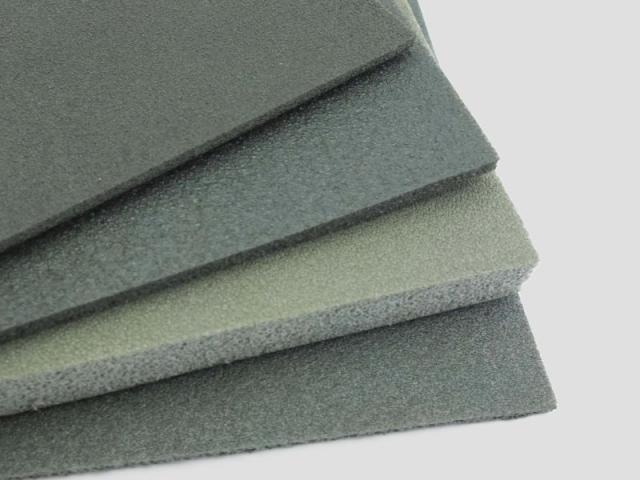
Foamed material and its matrix types
Foamed material is a solid that has been expanded with gas. A blowing agent is dispersed through a polymer — or through a metal, ceramic or glass melt — and then made to release gas, either by chemical decomposition or by physical injection. The gas forms cells, the cells are frozen in place as the material cools or cures, and what is left is a body of gas pockets held inside a solid matrix. Because gas replaces most of the solid, density falls sharply — and every property that tracks density, from stiffness to thermal conductivity to sound transmission, falls with it.
The name of a foamed material comes from its matrix, not from the gas inside it:
- Polymer foams. Polyurethane, polystyrene and polyethylene are the three largest families by volume. Bofeng Foam works in the cross-linked polyethylene group: XPE foam, IXPE foam and IXPP foam.
- Metal foams. Aluminium and magnesium alloys are foamed into panels used where a stiff, non-combustible core is needed.
- Ceramic and inorganic foams. Foamed glass and ceramic foams serve as insulating layers and fire barriers.
Properties of foamed material
Each property below follows from the pore structure rather than from the chemistry of the matrix.
- Low density. Gas cells occupy most of the volume and almost none of the mass. A cross-linked polyethylene foam at 40× expansion has an apparent density of 26.8 ± 3 kg/m³ (GB/T 6343), against 300 ± 40 kg/m³ at 3×.
- Thermal insulation. Heat crosses a foam by conduction through the cell walls and the trapped gas, and by convection inside the cells. Closed cells limit the movement of that gas, so convection carries very little, and the gas itself conducts far less than the solid it replaced. Our cross-linked polyethylene grades run from 0.095 W/(m·K) at 3× to ≤0.040 W/(m·K) at 40× (GB/T 10297).
- Sound absorption and insulation. Sound energy entering an open-cell foam is turned into heat by friction as air moves through the pores. A closed-cell foam reflects more and absorbs less, which is why closed-cell sheet is specified as a barrier under floors and inside vehicle cabins rather than as a wall absorber.
- Cushioning and shock absorption. The cells deform and the gas inside them compresses, spreading a short, sharp impact over a longer, gentler one. How stiff that response is follows the expansion ratio: 3× sheet at 300 ± 40 kg/m³ takes load, 40× sheet at 26.8 ± 3 kg/m³ conforms to it.
- Water and chemical resistance. Polyethylene is non-polar, so water does not wet it, and the closed cells give it no open path inwards. Water absorption stays at or below 0.4% across the range (GB/T 1034, method 4), and the sheet resists sea water, oils, greases and dilute acids and alkalis.
- Conversion. Foam is cut, thermoformed, laminated and skived with ordinary tooling. Cross-linked polyethylene sheet heat-bonds into multi-layer board from 15 mm to 200 mm thick, and our functional grades can be heat-bonded into the same multi-layer builds, with solvent adhesive coating where required.
- Recyclability. Thermoplastic foams can be reground and re-used, and foams based on bio-based or biodegradable polymers break down under industrial composting. That is a property of the chosen polymer rather than of foaming in general — check the grade, not the category.
Where foamed material is used
Applications follow the same logic: wherever weight, heat flow, sound or impact has to be managed, a foam is a candidate.
- Construction and thermal insulation
- Wall and roof insulation: EPS and XPS board, and foil-faced polyethylene roll, cut the heat flow through the building envelope.
- Underfloor heating: a foam layer under the screed stops heat escaping downwards, so more of it reaches the room.
- Packaging and transport
- Protective packaging: polyethylene and polyurethane foams hold instruments and electronics in place and absorb the drop.
- Cold chain: PU boxes and foil-faced PE liners hold food and pharmaceuticals inside a temperature band.
- Automotive and transport equipment
- Interior trim: seat, dashboard and door-panel foam provides the soft touch and damps vibration.
- Noise control: closed-cell sheet under the carpet and behind the trim blocks road and engine noise.
- Lightweighting: aluminium foam replaces heavier cores in some body and chassis parts.
- Aerospace
- Structural cores: metal foam carries load at low weight in some aircraft and spacecraft parts.
- Insulation and fire barriers: foam layers line cabins and separate hot zones.
- Medical and hygiene
- Support and pressure relief: polyurethane foam is the standard cushioning in mattresses, positioning wedges and orthopaedic padding.
- Single-use items: foam pads, trays and disposable hygiene products.
- Sports and leisure
- Equipment: midsoles, protective padding, yoga mats and gym tiles are all foamed.
- Water sports: closed-cell foam provides buoyancy in life jackets and boards because it takes up almost no water.
For the polymer overview see foam material; for plastic-specific grades see foamed plastic and PE foam. Our cross-linked range is on foam materials, and you can contact us about a specific matrix.