
Insulation foam is not one material. The term covers several distinct families, and the number that matters is not how many exist but how many are a realistic option for the job in front of you. This article groups them, shows what each is good at, and narrows the list to the materials we actually manufacture.
The material families, grouped
Six families cover almost everything sold as insulation foam or insulation wool.
- Mineral wools — glass wool, rock wool and slag wool. Non-combustible, inexpensive, tolerant of very high temperature. Used in building cavities, industrial pipework and furnace linings. They must be kept dry.
- Refractory fibres — ceramic fibre and aluminium silicate fibre. Chosen for kilns and high-temperature industrial plant, where the service temperature rules out everything else.
- Aerogel — a nanoporous silica network, the best insulator per millimetre and the most expensive. Used where space or weight is the binding constraint.
- Polyurethane (PU) — a cellular plastic, most often closed cell. Used in panels, sprayed insulation and refrigeration. Available across a wide range of densities and stiffnesses.
- Phenolic (PF) — a closed-cell cellular plastic chosen where fire performance matters as much as insulation value.
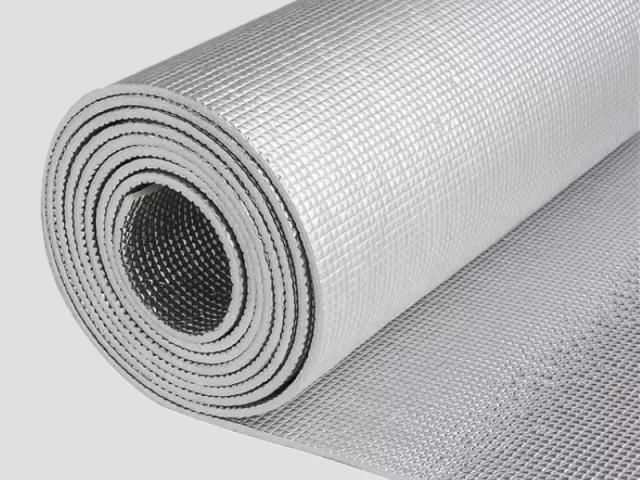
- Polyolefin foams — polyethylene and polypropylene foams, including the cross-linked XPE, IXPE and IXPP that we manufacture. Closed-cell, flexible, supplied in thin gauges, and the family that flexible insulation is normally specified from.
Where the choice actually matters
In a building cavity the decision is usually made on fire class and cost, and the mineral materials win. The decision becomes interesting when the insulation has to do something else as well — when it has to bend around a pipe, be cut to a part, be laminated to a facing, or hold its performance in a wet place.
| Family | Water | Flexible | Best for |
|---|---|---|---|
| Mineral wool | Absorbs; needs a vapour barrier | No | Cavities, industrial pipework, high temperature |
| Refractory fibre | Moisture-tolerant | No | Kilns, furnaces, very high temperature |
| Aerogel | Hydrophobic when treated | Limited | Space- and weight-constrained insulation |
| Polyurethane (PU) | Closed-cell types resist water | Rigid or spray foam | Panels, spray insulation, refrigeration |
| Phenolic (PF) | Resists water | Rigid board | Insulation where fire performance leads |
| Cross-linked PE (XPE, IXPE) | 0.2% or less water absorption at 3–10×, rising to 0.4% or less at 25–40× (GB/T 1034, method 4) | Yes, in thin gauges | Flexible layers, part-shaped insulation, lamination |
The polyolefin options in detail
Within the family we make, the material is chosen on three parameters rather than on a catalogue name.
- Cross-linking method — XPE is chemically cross-linked with peroxide; IXPE and IXPP are cross-linked by electron-beam irradiation. The irradiation route produces a finer and more uniform cell, which is what allows single layers down to 0.1 mm.
- Expansion ratio — we produce from 3× to 40× in polyethylene and 5× to 25× in polypropylene, covering densities from 26.8 to 300 kg/m³. The ratio sets density, hardness and stiffness together.
- Base polymer — polyethylene for the general case, polypropylene where the layer has to be stiffer or run hotter, up to 140 °C.
Thickness follows from those choices: XPE single layers of 3–15 mm, IXPE from 0.1–15 mm, IXPP from 1–6 mm, all in widths of 500–2000 mm (IXPP 500–1500 mm) and heat-bonded up to 200 mm.
Insulation foam FAQ
How many materials are there in insulation foam?
Six families cover almost all of it: mineral wools, refractory fibres, aerogel, polyurethane, phenolic and polyolefin foams. Within a single family the variants multiply quickly — our own range alone spans three cross-linking routes, expansion ratios from 3× to 40× and densities from 26.8 to 300 kg/m³. The useful question is usually which two or three are realistic for a given duty.
How many of these do you manufacture?
Three: XPE, IXPE and IXPP, all of them cross-linked polyolefin foams. We also supply non-cross-linked PE foam for general cushioning and silicone foam for temperature ranges that polyethylene cannot cover. We do not make mineral wools, aerogel, polyurethane or phenolic foams, and we will say so rather than quote a material we do not produce.
Which insulation material is cheapest?
Mineral wools are the least expensive per square metre in a building cavity, and they are difficult to beat on that measure. Foam competes on a different basis: it does not need a separate vapour barrier in damp service, it can be supplied flexible and thin, and it can be cut, laminated and coated into a finished part. The comparison that matters is usually total installed cost for the build-up, not the price of the sheet.
Which is the best insulator per millimetre?
Aerogel, by a clear margin, and it is priced accordingly. Among the materials we make, the dense end of the polyethylene range measures 0.095 W/(m·K) by the GB/T 10297 test method, and lighter expansion ratios trade some conductivity for lower weight, greater flexibility and lower cost.
See thermal insulation foam for our grades and figures, the materials hub to compare XPE, IXPE and IXPP, or contact us with the duty and we will narrow the list for you.