
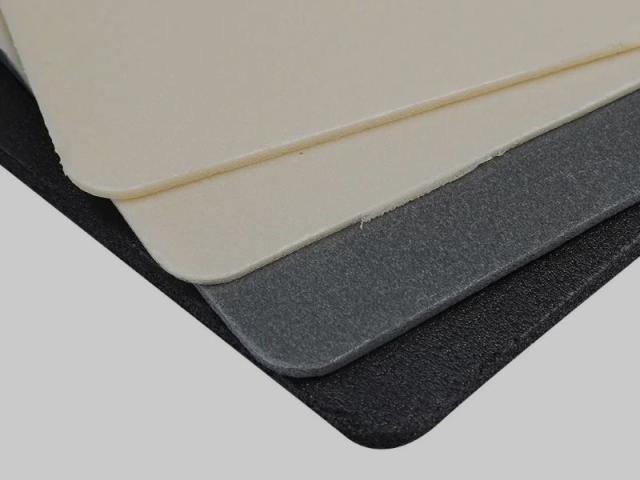
“Medical grade” is not a material property, and it is not a certification a foam supplier can issue. It is a buyer’s designation for a level of control, and what it means in practice depends on where the part sits in the device. Before comparing suppliers, the word has to be split — because on one medical purchase order, “auxiliary material” covers at least three different things.
Three different things on one purchase order
- Material. Sheet or roll, priced by square metre, kilogram or roll. You receive the material itself, and the specification is the technical data table.
- Fabricated part. The shaped article delivered after die-cutting, laminating and adhesive coating. You receive dimensions and outline; the material is only the premise.
- Packaging insert. The cushioning inside an instrument tray, the locating piece inside a transit case. It does not touch the patient, but it decides whether the instrument is still in position when it reaches the site.
All three are called auxiliary material. The acceptance clauses are completely different: the first is accepted against material parameters, the second against a drawing and tolerances, the third against cushioning and retention. Discussed as one thing, the two commonest failures follow — comparing a fabricated part’s price against a material price, or accepting a fabricated part against a material report.
The boundary: auxiliary material is not the device
This has to be stated first, because it decides where responsibility sits for everything below. Bofeng Foam supplies foam material and fabricated parts. We do not manufacture or certify finished medical devices. Biocompatibility evaluation, sterilisation validation and device registration are carried out by the device manufacturer under the requirements of their own market.
This is not boilerplate. It has a specific consequence: any conclusion about a finished device should not be requested from a material supplier, and equally, what the material side can deliver should not be blurred. The four layers below keep the two sides apart.
Layer 1: material identity
The first step in acceptance is not reading numbers; it is confirming that this delivery is the same thing as the last one. Three items have to be in the specification:
- Material family. XPE is chemically cross-linked; IXPE is electron-beam cross-linked. The grades are not interchangeable, and “PE foam” on a purchase order does not identify either.
- Expansion ratio. 3× to 40×. Within one material family, change the ratio and density, hardness and tensile strength all move with it.
- Density and thickness. Apparent density 26.8–300 kg/m³, banded by ratio; single-layer thickness 3–15 mm or 0.1–15 mm depending on the family.
Omit any one of the three and a supplier can deliver foam that is “right” but not what you wanted, with no way afterwards to decide who was wrong — because the specification itself never completed the material identity.
Layer 2: dimensional tolerance
This is where thin and thick differ most.
| Item | XPE | IXPE |
|---|---|---|
| Single-layer thickness | 3–15 mm | 0.1–15 mm |
| Multi-layer heat lamination | 15–200 mm | 15–200 mm |
| Width | 500–2000 mm | 500–2000 mm |
0.1 mm appears only in IXPE; it is what electron-beam cross-linking makes possible. XPE single layers start at 3 mm. Thin parts are therefore almost always an IXPE case — not a preference, but the lower process limit.
Die-cut part tolerances are a separate calculation, and there is no general table that applies to every shape: the tolerance depends on the shape, the material thickness and the cutting die. The practical move is to mark mating dimensions (the ones that assemble against another part) separately from outline dimensions on the drawing, and we confirm item by item.
Layer 3: batch consistency
The trouble with medical auxiliary materials is usually not the first batch but the tenth. A first batch that works does not mean the rest will. Four quantities can be written into a specification and matched by the supplier on every delivery. All are from our technical data table.
| Indicator | Standard | What it means for an auxiliary part |
|---|---|---|
| Apparent density | GB/T 6343 | Sets the feel and the rebound, and the weight at a given thickness |
| Shore hardness | GB/T 2411 | Sets conformity and support; thin and thick sheet are banded differently |
| Compression set | GB/T 6669 | Whether it collapses under long-term compression; measured at 23±2 °C for 22 h |
| Water absorption | GB/T 1034 | Whether it swells after cleaning — where closed-cell material quantifies its advantage |
All four are banded by expansion ratio. The selection point matters more than the numbers: do not write “density 40”. Write “25×, density 40±4 kg/m³”. The ratio and the density are one pair, and writing half of a pair leaves the other half free.
Layer 4: documentation
This is the layer where negotiations break down, so both columns are written out.
What we can provide: the material specification — the banded parameters on this page and on the product pages; fabrication to your drawing; lamination, adhesive coating and die-cutting done by one supplier, so the specification does not have to be reconciled between several parties.
What we do not hold, and therefore do not claim: ISO 10993 biocompatibility testing, sterilisation validation, and medical device regulatory registration. All three are about the finished device; the responsible party is the device manufacturer, not the material supplier.
If the documents your project needs are not in either column, send the requirement. We confirm per project what can be provided, rather than agreeing first and explaining afterwards.
Four forms, and where responsibility stops
| Form | How far we go | Who takes over |
|---|---|---|
| Sheet and roll | Material and slitting | Converter cuts, laminates, coats |
| Adhesive-backed laminate | Solvent adhesive plus release liner | Tape converter sets the adhesive system; final bonding is a design decision |
| Die-cut insert | Die-cutting to drawing | Device plant assembles, cleans and validates sterilisation |
| Laminated cushion | Lamination to non-woven or film | Device plant forms and evaluates the finished article |
The use of this table is: when a report in your hand does not match, first see which row it belongs to. A report on material parameters should not be used to prove a finished article conforms, and a finished-article conclusion should not be turned around into a demand on the material supplier.
Cleaning and sterilisation are not the same question
The two words appear together in enquiries, but they place different requirements on the material and can be delivered to different degrees.
Cleaning. The cells are closed, liquid does not enter, and the surface can be wiped. IXPE’s technical documentation gives resistance to water, grease and acids and alkalis. This is something we can discuss and write into a specification.
Sterilisation. This page gives no conclusion. Our technical data carries no sterilisation-tolerance data — ethylene oxide, radiation and steam are three different stresses, and tolerance to one cannot be inferred from another. So there is no blanket tolerance statement here, and no recommendation to design around a particular route. If your project already has a defined sterilisation route, tell us and we will confirm how far we can supply against it.
Keeping the two apart prevents a familiar outcome: a specification written from a “medical grade” template that includes sterilisation tolerance, and a delivery at which nobody turns out to own that line.
The electronic medical device branch
Where the auxiliary part is assembled into electronic medical equipment — monitoring, imaging, laboratory instruments — static has to be addressed separately. Bofeng Foam can supply two permanent types: conductive at 10³–10⁶ Ω and static-dissipative at 10⁶–10⁹ Ω.
Two cautions. Conductive is not electromagnetic shielding: shielding effectiveness is a different quantity and is not given here. And the quantity, method and measurement conditions for resistance have to be agreed with the supplier, or two reports cannot be compared directly. Both are covered in how to read a surface resistance figure.
Common questions
What certification does a medical auxiliary part need?
It depends where it sits in the device. Market access for the finished device — registration, biocompatibility evaluation, sterilisation validation — belongs to the device manufacturer. What the material side can provide is the material specification and batch-to-batch consistency. Bofeng Foam does not hold and does not claim ISO 10993 biocompatibility testing or device registration.
How do XPE and IXPE divide the work?
Thin parts use IXPE: single layer down to 0.1 mm, fine cells, clean cut edges, suitable for tape backing and thin liners. Thicker, more load-bearing cushions use XPE: single layer 3–15 mm, heat laminated to 200 mm. Using both in one product is common.
What tolerance can you hold on a die-cut part?
No general number. Die-cut tolerance depends on shape, material thickness and cutting die, and is confirmed per drawing. Separating mating dimensions from outline dimensions saves a round trip.
What can you offer on sterilisation?
No conclusion — our technical data carries no sterilisation-tolerance data. On the cleaning side we can say that the closed-cell structure does not absorb liquid and that IXPE resists water, grease and acids and alkalis. If the sterilisation route is already fixed, send it and we will confirm per project.
How are minimum order and lead time set?
Minimum order, lead time and price depend on specification and order quantity; we quote per project and do not publish fixed figures. Send material, ratio, density, thickness, sheet size and quantity and an engineer will confirm lead time and price.
Boundaries
This page is about where responsibility falls when foam is used as a medical auxiliary material, and how acceptance is layered. It is not device design and does not replace your own quality system documents. Where a project has a specified document format or acceptance method for any of the four layers, that requirement governs — our job is to confirm that we can meet it, not to ask you to change your table to ours.
What Bofeng Foam supplies
Bofeng Foam is a manufacturer of cross-linked polyolefin foam, with a 10,000 m² plant, five production lines and 5,000 tonnes of annual capacity in Zhuhai, Guangdong. XPE (chemically cross-linked, single layer 3–15 mm), IXPE (electron-beam cross-linked, single layer 0.1–15 mm) and IXPP; expansion 3× to 40×, apparent density 26.8–300 kg/m³, width 500–2000 mm, multi-layer heat lamination 15–200 mm. Available laminated to non-woven or film, solvent-adhesive coated with a release liner, and die-cut to drawing. Flame-retardant grades with an oxygen index of 27, and functional grades at 10³–10⁶ Ω and 10⁶–10⁹ Ω. The foam is non-latex.
See medical and device foam · Discuss a device project
See also reading a surface resistance figure, custom foam inserts, packaging foam, XPE foam, IXPE foam, certifications and compliance and all foam materials.