
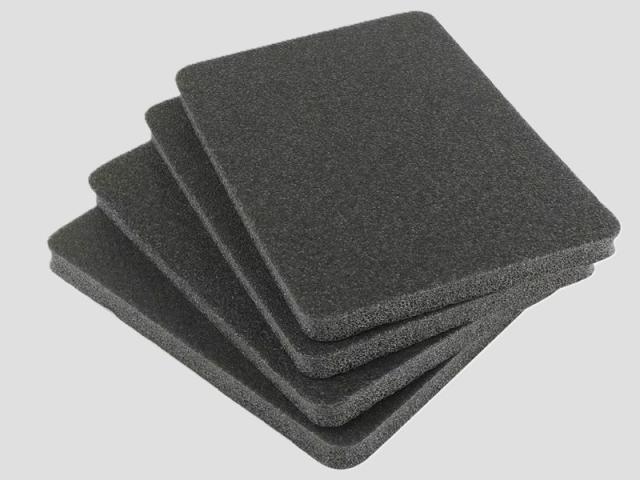
IXPE is irradiation cross-linked polyethylene foam. It uses the same base resin as XPE; the only difference is the energy that joins the molecular chains. XPE relies on a peroxide that decomposes under heat, IXPE relies on an electron beam driven straight through the sheet. That single substitution is what lowers the minimum single-layer thickness from 3 mm to 0.1 mm.
This page covers where that process route stops, what it costs, and when it is the only option. The material definition and the full property table live on the IXPE foam product page and are not repeated here.
What the electron beam does inside the sheet
An accelerator speeds electrons to high energy and sweeps the resulting beam across extruded polyethylene sheet. As the electrons pass through, they break carbon–hydrogen bonds along the polymer chains. The radicals left behind are unstable and recombine with neighbouring chains, so a chemical bond appears between two chains that were previously independent. Repeated many thousands of times across the sheet, isolated linear molecules become a three-dimensional network.
The reaction does not need temperature to trigger it. It needs dose — the total energy delivered to the material, set by beam current and line speed together. Run the sheet fast and the dose is low; run it slowly and the dose is high. Too little dose leaves the network incomplete and the cell walls collapse during expansion. Too much breaks chains faster than it joins them, and the foam turns brittle.
What matters for everything below is that cross-linking is applied from outside and does not depend on heat travelling from the surface to the core.
Why this route reaches 0.1 mm
XPE is cross-linked by heat. The peroxide has to reach its decomposition temperature inside the sheet, and heat arrives from the surface. The thinner the sheet, the narrower the window in which that temperature can be held; below 3 mm per layer, the order of cross-linking and expansion is hard to keep in step.
IXPE has no such constraint. The beam passes through the whole sheet, so dose can be set directly for a thin sheet and a thick one alike, with no wait for heat to travel the full thickness. Three things follow:
- Thin sheet still forms an even network. A single layer can be made at 0.1 mm — the one range where XPE cannot substitute for IXPE at all.
- No solid cross-linking agent. There is no peroxide to disperse evenly through the resin, so there is no uneven-agent-distribution failure mode, and the cells come out finer and more uniform.
- Smooth surfaces. Both faces are flat and take printing, adhesive coating or lamination directly, without a primer step.
Thicker sections are still built by heat-laminating several layers: 0.1–15 mm per layer, up to 200 mm when multi-layer.
Three limits we will not oversell
First, thickness is a hard boundary. Single layer 0.1–15 mm. That 15 mm is not the same figure as XPE's: XPE starts at 3 mm and IXPE starts at 0.1 mm, and the two share the same upper limit.
Second, it costs more. An electron accelerator is heavy capital equipment, and its depreciation lands in every kilogram. At the same expansion ratio and the same thickness, IXPE’s unit price is higher than XPE’s. Not every part justifies it — a thick part with a simple shape is better value in XPE.
Third, temperature resistance still comes from polyethylene. The heat-resistant grade withstands a 110 °C working environment with shrinkage of 8% or less. Above that the material should be IXPP, which reaches 140 °C. Irradiation raises strength and uniformity; it does not change the melting point of the base polymer.
When IXPE is the only choice
Four tests, in priority order:
- Section below 3 mm. A hard condition with no alternative. Phone and battery gaskets, precision electronics liners and medical dressing backings all sit here.
- Direct printing, coating or lamination. The smooth surface removes a whole pre-treatment step, which shows most clearly on thin parts.
- Sensitivity to residue. No cross-linking agent means no cross-linking agent residue, which is why skin-contact parts and the interiors of sensitive electronics often use it. Where a substance compliance document is required, it is handled case by case; this page makes no claim either way.
- A finer, more even cell structure. At the same expansion ratio IXPE’s cells are more uniform, so thin cushioning and sealing parts compress more consistently.
Conversely, if the part is over 3 mm, simple in shape and has no surface requirement, XPE is better value. The two grades are not substitutes for one another; they divide the work by thickness and surface requirement. For a cross-comparison of the three materials, see how XPE, IXPE, EPE and EVA differ.
Handling and storing thin roll stock
IXPE from 0.1 to 1 mm is usually supplied in rolls, 500–2000 mm wide. Two things matter when handling thin sheet:
- Tension. Excessive unwind and rewind tension leaves marks that are especially visible on thin sheet. Slacken the roll and let it rest before slitting or die cutting, so the stress can relax.
- Temperature. The label-grade specification gives a storage temperature of no more than 35 °C, away from heat sources and open flame, protected from high humidity and direct sunlight — prolonged heat makes thin sheet stick to itself and ruins the whole roll. Keep hard and sharp objects from pressing into it.
Specifications
IXPE foam supply range:
- Expansion ratio: 3× to 40×
- Apparent density: 26.8–300 kg/m³, varying with the ratio
- Single-layer thickness: 0.1–15 mm
- Heat-laminated multi-layer: 15–200 mm
- Width: 500–2000 mm
- Colour: black, white, grey, custom colours
- Surface treatment: corona treatment and embossing available
- Heat-resistant grade: 110 °C, shrinkage 8% or less
- Flame-retardant grade: oxygen index 27, GB 8410 A0, UL94 V2; low-smoke option available
Water absorption measured to GB/T 1034 method 4: 0.2% or less at 3–15×, 0.3% or less at 15–20×, 0.4% or less at 25–40×. Thermal conductivity measured to GB/T 10297 falls from 0.095 W/(m·K) or less at 3× to 0.040 W/(m·K) or less at 40×. The full grade-by-grade table is on the product page.
What Bofeng Foam supplies
Bofeng Foam is a manufacturer of cross-linked polyolefin foam, with a 10,000 m² plant and five production lines in Zhuhai, Guangdong, and annual capacity of 5,000 tonnes. IXPE is supplied from 3× to 40× expansion, down to 0.1 mm in a single layer and 500–2000 mm wide, available corona treated, embossed or laminated, and in flame-retardant, anti-static and conductive grades.
Common questions
What is the difference between IXPE and XPE?
Only the cross-linking method. XPE is chemically cross-linked by a peroxide decomposing under heat; IXPE is cross-linked by an electron beam. Base resin, expansion range and width are the same. The differences appear in the result: IXPE’s single-layer minimum is 0.1 mm against XPE’s 3 mm, its surface is smoother and carries no cross-linking agent residue, and it costs more.
How thin and how thick can IXPE be made?
0.1 mm at the thinnest single layer, 15 mm at the thickest. Above 15 mm the part is built by heat-laminating several layers, up to 200 mm.
Can IXPE be printed or laminated?
Yes. The surface is smooth and can be corona treated, so it takes printing, adhesive coating, or lamination to aluminium foil, non-woven fabric, leather or brushed fabric directly. For facing selection see laminated foam.
What temperature can IXPE withstand?
The heat-resistant grade withstands a 110 °C working environment with shrinkage of 8% or less. Standard grades are used at ordinary indoor, vehicle-cabin and equipment-internal temperatures. Where more is needed, IXPP reaches 140 °C.
Further reading
See also XPE foam, IXPP foam, PE foam: uncross-linked versus cross-linked grades, how foamed plastic is made, closed cell versus open cell foam, medical grade foam, or contact us for samples.