
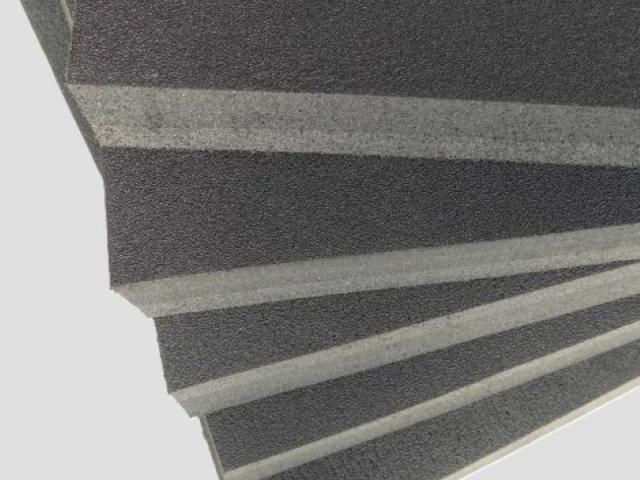
XPE foam is chemically cross-linked polyethylene foam. The polyethylene chains are joined into a three-dimensional network before the resin is expanded into cells, and that network is what lets the material be blown to 40 times its original volume and still hold its thickness under a sustained load — ordinary, uncross-linked PE foam collapses under the same treatment. Density runs from 26.8 to 300 kg/m³ and single layers from 3 to 15 mm; anything thinner is IXPE, which is cross-linked by an electron beam rather than a peroxide.
How XPE foam is made
Polyethylene resin is compounded with a blowing agent and, for the functional grades, with a flame retardant or conductive carbon. A peroxide cross-linking agent is then activated under heat, joining the polymer chains before the blowing agent decomposes and expands the sheet into cells. Because cross-linking happens first, the cells that form are small, regular and sealed — a closed-cell structure rather than an open foam.
The alternative route is irradiation. In IXPE the chains are joined by an electron beam instead of a chemical agent. The irradiation process produces an even finer and more uniform cell, which is why IXPE can be produced in single layers down to 0.1 mm with a smoother surface, while XPE is supplied from 3 mm upwards.
XPE foam specifications
| Property | XPE foam | IXPE foam | IXPP foam |
|---|---|---|---|
| Base polymer | Polyethylene | Polyethylene | Polypropylene |
| Cross-linking | Chemical (peroxide) | Radiation (electron beam) | Radiation (electron beam) |
| Expansion ratio | 3–40× | 3–40× | 5–25× |
| Density | 26.8–300 kg/m³ | 26.8–300 kg/m³ | — |
| Width | 500–2000 mm | 500–2000 mm | 500–1500 mm |
| Single-layer thickness | 3–15 mm | 0.1–15 mm | 1–6 mm |
| Heat-bonded multi-layer | 15–200 mm | 15–200 mm | 6–100 mm |
| Maximum service temperature | Heat-resistant grade to 110 °C | Heat-resistant grade to 110 °C | Up to 140 °C |
| Cell structure | Closed cell | Closed cell | Closed cell |
| Water absorption | ≤0.2% to ≤0.4% (GB/T 1034, method 4) | ≤0.2% to ≤0.4% (GB/T 1034, method 4) | Closed cell |
The thermal conductivity of the dense 3× grade is 0.095 W/(m·K) by the GB/T 10297 test method; hardness, tearing strength and other properties vary with the expansion ratio and are tabulated grade by grade on the XPE foam product page.
Properties that come from the cross-linked structure
- Low compression set — the network stops the chains flowing, so a cushion does not progressively flatten under repeated loading.
- Stable thickness — the material holds its gauge under a sustained static load, which is what an insulation or underlayment layer depends on.
- Closed cells — water absorption between 0.2% and 0.4% depending on the grade, so the foam does not soak, does not freeze and does not lose its insulation value in damp service.
- Chemical resistance — polyethylene resists acids, alkalis and oils in normal industrial exposure.
- Convertible — die-cut, CNC-contoured, slit, laminated and adhesive-coated, so the material can be supplied as a finished part.
XPE foam compared with ordinary PE foam
Non-cross-linked PE foam is softer, cheaper and easier to produce, and it remains the right material for general cushioning and void fill. The difference shows up under load and over time. An uncross-linked foam compresses for long enough and it stays compressed, because nothing prevents the polymer chains from moving past each other. The cross-linked network in XPE resists that, which is why XPE — rather than plain PE foam — is specified for underlayment, gaskets, sports matting and automotive parts. See closed cell vs open cell foam and XPE vs IXPE for the wider comparisons.
What XPE foam is used for
- Packaging — protective inserts, tool box liners and dunnage; see packaging foam.
- Automotive — sound deadening, insulation and sealing behind trim; see automotive foam.
- Construction and flooring — acoustic underlayment and insulation; see flooring foam.
- Sports and body contact — yoga and gym matting, insoles and padding; see high resilience foam.
- Electronics and ESD — conductive and anti-static parts; see ESD foam.
XPE foam FAQ
What does XPE stand for?
XPE stands for cross-linked polyethylene. The X denotes the cross-linking: the polyethylene chains are joined to one another by chemical bonds, using peroxide as the cross-linking agent, rather than being left as separate linear chains as they are in ordinary PE foam.
What is the density of XPE foam?
We produce XPE foam at expansion ratios from 3× to 40×, which covers densities from 26.8 to 300 kg/m³. The expansion ratio is the input and the density is the result: a 40× foam is light and soft, a 3× foam is dense and firm. Density, hardness, tearing strength, water absorption and thermal conductivity are tabulated per ratio on the XPE foam page.
What temperature can XPE foam withstand?
Standard XPE foam is used at normal indoor, outdoor and vehicle-cabin temperatures. Where the part runs warm, our heat-resistant grade is rated to 110 °C with shrinkage of 8% or less. For genuinely hot surfaces, IXPP foam extends the service ceiling to 140 °C; above that, polyethylene is the wrong material.
Is XPE foam water-resistant?
Yes. The closed-cell structure gives water absorption of 0.2% to 0.4% depending on the grade, by the GB/T 1034 method 4 test. The foam does not wick, does not become heavy and does not lose its cushioning or insulation value when it is wet, which is why it is used in bathroom matting, cold-chain packaging and underfloor applications.
What is the difference between XPE and IXPE foam?
The cross-linking method, and the thickness that follows from it. XPE is chemically cross-linked; IXPE is irradiation cross-linked, which gives a finer and more uniform cell and allows single layers down to 0.1 mm instead of 3 mm. IXPE is the grade for thin gaskets, precision lamination and electronics; XPE is the general-purpose material. Both are made from the same polymer and both are closed cell.
See XPE foam for the full grade table, the materials hub to compare XPE, IXPE and IXPP, or contact us with the application and we will confirm a ratio and a thickness.