
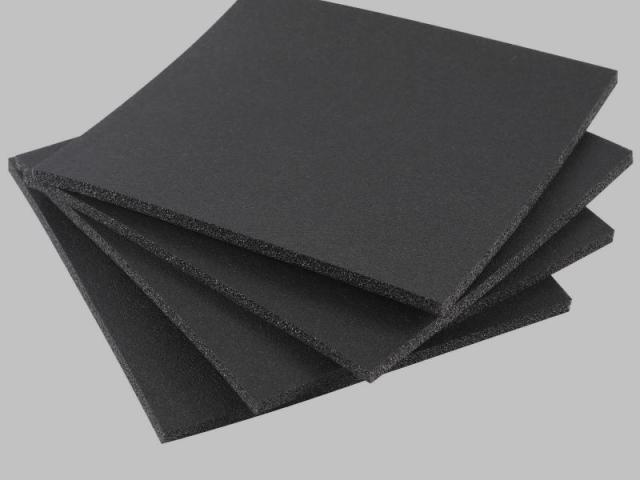
XPE, IXPE and IXPP are all cross-linked closed-cell polyolefin foam, and at a glance the three look interchangeable. They are not, and the difference is not a quality ranking: it is a set of hard process limits on thickness, a working temperature range, and how many properties can actually be tested on each material. This page is written as a decision guide — which of the three to choose, and what to check before switching an existing part from one to another.
The three are covered individually in XPE foam, IXPE foam and IXPP foam.
What the three share
All three are polyethylene or polypropylene foams that have been cross-linked before foaming, which gives them closed cells, low water absorption and a memory for their original shape. All three accept the same finishing operations — calendering, corona treatment, lamination, adhesive coating, die-cutting, CNC routing. All three are supplied in the same width band.
The shared part is why the differences are so often missed: a sample of each feels similar, cuts the same way and glues the same way. What separates them is what happens at the extremes — very thin, very thick, very hot — and what can be proven on paper.
The first gate: thickness
Before any property comparison, check whether the thickness the design needs can be made in the material at all. This is a manufacturing limit, not a recommendation.
| XPE | IXPE | IXPP | |
|---|---|---|---|
| Single layer | 3–15 mm | 0.1–15 mm | 1–6 mm |
| Heat-laminated multi-layer | 15–200 mm | 15–200 mm | 6–100 mm |
| Width | 500–2000 mm | 500–2000 mm | 500–1500 mm |
Read the first row and most switching questions resolve immediately. Below 3 mm, XPE is not available as a single layer — the material changes to IXPE. Below 1 mm, IXPP is not available at all. Above 15 mm, every one of them is a laminated stack rather than one block, and the bond layer has to be qualified in its own right, as described in foam lamination.
The second gate: temperature
XPE and IXPE are polyethylene, and polyethylene softens well below the temperature polypropylene tolerates. IXPP is chosen almost entirely for its higher working temperature and its resistance to boiling water; where neither of those matters, there is rarely a reason to pay for it.
These figures are material limits, not assembly limits. A part bonded to something else is limited by the bond or by the substrate long before it reaches the foam’s own ceiling.
The three grades are not the same number
Expansion ratio is defined the same way across the three materials — the ratio of the finished foam’s volume to the solid polymer it came from — but the density that results is not identical, because the base polymers differ. At 25×, XPE is nominally 40±4 kg/m³ and IXPP is 40±5 kg/m³. Close enough to be quoted as an equivalent grade; not close enough to treat the tolerance bands as interchangeable.
Compression behaviour also separates at the same nominal grade. At 25× the compression-set ceiling is ≤10% for XPE and ≤9% for IXPE. That is a real difference for a part under sustained load, and it is one of the few places where switching to IXPE improves a mechanical property beyond merely allowing a thinner sheet.
What changes when you switch: three different kinds of change
“Switch material” gets used for three operations with very different consequences. Separating them is the whole of this section.
| Kind of change | What stays the same | What has to be re-qualified |
|---|---|---|
| Grade change — same material, different expansion ratio | Process route, finishing, bonding | Density, hardness, compression set, dimensional change, cost per square metre |
| Material change — XPE to IXPE or IXPP | The general look and the finishing operations | Thickness limits, temperature range, compression set, the set of testable properties, and every number on the drawing |
| Structure change — single layer to laminated | The material | The bond layer: shear, peel, temperature resistance, ageing; plus a new failure location that did not previously exist |
Most of the trouble comes from a request written as a material change that is really a grade change, or the reverse. “We need it firmer” is a grade change — move from 25× to 15× and keep XPE. “We need it thinner than 3 mm” is a material change, and the whole drawing has to be revisited.
The switch that does not solve the problem
The most common misdiagnosis: a part is running too hot, so the material is changed from XPE to IXPE. IXPE is a better foam for thin sheet, but it is still polyethylene foam, with a working temperature in the same band as XPE. Switching XPE to IXPE does not solve a heat problem.
If the temperature is the constraint, the answer is a different polymer — IXPP, or a non-foam insulation — or a change in the construction, not a thinner sheet of polyethylene. Confirming the actual surface temperature first, rather than the ambient, is usually what settles it.
What can be tested, and what cannot
This is the part most often skipped, and it matters more than the property comparison: the three materials do not come with the same set of measurements.
| Property | XPE | IXPE | IXPP |
|---|---|---|---|
| Apparent density (GB/T 6343) | Yes, ten grades | Yes | Yes, five grades |
| Shore hardness | Yes | Yes | Not given |
| Tear strength, machine / cross | Yes, both directions | Yes | Not given |
| Compression set (GB/T 6669) | Yes | Yes | Not given |
| Water absorption (GB/T 1034) | Yes | Yes | Not given |
| Thermal conductivity (GB/T 10297) | Yes | Yes | Not given |
| Compression strength | Not given | Not given | Yes, cross direction only, JIS-K6767 (1999) at 25% compression |
IXPP is the odd one out in both directions. It is the only one of the three with a compression-strength row, and the only one without hardness, tear, compression set, water absorption or conductivity. Its data rests on five measured grades — 7, 10, 15, 20 and 25× — not the ten XPE carries.
Two consequences follow. First, a specification written for XPE and copied onto IXPP will contain blank rows, and blank rows are not passes. Second, the IXPP compression-strength number cannot be carried back to XPE: it is a different polymer, a different test method, and only one direction.
Test methods also differ. XPE and IXPE are specified to the GB/T series; IXPP’s compression strength is to JIS-K6767 of 1999. Numbers from different methods are not comparable, and a table that mixes them is not a comparison.
A worked switching decision
A part is currently 10 mm of 25× XPE, and the customer wants it 40% thinner without losing support.
First gate: the new thickness is 6 mm. XPE can be made at 6 mm as a single layer, so no material change is forced by thickness. Second gate: the service temperature is unchanged and modest, so there is no reason to buy IXPP. What is left is a grade change: at 10 mm of 25× the part sits at 40 kg/m³; to keep a similar feel at 6 mm, move toward 20× (50 kg/m³) and check compression set against the new loading. No new property has to be qualified and no bond layer appears.
Now change the requirement to 2 mm. The first gate fails immediately: XPE cannot be made at 2 mm as a single layer. That is a material change to IXPE, and everything follows — a new density that may not be available in the grade you wanted, a new compression-set ceiling, and a new feel to sample. This is why the thickness number should be established before the density number.
When to stop switching
Switching materials is not free. Each change brings re-sampling, re-qualification of the drawing, and often a re-run of the customer’s own validation. If the current material is within its limits on thickness and temperature and the problem is a property, the answer is usually a grade change, which costs nothing in qualification beyond the sample. Reserve the material change for the two gates.
Evidence: what a supplier can and cannot claim
Certifications that are commonly asked about fall into two groups, and they answer different questions.
Product-level evidence: measured values against the standards named in the table above, supplied as a technical data sheet with the grade and the method. Flame-retardant grades meet UL94 V2 and GB 8410 A0 and are available with a low-smoke option.
Company-level evidence: ISO 9001 and ISO 14001. These describe how the plant is managed. They are not a statement that any particular product meets any particular property, and a quotation that offers ISO 9001 where a material property was asked for has not answered the question.
RoHS and REACH are declarations of compliance support, not certificates held for a finished part; the declaration is for the material as supplied and the customer’s own article assessment remains theirs. Ask for the document you actually need — a data sheet, a declaration, or a management-system certificate — because they are not substitutes for one another.
Common questions
Is IXPE better than XPE?
It is better at being thin. IXPE reaches 0.1 mm, where XPE stops at 3 mm, and its 25× compression set is ≤9% against ≤10%. Where the part is thick enough for XPE and the load is not severe, there is no reason to pay the difference.
Is IXPP just a firmer XPE?
No. It is polypropylene rather than polyethylene, which is why it tolerates a higher working temperature and boiling water. It also comes with far fewer testable properties and a narrower thickness and width range.
Can I switch to solve a temperature problem?
Only if you switch to IXPP, and only if 140 °C class performance is what you need. XPE to IXPE is not a temperature answer. Check the real surface temperature first.
Why does IXPP have no compression-set row?
Because the data we hold for it does not include one. A blank row is not a pass; if you need compression set on IXPP, it has to be sampled and measured rather than assumed from the XPE table.
Can a part be 20 mm in one piece?
Not in any of the three. Above 15 mm — and above 6 mm for IXPP — it is a heat-laminated stack, and the bond layer becomes part of the specification.
What Bofeng Foam supplies
Bofeng Foam produces XPE, IXPE and IXPP foam in Zhuhai, Guangdong, with a 10,000 m² plant, five production lines and 5,000 tonnes of annual capacity. XPE from 3× to 40×, apparent density 26.8–300 kg/m³, single layer 3–15 mm; IXPE single layer 0.1–15 mm; IXPP single layer 1–6 mm, width 500–1500 mm. Heat lamination to 200 mm, width to 2000 mm on XPE and IXPE. Finished stock can be calendered, corona treated, laminated, adhesive backed, die-cut, CNC routed or punched.
Send the thickness, the service temperature and the property the part is judged on, and we will say which of the three can meet it — including when the answer is that none of them can.
Ask which material fits your part
See also what XPE foam is, IXPE material, PP foam, XPE, EPE and EVA compared, XPE and IXPE at the same ratio, choosing XPE density and all foam materials.