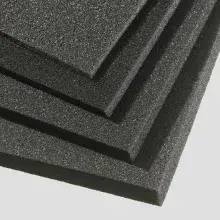
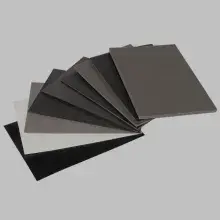
Anti-static foam is cross-linked polyethylene foam compounded with conductive carbon so that static charge drains away instead of building up on the surface. Bofeng Foam manufactures anti-static foam in Zhuhai, China, with surface resistance specifiable from 10⁶ to 10⁹ Ω, supplied as sheet, as die-cut parts and laminated into trays, dividers and liners.
Static is a manufacturing problem before it is a shipping problem. A charge that builds on an insulating foam as a component is handled or unpacked can discharge into the device, and the damage is often latent — the part passes test and fails in the field. Anti-static foam removes the charge path by giving it somewhere to go.
What is anti static foam?
Untreated polyethylene foam is a good insulator, which is exactly the problem: it holds charge and it will not let it go. The fix is to compound conductive carbon black into the polyethylene before the foam is expanded, so that the finished material is conductive through its volume rather than only on its surface.
That distinction matters in practice. A surface coating can be rubbed off in handling or dissolved by a cleaning solvent, and the foam quietly reverts to being an insulator while still looking correct. A volume-conductive foam keeps its resistance across a cut edge, which is what you need in a divider or a tray liner where the part is cut and re-cut. Resistance also stays stable as humidity changes, unlike materials that rely on absorbed moisture to conduct.
- Volume conductive — carbon compounding through the material, so a cut edge conducts as well as the original surface.
- Specifiable resistance — surface resistance from 10⁶ to 10⁹ Ω, matched to the sensitivity of the device being protected.
- Humidity independent — performance does not depend on ambient moisture, so it holds in air-conditioned assembly areas and in dry climates.
- Still a foam — cushioning, sealing and vibration damping are retained, so the protective function and the ESD function come in one layer.
- Convertible — die-cut, CNC-contoured, laminated and bonded into trays, divider systems and tote liners.
Foam materials used for anti static foam
Anti-static grades are produced across the same XPE, IXPE and IXPP base materials, so the thickness and stiffness you need for the part are still available.
- XPE foam — chemically cross-linked polyethylene foam. Closed-cell, produced at 3–40× expansion with a density range of 26.8–300 kg/m³, in single layers of 3–15 mm. The general-purpose grade for most industrial work. View XPE foam →
- IXPE foam — radiation (electron-beam) cross-linked polyethylene foam. The finer cell structure allows single layers down to 0.1 mm with a smoother, more uniform surface. View IXPE foam →
- IXPP foam — radiation cross-linked polypropylene foam. Stiffer and more heat resistant than PE foam, with a maximum service temperature up to 140 °C. View IXPP foam →
| Material | Cross-linking | Expansion ratio | Width | Single-layer thickness | Heat-bonded multi-layer |
|---|---|---|---|---|---|
| XPE foam | Chemical (peroxide) | 3–40× | 500–2000 mm | 3–15 mm | 15–200 mm |
| IXPE foam | Radiation (electron beam) | 3–40× | 500–2000 mm | 0.1–15 mm | 15–200 mm |
| IXPP foam | Radiation (electron beam) | 5–25× | 500–1500 mm | 1–6 mm | 6–100 mm |
Thin IXPE is used for liners and interleaves where the sheet has to slip between boards. XPE in thicker gauges becomes trays, dividers and tote inserts that hold their shape under a stack. Where the foam also sits near heat, IXPP extends the service ceiling to 140 °C.
Anti static foam products we manufacture
- Conductive foam divider — dividers that separate and protect boards in transit
- Conductive foam tray — trays for handling and shipping ESD-sensitive parts
- Anti-static crates — tote and crate liners for ESD-protected storage
- Anti-static blister trays — formed trays for component presentation
- Anti-static injection molded trays — moulded trays for automated handling
- Anti-static foam LCD protection film — protective interleaves for display panels
- ESD foam — conductive and anti-static foam overview
Typical applications
- PCB handling, storage and transport
- Divider and tote liner systems in electronics assembly
- LCD and display panel protection and interleaving
- Component trays for automated pick-and-place lines
- Sensitive instrument and device packaging
- Work-in-progress handling in ESD-protected areas
Why choose Bofeng Foam?
Bofeng Foam is a direct factory manufacturer of cross-linked polyethylene foam in Zhuhai, China, with more than 10 years of experience in the foam industry. We run both chemical and radiation cross-linking in house, which means the material grade, density and surface finish can all be matched to your application rather than picked from a fixed catalogue.
- Both cross-linking routes in house — chemical (XPE) and electron-beam radiation (IXPE, IXPP), so you are not pushed towards one material for supply reasons.
- Wide grade coverage — expansion ratios from 3× to 40× and densities from 26.8 to 300 kg/m³, with single-layer thickness from 0.1 mm and heat-bonded multi-layer stock up to 200 mm.
- Converting under the same roof — die-cutting, CNC contouring, lamination, adhesive coating and slitting, so a finished part arrives instead of a roll.
- Functional grades when the application demands it — flame retardant (limiting oxygen index 27, meeting GB 8410 A0 and UL94 V2 requirements), heat resistant (110 °C, shrinkage ≤8%) and conductive (10³–10⁶ Ω) or anti-static (10⁶–10⁹ Ω).
- Engineering-led specification — send a drawing or a sample and our team will recommend the material, density, thickness and surface treatment that fit the load case, then confirm it against the GB/T test standards published on our material pages.
Request a quote for anti static foam →
Tell us the surface resistance your ESD control plan requires and the part the foam has to hold, and we will confirm the grade, the thickness and the cut. Because the foam is conductive through its volume, a die-cut divider or a CNC-contoured tray insert keeps its resistance in the cut faces, which is where coated materials tend to fail.
Anti static foam FAQ
What is the difference between anti-static and conductive foam?
The difference is how fast charge moves. Anti-static or dissipative foam has a relatively high surface resistance and bleeds charge away slowly and safely, which is what protects sensitive devices. Conductive foam has a lower resistance and gives charge a faster path to ground, and is typically used for trays, tote liners and shipping containers rather than directly against a bare device. Both are produced from the same base material at different carbon loadings.
What surface resistance does my application need?
It follows from what you are protecting and how it is handled. Dissipative foam at 10⁹ Ω and above is the usual choice for material that contacts assembled boards; the 10⁴–10⁶ Ω conductive band is used for trays and divider systems where a faster ground path is wanted. Your ESD control plan will normally state a target range — send it to us and we will confirm what the foam can hold.
Does the anti-static effect wear off?
It does not depend on a surface coating, so it cannot be rubbed off in handling. The carbon is compounded through the polyethylene, which means the resistance is a property of the material itself and is preserved on cut faces. Cleaning solvents that would remove a topical treatment do not affect it.
Does humidity affect anti-static foam?
No, and that is one of its advantages. Materials that rely on absorbed moisture to conduct become less effective as the air dries out, which is a real problem in air-conditioned assembly areas and in dry climates. Carbon-compounded foam holds its resistance across the humidity range.
Can anti-static foam be die-cut into dividers and inserts?
Yes, and that is how it is most often supplied. We die-cut and CNC-contour the foam into dividers, tray inserts and tote liners, and can laminate it to a firmer substrate where the part has to hold a stack. Because the material is conductive through its volume, the cut faces remain conductive.
Related reading
See also: Conductive foam and ESD guide · IXPE foam for electronics · Custom foam inserts: packaging design guide · Closed cell vs open cell foam.