
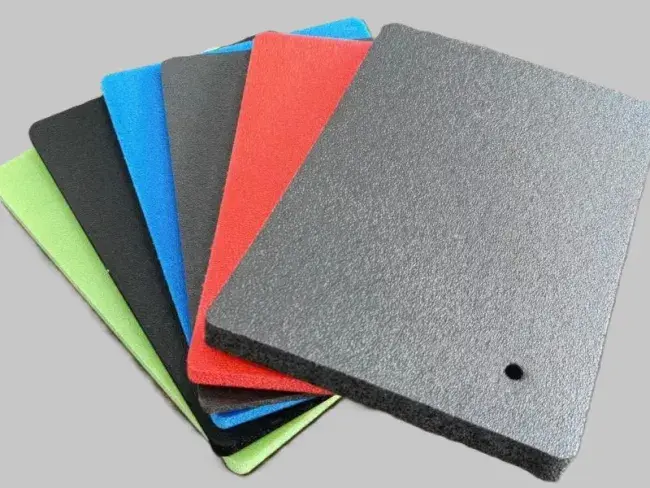
- Cross-linking: chemical (peroxide) cross-linking
- Expansion ratio: 3–40 times
- Density: 26.8–300 kg/m³ (see table below)
- Width: 500–2000 mm
- Thickness: single layer 3–15 mm; heat-bonded multi-layer 15–200 mm
- Surface treatment: calendering or corona treatment available
- Colour: black, white, gray, custom colours
XPE foam (cross-linked polyethylene foam) is a closed-cell foam made by chemically cross-linking polyethylene before it is expanded. The cross-linked network is what separates it from ordinary PE foam: it resists softening when heated and springs back after compression.
Physical properties by expansion ratio
Ratio | Density (kg/m³) | Shore hardness (C) | Tearing strength MD/TD (kN/m) | Water absorption (%) | Thermal conductivity (W/m·K) |
|---|---|---|---|---|---|
3x | 300±40 | 65–75 | ≥14 / ≥12 | ≤0.2 | ≤0.095 |
5x | 200±30 | 60–70 | ≥13 / ≥12 | ≤0.2 | ≤0.095 |
8x | 125±15 | 50–60 | ≥9.5 / ≥9.0 | ≤0.2 | ≤0.084 |
10x | 100±10 | 45–50 | ≥6.5 / ≥6.0 | ≤0.2 | ≤0.073 |
15x | 66.7±8 | 35–45 | ≥5.0 / ≥4.5 | ≤0.3 | ≤0.065 |
20x | 50±6 | 30–35 | ≥3.0 / ≥2.5 | ≤0.3 | ≤0.055 |
25x | 40±4 | 25–30 | ≥2.5 / ≥2.0 | ≤0.4 | ≤0.049 |
30x | 33.3±3 | 18–25 | ≥1.5 / ≥1.2 | ≤0.4 | ≤0.045 |
35x | 28.6±2 | 13–18 | ≥1.3 / ≥1.2 | ≤0.4 | ≤0.040 |
40x | 26.8±3 | 13–18 | ≥1.3 / ≥1.1 | ≤0.4 | ≤0.040 |
Ratio | Tensile strength MD/TD (MPa) | Elongation at break MD/TD (%) | Compression set (%) 23±2 °C, 22 h | Dimensional change MD/TD (%) 70±2 °C, 22 h |
|---|---|---|---|---|
3x | ≥1.6 / ≥1.4 | ≥170 / ≥150 | ≤2 | ≤6 / ≤4 |
5x | ≥1.5 / ≥1.3 | ≥150 / ≥130 | ≤2 | ≤6 / ≤4 |
8x | ≥1.0 / ≥0.9 | ≥125 / ≥120 | ≤3 | ≤6 / ≤4 |
10x | ≥0.8 / ≥0.7 | ≥120 / ≥110 | ≤5 | ≤6 / ≤4 |
15x | ≥0.6 / ≥0.5 | ≥110 / ≥100 | ≤7 | ≤6 / ≤4 |
20x | ≥0.38 / ≥0.35 | ≥90 / ≥80 | ≤8 | ≤8 / ≤6 |
25x | ≥0.35 / ≥0.3 | ≥90 / ≥80 | ≤10 | ≤8 / ≤6 |
30x | ≥0.25 / ≥0.2 | ≥90 / ≥80 | ≤10 | ≤8 / ≤6 |
35x | ≥0.2 / ≥0.15 | ≥80 / ≥70 | ≤11 | ≤8 / ≤6 |
40x | ≥0.15 / ≥0.12 | ≥80 / ≥70 | ≤11 | ≤8 / ≤6 |
Test standards: density GB/T 6343 · hardness GB/T 2411 · tearing strength GB/T 10808 · tensile strength and elongation GB/T 6344 · water absorption GB/T 1034 (method 4) · thermal conductivity GB/T 10297 · compression set GB/T 6669 · dimensional change GB/T 8811. MD is the machine direction and TD the transverse direction. Compression set at 23±2 °C for 22 hours runs from ≤2% at 3x to ≤11% at 40x; dimensional change at 70±2 °C for 22 hours is within 4% transversely and 6% longitudinally up to 15x, widening to 6% and 8% above that.
Optional functional grades
The standard grades above can be supplied in functional versions for applications that need fire, heat or static control:
- Fire retardant: oxygen index 27, meeting GB 8410 A0 and UL94 V2
- Heat resistant: withstands a 110 °C service environment with shrinkage of 8% or less
- Conductive / anti-static: permanent conductivity — conductive 10³–10⁶ Ω, anti-static 10⁶–10⁹ Ω
Conversion available on these grades: heat lamination of multiple layers up to 200 mm thick, adhesive coating with a solvent adhesive and release liner, die cutting and embossing.
XPE foam is chemically cross-linked polyethylene foam: a closed-cell sheet made with a peroxide cross-linking agent. The cross-links lock the polymer into a three-dimensional network, and that network is what holds the sheet’s dimensions under heat and resists tearing when it is pulled.
Features
- Light weight, high strength
- XPE foam is low in density but still carries high compressive and tear strength.
- That combination suits parts that have to shed weight without losing a defined stiffness.
- Thermal and acoustic insulation
- The closed-cell structure seals the gas into discrete pockets, so heat and sound travel through the polymer itself rather than through open air.
- That is why the sheet is used for building insulation and for automotive sound deadening.
- Water and chemical resistance
- A closed cell gives water no open path, so the sheet keeps its physical properties even after long immersion.
- It also resists most chemicals, which suits packaging and protection in chemical environments.
- Easy to convert
- XPE takes thermoforming, die cutting and CNC contouring, so it can be shaped rather than only supplied as flat sheet.
- The surface is smooth and even, so it bonds and prints without extra preparation.
Application
- Packaging
- Cushioning that protects fragile goods in transit.
- Lining for electronics, glassware and other high-value items.
- Construction
- Wall and roof insulation that lowers a building’s energy demand.
- Underfloor matting that gives a comfortable footing and cuts impact noise.
- Automotive
- Acoustic insulation for interiors, to bring cabin noise down.
- Seat padding, for ride comfort.
- Sports and leisure
- Yoga mats, fitness mats and similar goods, where support and grip both matter.
- Core material for flotation boards and life jackets.
- Healthcare
- Wheelchair cushions and mattresses, where the surface has to be soft but still supporting.
- Base material for disposable surgical drapes and dressing backings.
Why Choose Bofeng Foam as Your XPE Foam Manufacturer?
Bofeng Foam is a direct factory manufacturer of XPE foam in Zhuhai, China, with more than 10 years of foam-industry experience. Buying directly from the factory means strict quality control, custom sizes and competitive pricing without a trading middleman.
- In-house R&D of flame-retardant, high-temperature, permanent anti-static, conductive and open-cell foam series.
- Custom thickness, density, width and colour to your specification.
- OEM / ODM service, including die-cutting, lamination and slitting.
Custom and bespoke XPE foam
Standard rolls and sheets are only part of what leaves the plant. We convert XPE foam to your drawing: die-cutting, CNC routing, lamination to aluminium foil, film, fabric or non-woven, adhesive coating with a release liner, slitting and thermoforming. Prototype parts and repeat production run on the same line, so the part you approve is the part we ship.
When you send an enquiry, the application and the constraint matter more than the material name. Where a standard grade cannot meet the requirement we compound the material — flame-retardant, high-temperature, conductive or anti-static — instead of buying a finished sheet and reselling it.
Industrial and OEM supply
Industrial buyers usually care about the second order more than the first: the same density, the same cell structure and the same dimensions on every repeat. Five production lines in Zhuhai run 5,000 tonnes a year out of a 10,000 m² plant, and conversion sits in the same building. That is what lets a specification hold across orders. We are a factory, not a trading company.
Typical industrial supply forms are rolls for converters, slit rolls for tape makers, sheets for printers and thermoformers, and finished die-cut parts for OEM assembly lines.
How to qualify Bofeng Foam as a supplier
Ask for three things before the first order: a material sample, the specification sheet for the grade you are considering, and the test report for that grade where one exists. We hold ISO 9001 and ISO 14001. If your market requires a particular standard, tell us the standard and the destination market — we will confirm what documentation can travel with the shipment rather than promise a certificate we do not hold.
Ordering: MOQ, lead time and samples
| Item | Standard |
|---|---|
| MOQ | 1,000 m² for standard rolls and sheets; custom parts quoted individually |
| Lead time | 15–20 days from order confirmation |
| Samples | A4 sheet, free of charge, shipping included |
| Supply form | Rolls, sheets, slit rolls, laminated sheet, die-cut and CNC-routed parts |
XPE Foam FAQ
Is XPE foam water-resistant?
Yes. XPE foam has a closed-cell structure, so every air pocket is sealed and the sheet absorbs very little water. It keeps its physical properties even after long exposure to moisture, which is why it is used in flotation equipment, humid environments and outdoor applications.
What thickness, density and width can you produce?
Single-layer XPE foam from 3 mm to 15 mm, and heat-bonded multi-layer sheets up to 200 mm. Foaming times range from 3 to 40 times — the higher the foaming ratio, the lower the density. Widths up to 2000 mm. All values can be customized.
Can XPE foam be cut and laminated?
Yes. XPE foam can be die-cut, thermoformed and laminated with aluminium foil or non-woven fabric. Printing is done downstream by the customer's printer. The surface can be corona-treated to improve adhesion.
What is the difference between XPE and IXPE foam?
Both are cross-linked polyethylene foam. XPE is chemically cross-linked, while IXPE is irradiation (electron-beam) cross-linked. IXPE can be produced much thinner (from 0.1 mm) and has a smoother, more uniform surface, which is why it is preferred for automotive interiors and baby products.
What is your MOQ?
For standard XPE rolls and sheets the minimum order is 1,000 m². Custom sizes, colours and die-cut parts are quoted individually — send the drawing or specification and we will confirm the minimum for that part.
What are your lead times and how is pricing calculated?
Standard lead time is 15–20 days from order confirmation. Price depends on the foam specification and the order volume, so we quote per project rather than publish a fixed figure. Send the material, thickness, density, sheet size and quantity you need, and our engineers will confirm both.