
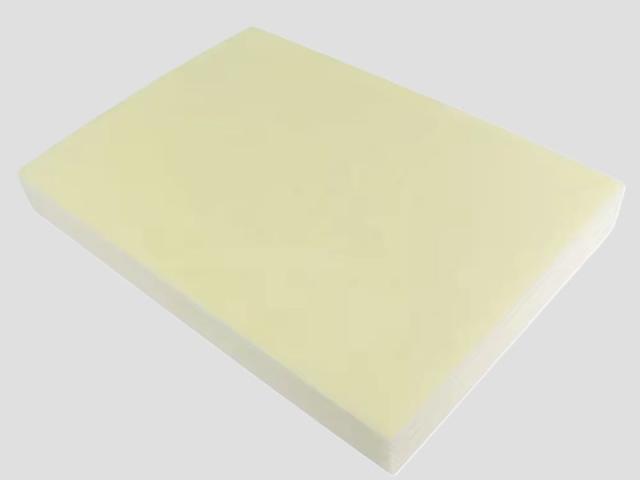
A foam formulation comes down to three things: a base material, a blowing agent, and cross-linking. The base material is the polymer the cell walls are made of, the blowing agent puts gas into it, and cross-linking decides whether the chains are tied together before the material expands. The bubbles themselves weigh almost nothing, so for the same kilogram of polymer the volume you get is set by how much gas the blowing agent releases.
There are also nucleating agents, antioxidants and other additives, but they are supporting players. What decides a foam’s name and what it can do is those three lines.
The three components, and what each decides
| Component | What it is | What it decides |
|---|---|---|
| Base material | A polymer: polyethylene, polypropylene, polyurethane, polystyrene, EVA and others | The strength and chemical nature of the cell walls: temperature tolerance, chemical resistance, hardness |
| Blowing agent | A compound that decomposes on heating to release gas, or a gas dissolved into the melt under pressure | The expansion ratio, and therefore the density — more gas, lighter material |
| Cross-linking | A peroxide-type compound, or no compound at all if an electron beam is used instead | Whether the chains can slide: whether the sheet can be made thin, and whether it can be remelted |
Base material: what the cell walls are made of
The cell walls are the plastic itself, so the foam inherits the properties of its base. Polyethylene is flexible, chemically resistant and does not absorb water. Polypropylene is stiffer and tolerates more heat. Polyurethane spans from very soft to fairly rigid, with a wide density range. Polystyrene is light and stiff and moulds well. EVA is soft with a rubbery feel and thermoforms easily.
The service temperature each base can take is a hard figure that does not move with processing. Heat-resistant grades of polyethylene withstand a 110 °C working environment with shrinkage of 8% or less; polypropylene foam (IXPP) reaches a maximum service temperature of 140 °C.
Blowing agent: where the gas comes from
There are two ways to grow bubbles inside a plastic.
- Dissolve the gas into the melt. Gas is mixed into molten plastic under pressure, and when the pressure is released the gas comes out of solution as bubbles. Physical blowing agents work this way — carbon dioxide, nitrogen and hydrocarbons such as butane are common.
- Let an additive release the gas. A compound that decomposes on heating is mixed in, and it releases gas in place at processing temperature. This is the chemical blowing agent route — azodicarbonamide is the usual choice for polyolefin foam.
Both routes arrive at the same place: gas nucleates and grows inside the plastic and is finally sealed in by the cell walls as they set. The expansion ratio is simply how many times the original volume was stretched, and density and ratio are two ways of writing one number — the more it is stretched, the lower the density.
Cross-linking: why it is not optional
The extruder melts the polyethylene, mixes it, and releases the pressure at the die, and the gas expands the polymer into cells. If the chains can still slide past one another, the cell walls are drawn thinner and thinner as the gas expands, and once density is pushed low enough the cells merge or collapse.
Cross-linking prevents that. It ties the chains into a three-dimensional network before expansion, the network holds the cell walls, and the material can keep complete, uniform cells at lower density. XPE uses peroxide chemical cross-linking; IXPE and IXPP use no cross-linking agent at all and go through electron-beam irradiation instead, where high-energy electrons join the chains directly. The two routes on the line are compared in how XPE foam is made.
Same polyethylene, three materials
All three are polyethylene. What changes is whether the chains were tied before expansion, and by what.
| PE foam (uncross-linked) | XPE | IXPE | |
|---|---|---|---|
| Cross-linking agent | None | Peroxide | None; electron beam instead |
| Cells | Coarser, thicker walls | Fine and uniform | Finest |
| Thinnest single layer | Set by the extrusion line | 3 mm | 0.1 mm |
| Melt recyclable | Yes | No | No |
Which of the three to use is decided by the part rather than by the material; the trade-offs are set out in PE foam and the cross-linked grades.
Common questions
Is there air inside foam?
At the moment of forming, the cells hold the gas the blowing agent released, and the walls seal it in as the material cools. Over the long term small gas molecules diffuse slowly through the walls and exchange with the surrounding air, so eventually the cells are mostly air. In a closed-cell structure this happens very slowly, which is why the foam keeps its low thermal conductivity for years — and it is the premise of closed-cell foam being used for insulation. See the types of foam material.
What happens without a cross-linking agent?
The chains can still slide, the cell walls are continuously drawn thinner as the gas expands, and once density is pushed down the cells merge or collapse. The result is coarser cells, a sheet that cannot be made thin, and low-density grades that will not hold up under sustained compression. What you get in exchange is remeltability: uncross-linked PE foam can go back into a melt stream, cross-linked foam cannot.
Are expansion ratio and density the same thing?
They are two ways of writing one number. The ratio is how many times the volume was stretched; the density is the weight per unit volume. Our XPE at 3× corresponds to an apparent density of 300±40 kg/m³, and at 40× to 26.8±3 kg/m³. Choosing a density is choosing a ratio, and the criterion is the load and compression requirement — see high-density XPE foam.
Can foam be made more heat resistant than solid plastic?
No. Foam inherits the temperature tolerance of its base; bubbles do not raise it, and because the cell walls are thin it is in fact more prone to shrinkage under sustained heat. The heat-resistant grade of polyethylene foam is a 110 °C working environment with shrinkage of 8% or less. To hold dimensions at higher temperature the base has to change — IXPP reaches 140 °C. Above that it is no longer a foam application.
What Bofeng Foam supplies
Bofeng Foam is a manufacturer of cross-linked polyolefin foam, with a 10,000 m² plant, five production lines and 5,000 tonnes of annual capacity in Zhuhai, Guangdong. Our formulation is the “polyethylene or polypropylene plus cross-linking” branch: XPE (peroxide chemical cross-linking), and IXPE and IXPP (electron-beam cross-linking), expansion ratio 3× to 40× (5× to 25× for IXPP). Thinnest single layer: IXPE 0.1 mm, XPE 3 mm. Width 500–2000 mm; multi-layer heat lamination to 200 mm for XPE and IXPE, 100 mm for IXPP.
See the cross-linked foam range · Send an application and we will point to a base material
See also the types of foam material, PE foam, foamed material, foamed plastic, how XPE foam is made and what XPE foam is.