
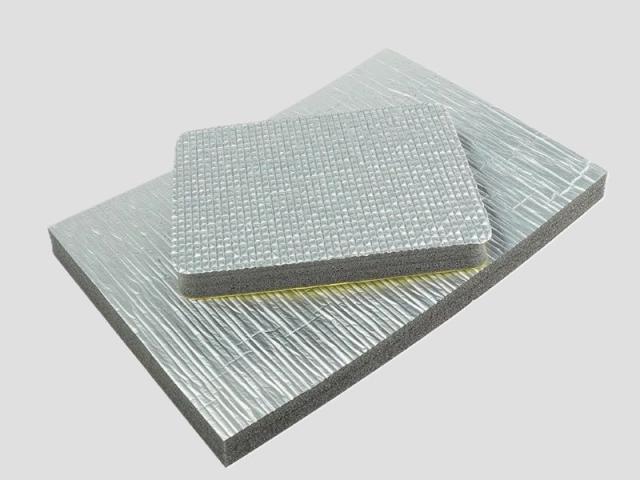
XPE foam insulates because of its cell structure rather than because of any additive. The closed cells trap gas in place, the polymer cell walls conduct heat slowly, and the result is a low thermal conductivity that holds up across the whole range of expansion ratios. It also means one sheet does two jobs: the same layer that slows heat flow is also a vapour barrier, so an insulation layer and a moisture-control layer can be a single product.
XPE foam insulation features
- Low thermal conductivity. Thermal conductivity measures how much heat passes through a material, and the lower the value the better the insulation. XPE foam runs from 0.095 W/(m·K) at 3× expansion down to ≤0.040 W/(m·K) at 40× (GB/T 10297): the higher the expansion ratio, the more gas and the less polymer sits in the heat path, so the lower the conductivity.
- Closed-cell structure. Every cell is sealed, so the gas inside it cannot circulate and water has no open path through the sheet. That is what makes one sheet both an insulator and a moisture barrier, and why the thermal performance does not collapse once the foam gets wet. Because gas and water cannot move from cell to cell, the sheet also returns to its own thickness after repeated compression instead of flattening.
- Light and strong. XPE foam is low in density but keeps useful compressive and tear strength, so a thin sheet does the work of a much heavier board. That matters on vehicles, and anywhere the weight of the insulation itself counts against the payload.
- Temperature range. The standard grades keep their properties through ordinary service conditions without embrittling or softening. Where service temperature is the binding constraint, heat-resistant functional grades are rated for a 110 °C environment with shrinkage of 8% or less.
Thermal conductivity by expansion ratio
| Expansion ratio | Apparent density (kg/m³) | Thermal conductivity (W/(m·K)) |
|---|---|---|
| 3× | 300 ± 40 | 0.095 |
| 10× | 100 ± 10 | ≤0.073 |
| 20× | 50 ± 6 | 0.055 |
| 30× | 33.3 ± 3 | ≤0.045 |
| 40× | 26.8 ± 3 | ≤0.040 |
Values are measured to GB/T 10297 for thermal conductivity and GB/T 6343 for density. Intermediate ratios are available across the full 3× to 40× range.
XPE foam insulation applications
- Construction. Wall and roof insulation, underfloor layers, and the backing in laminate and engineered flooring, where the sheet cuts heat loss and deadens impact noise.
- Automotive. Interior sound and heat insulation pads under the carpet, inside the doors and behind the trim.
- Packaging. Protective packaging that cushions fragile items and, in cold-chain use, slows the temperature change during transit.
- Sports and leisure. Yoga mats, exercise tiles and buoyancy products, where the same foam supplies softness and warmth underfoot.
- Other uses. Greenhouse covering and thermal liners, and padding in medical and rehabilitation equipment.
Specifying wall insulation foam
This guide explains how XPE foam insulates. For wall insulation product specifications — thickness, density, foil backing and custom sizes — see our Wall insulation foam product page.