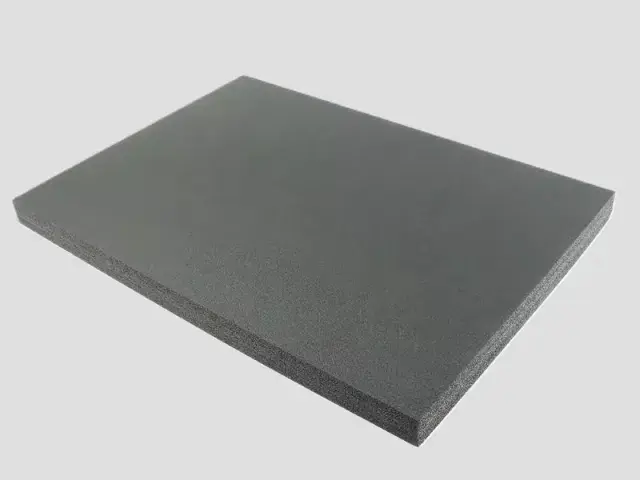
- Material: XPE foam, IXPE foam
- Expansion ratio: 15 times (66.7±8 kg/m³), 20 times (50±6 kg/m³)
- Thickness: 3 mm, 4 mm, 5 mm (thickness can be customized)
- Width: 1 m, 1.2 m, 1.5 m (width can be customized)
- Colour: black, white, gray (colour can be customized)
Customization
Made to order: density, thickness, colour and shape to your drawing. Die-cutting, CNC routing, lamination to film or fabric, slitting and adhesive coating all run in-house, so the part we quote is a finished part, not just a sheet. How a custom part is cut and routed explains what to send with the drawing.
Regular material: MOQ 1,000 m², lead time 15–20 days from order confirmation. Custom parts are quoted from the drawing. A4 samples are free, shipping included.
An insole has to do three things at once: absorb the impact of every step, return to shape afterwards, and stay thin enough to fit inside the shoe. Bofeng supplies XPE and IXPE foam sheet for insole manufacturers, in the 3–5 mm range and the higher densities that hold up under repeated loading rather than flattening out after a few weeks of wear.
Features
- High resilience – recovers quickly after compression, so the cushioning does not fade over the life of the shoe.
- Shock absorption – takes the ground reaction force before it reaches the knee and ankle.
- Light weight – provides support without adding weight to the finished shoe.
- Consistent sheet – even density and thickness across the sheet, so die-cut insoles match from pair to pair.
- Cut and mould friendly – die-cuts, laminates and thermoforms into shaped footbeds.
- Density and colour options – 15× (66.7±8 kg/m³) and 20× (50±6 kg/m³) grades in black, white or gray.
Applications
- Performance footwear – running, basketball and football insoles built for repeated impact.
- Casual and everyday shoes – comfort layers for standing and walking.
- Orthotic and rehab – foam layers used in custom and corrective footbeds.
- Children's footwear – cushioning layers sized for growing feet.
- Work and safety boots – insoles for long shifts on hard floors.
Specifications for athletic insole foam
An insole has to be thin, take a repeated point load and stay flat inside a shoe.
| Foam | Expansion | Apparent density | Single-layer thickness | Why this grade |
|---|---|---|---|---|
| IXPE | 15–20× | 40–66.7 kg/m³ | 0.1–15 mm | The fine-cell end of the range: single layers down to 0.1 mm, which is what an insole needs, with a uniform surface a shoe upper will not feel through. |
| XPE | 15–20× | 40–66.7 kg/m³ | 3–15 mm | Firmer midsole grade where the insole also has to support the arch. |
Base material specifications are on the XPE, IXPE and IXPP material pages; finished products are on the XPE foam and IXPE foam pages. Tell us the load, the space available and the service temperature and we will confirm the grade against your drawing.
Why Choose Bofeng Foam
- 15× (66.7±8 kg/m³) and 20× (50±6 kg/m³) grades.
- 3 / 4 / 5 mm thickness as standard, other gauges on request.
- Sheet widths of 1 m, 1.2 m and 1.5 m.
- Black, white and gray as standard, further colours on request.
- Samples and specification sheets available before production.
The four numbers on a foam data sheet — density, hardness, compression set and resilience — and what each one answers, are set out in our density and hardness guide.
Insole Foam: Approve the Layer Inside the Actual Shoe
Balance Space and Compression
Provide the shoe or insole construction, available space and the intended support locations. A thicker or softer layer can change fit and pressure distribution. Evaluate the complete insole in the actual shoe rather than comparing free sheet samples only. A material grade does not establish a medical, orthopaedic or injury-prevention benefit.
Separate Recovery From Wear Life
Compare grade-specific compression-set values under the same test conditions, then agree the relevant repeated-use assessment. The laboratory value does not predict the number of steps, months of wear or a permanent support shape. Inspect the bonded construction and the areas receiving concentrated contact after the agreed evaluation.
Define the Textile and Moisture Route
Closed-cell foam does not by itself provide through-sheet breathability. Identify the contact textile, perforations, channels or other design features if moisture and comfort are requirements. Low material water uptake does not demonstrate odour control or antimicrobial performance. Request specific evidence for any such claim rather than assuming it follows from a foam family.
Keep the Converting Details
Specify the contour, thickness, facing, adhesive and orientation. Check trimmed edges and any perforated features on a complete sample. Retain the approved construction and measurement method so later deliveries can be compared meaningfully. Send the intended shoe application and the functional requirements with the drawing.
For sample identity, dimensions and the acceptance record, use the first-article review checklist with the application-specific checks above.
Building an insole specification around the shoe
Define the installed volume
An insole is evaluated inside a shoe. Supply the intended shoe type, last or cavity information and an example of the existing insert where available. Show the outline and any zones with different thicknesses, rather than describing the whole piece with a single nominal thickness. Identify whether the foam is a removable insole, a layer within a built up insole or a component bonded to another material. These details determine what the first article must reproduce.
Check that the proposed insert leaves the intended space for the foot and the closure. An insert that feels comfortable when held in the hand may change the fit of the shoe after installation. Review the heel position, forefoot space and any interference at the sides with the footwear developer. These are design observations, not evidence of an orthopaedic effect or a claim to treat pain.
Separate geometry from material feel
Compare samples using the same shoe and the same agreed fitting procedure. If the outline or thickness changes between samples, record that change alongside the foam grade; otherwise the team may attribute a fit difference entirely to hardness. Note where the insert is unsupported, where its edge meets the lining and whether the cover creates a raised seam. A local geometry correction can be more relevant than changing the grade across the whole insole.
Where the design has a cover fabric, backing or adhesive, evaluate those layers together. Identify the side facing the foot and the side facing the shoe, especially when the two surfaces look similar. If the insert must be removed for drying or cleaning, check that it can be refitted without folding or reversing it. Do not assume a bonding process or a care instruction remains valid after a cover material is changed.
Approve use and care claims separately
Ask the footwear owner to define the wear evaluation and the conditions it is intended to represent. Record fit observations, visible changes, layer attachment and user feedback as separate parts of the sample review. A short wearing trial cannot establish a general service life. Foam recovery data also cannot demonstrate a medical benefit, prevention of injury or suitability for every wearer. Any such product claim needs its own relevant evidence.
For production, retain the size mapping, cutting drawing, foam grade and complete layer description with the approved sample. If one insole design is scaled across a range, identify which sizes were physically checked. Record whether a reorder is an exact repeat or an altered construction. This allows the buyer to discuss the actual fit and manufacturing issue without relying on broad terms such as premium cushioning or all day comfort.
If the insole is supplied as a trim to fit article, provide the proposed trimming guides and instructions for review. Check the result in the intended shoe range, including whether the cut edge affects positioning or the covering. Approval of the untrimmed blank does not automatically approve every user modified outline. Keep the scope of the intended fitting method with the product specification and avoid presenting it as a universal fit for all footwear. Mark the intended trim lines on the approved sample.
Conclusion & Inquiry
Automotive foam gathers the related cushioning, sealing and NVH applications in this range, and luggage liner foam uses the same material for bag construction. Contact us with your insole spec and we will quote sheet or die-cut supply.