
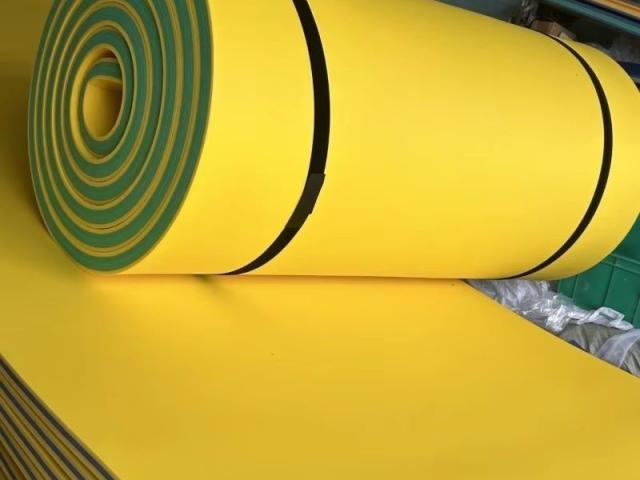
Flotation foam works on a simple principle: a closed-cell foam is mostly gas trapped in sealed pockets, so it displaces more water than it weighs and floats. The engineering question is not whether it floats on day one — it is whether it still floats after a season in the water.
Why Closed-Cell Foam Floats
A foam's buoyancy comes from the volume of gas sealed inside it. In a closed-cell foam every cell is a sealed pocket, so the gas stays where it is and the material keeps its density. In an open-cell foam the cells are connected and water can displace the air — the foam gains weight, loses buoyancy and eventually sinks.
Density and Buoyancy
Buoyancy is the difference between the weight of water displaced and the weight of the foam itself. Because water is far denser than any of these foams, the reserve is large: the lower the foam density, the more buoyancy a given volume provides, but the softer and more compressible the foam becomes.
Bofeng Foam produces XPE and IXPE from 3x to 40x expansion, giving apparent densities from 26.8 to 300 kg/m³. The low-density end — the 25x to 40x range, roughly 26.8 to 40 kg/m³ — is where flotation boards and pool floats sit. Higher densities are used where the part also has to carry a structural load or hold a shape.
How Much Lift One Cubic Metre Gives
A flotation part works by displacing water. Fresh water weighs 1,000 kg per cubic metre, so a cubic metre of foam that is fully submerged returns the weight of the water it pushes aside, less its own weight. That difference is the number a part has to be sized against, and across the grade range it moves far less than most buyers expect.
| Expansion ratio | Apparent density (kg/m³) | Lift per m³ (kg) |
|---|---|---|
| 25x | 40 | 960 |
| 30x | 33.3 | 967 |
| 35x | 28.6 | 971 |
| 40x | 26.8 | 973 |
The spread from 25x to 40x is about 13 kg per cubic metre — roughly 1.4% more lift from the lightest grade. Over the same range Shore hardness falls from 25–30 to 13–18. Where the part also has to hold a shape, carry a load or take a fixing, that stiffness is usually worth more than 13 kg, and the firmer grade is the better specification.
Thickness moves the answer far more than density does. Ten millimetres of foam displaces ten litres per square metre, which is just under 10 kg of lift; doubling the thickness doubles it. Choosing the lightest grade instead adds a fraction of a kilogram.
Water Absorption Is What Decides Long-Term Performance
| Property | XPE | IXPE |
|---|---|---|
| Expansion ratio | 3–40x | 3–40x |
| Apparent density (GB/T 6343) | 26.8–300 kg/m³ | 26.8–300 kg/m³ |
| Water absorption (GB/T 1034) | 0.4% or lower | 0.4% or lower |
| Chemical resistance | Water and moisture | Water, seawater, oils, acids and alkalis |
| Single-layer thickness | 3–15 mm | 0.1–15 mm |
| Laminated build | 15–200 mm | 15–200 mm |
A water absorption of 0.4% or lower is what keeps buoyancy stable. A material that took up several percent of its weight in water would lose a corresponding share of its reserve, and the loss would grow with every season in the water.
For salt water, IXPE is the better-specified grade: our factory data lists resistance to seawater, oils, acids and alkalis.
Water Absorption Rises as Density Falls
The grade that floats best is also the grade that takes up the most water. Absorption is measured by GB/T 1034 method 4 at 23 °C over 22 hours, and the limit is set per expansion ratio rather than for the material as a whole.
| Expansion ratio | XPE | IXPE |
|---|---|---|
| 3x–10x | 0.2% or lower | 0.2% or lower |
| 15x | 0.3% or lower | 0.2% or lower |
| 20x | 0.3% or lower | 0.3% or lower |
| 25x | 0.4% or lower | 0.3% or lower |
| 30x–40x | 0.4% or lower | 0.4% or lower |
Put that in the units that matter. At 26.8 kg/m³, 0.4% of the foam's own weight is about 0.11 kg of water per cubic metre, against a reserve of roughly 973 kg. Even if the whole allowance were taken up, the lift would change in the second decimal place. Absorption at this level is not what sinks a flotation part.
What does change the answer is where the water goes. A cut edge, a bonded seam, an adhesive film or an open-cell backing can each hold far more water than the foam body does, and those are the places to look when a part gains weight in service. Where the part is laminated, specify a closed-cell facing and seal the edges, then test the finished assembly rather than the sheet.
Building Thicker Flotation Parts
Single layers of XPE run 3 to 15 mm and IXPE from 0.1 to 15 mm. Thicker parts — flotation boards, thick cushions — are built by thermally bonding several layers, up to 200 mm in XPE and 100 mm in the functional grades. Foam can also be embossed for grip or laminated with a fabric facing.
Buoyancy Foam in Boats and Floating Structures
Most foam sold for buoyancy never sits in open water — it sits inside something. In a small boat it fills the under-deck cavity or a sealed seat box. On a pontoon or a floating dock it is the core of a panel. In a kayak or a paddleboard it is the core that keeps the board on the surface when nobody is standing on it.
Being enclosed changes two things. The foam is cut to the cavity rather than to a shape of its own, so the part is routed or die-cut instead of moulded, and the drawing is the cavity, not the product. And it has to tolerate the water that does reach it — bilge water, splash and condensation — which is why a closed-cell grade and a sealed edge matter here more than the last few kilograms of theoretical lift.
How much flotation a vessel must carry, where it goes and how it is verified is set by the builder and by the rules of the market the vessel is sold in. We supply the foam to the density, thickness and cut shape that builder specifies. We do not rate, test or certify the vessel.
Where the Material Stops
Bofeng Foam supplies foam as a buoyancy material. We do not manufacture, rate or certify finished lifejackets, personal flotation devices or other safety equipment.
Buoyancy rating, performance testing, certification and marking of a finished flotation device are the responsibility of the manufacturer of that device, under the rules of the market it is sold in. We supply the foam to the density, thickness and shape that device manufacturer specifies, and we make no claim about the performance of a finished device.
Discuss a flotation foam requirement →
Flotation Foam FAQ
What foam is used for flotation?
Closed-cell polyethylene foam — XPE for flotation boards and pool floats, IXPE where a thinner or denser layer is needed. The sealed cells trap gas, which is what produces buoyancy and keeps it stable in water.
Does flotation foam lose buoyancy over time?
Only if it takes on water. Our XPE and IXPE absorb 0.4% or lower by weight to GB/T 1034, so the reserve stays essentially unchanged in service. An open-cell foam would gain weight and lose buoyancy.
Can Bofeng Foam certify a lifejacket or flotation device?
No. We supply the foam as a buoyancy material only. Rating, testing, certification and marking of a finished flotation device belong to the device manufacturer.
How thick should buoyancy foam be?
Thickness follows from the lift required. Ten millimetres gives just under 10 kg per square metre, and lift scales linearly with thickness, so divide the load the part has to hold by the lift per square metre at the grade you intend. If the result is more than 15 mm — the single-layer ceiling for XPE and IXPE — the part is built by thermally bonding layers, up to 200 mm.
What grade is used for pool floats and swim floats?
The low-density end, 25x to 40x, or about 26.8 to 40 kg/m³, because that is where the lift per cubic metre is highest. Within that band the choice is usually decided by feel and stiffness rather than by buoyancy: the lift difference across the whole band is about 13 kg per cubic metre.
Is buoyant foam the same as flotation foam?
Yes. Buoyancy foam, buoyant foam and flotation foam describe one material doing one job: a closed-cell foam whose sealed cells give it a reserve of lift. The terms come from the application, not from a difference in the polymer.
Related Reading
See also: Marine & outdoor foam hub · Is XPE foam waterproof? · All cross-linked foam materials · Contact Bofeng Foam