
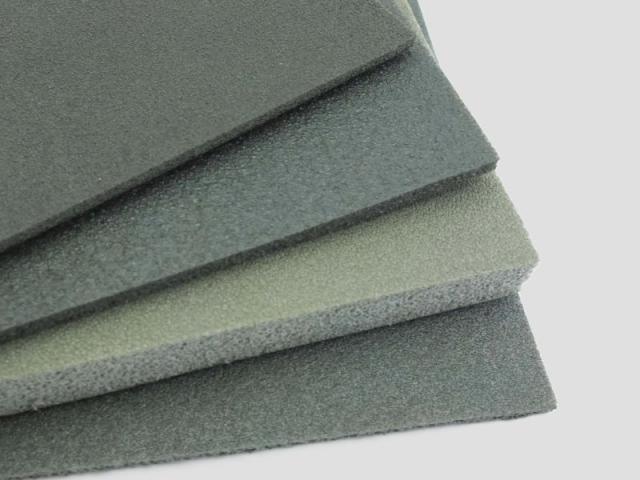
High-density XPE foam is not a different material. It is XPE expanded at a low ratio. Density and expansion ratio are two ways of writing one number: expanded 3× the polymer lands near 300 kg/m³, expanded 40× the same formulation lands near 26.8 kg/m³. High density means more polymer and less gas in the same volume.
What density buys: the low-ratio end of the table
Measured values for our XPE at the low expansion ratios. Read down a column and it is a stiffness scale.
| Test item | 3× | 5× | 8× | 10× |
|---|---|---|---|---|
| Apparent density (kg/m³) | 300±40 | 200±30 | 125±15 | 100±10 |
| Shore hardness (°) | 65–75 | 60–70 | 50–60 | 45–50 |
| Tear strength, cross / machine (kN/m) | ≥12 / ≥14 | ≥12 / ≥13 | ≥9.0 / ≥9.5 | ≥6.0 / ≥6.5 |
| Tensile strength, cross / machine (MPa) | ≥1.4 / ≥1.6 | ≥1.3 / ≥1.5 | ≥0.9 / ≥1.0 | ≥0.7 / ≥0.8 |
| Compression set (23±2 °C, 22 h) | ≤2% | ≤2% | ≤3% | ≤5% |
| Thermal conductivity (W/(m·K)) | ≤0.095 | ≤0.095 | ≤0.084 | ≤0.073 |
| Water absorption (23±2 °C, 22 h) | ≤0.2% | ≤0.2% | ≤0.2% | ≤0.2% |
Read in one direction and density is hardness. The 3× grade is hard and gives up almost no thickness under load; by 10× the same panel carries only a third of the polymer, and it feels like a soft pad.
Compression set: the row to look at under sustained load
Of the rows above, compression set matters most for a part that will carry a load for years. At 3× and 5× the permanent deformation after 22 hours at 23±2 °C is ≤2% — pressed and released, almost all of it comes back.
For a pad under a heavy object that never moves, this row decides whether the part is still in place in several years’ time more than hardness does. A grade that feels firm on the day of delivery and packs down to half its thickness is worse than a grade that felt slightly softer and stayed.
Five places where high density is the right answer
- Repeated point loads. Gym flooring, toolbox liners, underlayment under heavy furniture — the same spot is loaded every day. The dense grades hold their thickness, so the surface above them stays flat.
- Narrow edges and thin bridges. The narrow links in a die-cut part depend on tear strength: 3× to 8× sits at 12 kN/m and above, while 10× is down to 6 kN/m.
- Fasteners and inserts. A screw driven into low-density foam tears out; in a dense grade it bites.
- Machined edges. Denser foam cuts crisper and holds an edge, which matters when the part has to fit inside a housing.
- Thermoformed parts that must hold shape. High-density sheet can be heated and pressed to a form and keeps it after cooling.
The cost of density, and the opposite mistake
Density is bought with weight and material. In the same panel, the 10× grade carries a third of the polymer of the 3× grade, and weight and material cost fall with it. So most designs specify the lightest grade that passes the load test, not the densest one available.
The mirror mistake is pushing high density into places that need softness. Seat pads, yoga mats and thin liners want rebound and conformity; raising the density makes them heavier and harder, which is the wrong direction. Why some parts deliberately avoid the dense end is set out in hardware packaging inserts.
Common questions
What ratio counts as high density?
There is no universal line; it depends what you compare against. Our XPE covers 3× to 40×, apparent density 26.8–300 kg/m³. Against the 25–40× end used for thin packaging liners and floor mats (about 26.8–40 kg/m³), 3× to 10× is the high-density end.
Is higher density always better?
No. Density buys hardness, tear strength and compression resistance, and costs weight, money and feel. Positions that carry load and take fasteners want high density; positions that must be soft, conformable and light want the opposite.
How is high-density XPE processed?
The same as any XPE: die-cutting, routing, heat bonding, lamination to foil or non-woven, and adhesive backing can all be done in our plant. Denser foam cuts more cleanly and narrow edges resist tearing better.
What is the difference from ordinary XPE?
Two density ends of one material family, not two materials. The cross-linking route, the closed-cell structure and the water absorption are unchanged; what changes is how much polymer is in a given volume, and with it hardness, tear strength and how well the part holds its thickness under load.
Can it be made thicker than 15 mm?
Only by heat lamination. Single-layer XPE runs 3–15 mm; above that, layers are bonded to a maximum of 200 mm, and the bond lines are part of what has to be qualified.
What Bofeng Foam supplies
Bofeng Foam is a manufacturer of cross-linked polyolefin foam, with a 10,000 m² plant, five production lines and 5,000 tonnes of annual capacity in Zhuhai, Guangdong. XPE covers 3× to 40×, and in the high-density range thickness, width, colour and facing can be made to order. Width 500–2000 mm, single layer 3–15 mm, multi-layer heat lamination to 200 mm.
See the full XPE performance table · Ask for a recommendation
See also how to choose XPE density, XPE foam sheet, XPE foam roll, what XPE foam is, choosing density and thickness together and hardware packaging inserts.