
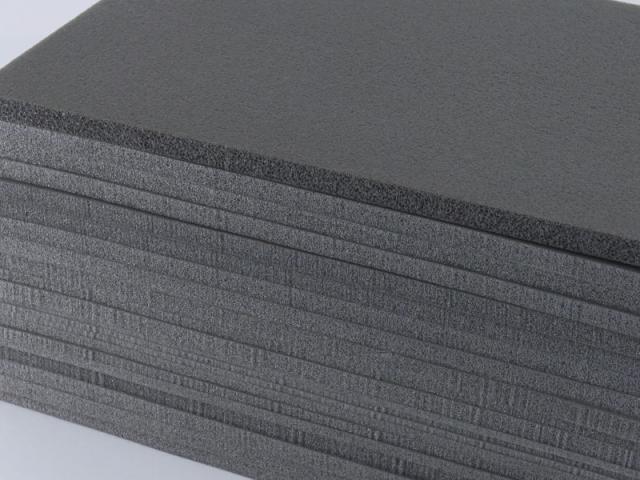
Density and thickness are not two options to be picked separately. Their product sets how much material each square metre uses, but the feel, the recovery and the insulation each of them controls do not follow that product. At the same area weight, thin-and-dense and thick-and-open are two different roads, and which one is right is decided by the available space, the loading and the long-term compression.
This page is about fixing the two numbers together. The ten density grades and how to write a density line are in how to choose XPE density; how specific applications land is on each application page.
Separate the three quantities first
On the desk, three things often get said as one sentence — “we want something firmer”. Taken apart, they are three quantities:
- Density (kg/m³) — weight per unit volume. Our XPE is supplied in ten grades defined by expansion ratio: discrete points, not a continuum.
- Thickness (mm) — the actual single-layer gauge. It is bounded by process limits at both ends, not free to be any number.
- Area weight (kg/m²) — density times thickness. This is how much material each square metre uses, and it is where both weight and material cost live.
The first two are inputs; the third is calculated. Many arguments are really about the third while being conducted in terms of the first two.
Area weight: the only quantity this page can calculate
The arithmetic is one multiplication: density (kg/m³) × thickness (mm) ÷ 1000 = area weight (kg/m²).
A 100 kg/m³ sheet at 10 mm gives 1.0 kg/m²; a 50 kg/m³ sheet at 20 mm gives the same 1.0 kg/m². Identical weight of material, and two entirely different products.
Precisely because it is the only thing that can be calculated, it is the easiest to mistake for the only thing that matters. Weight budgets, material cost and freight can all be worked out from it; load bearing, recovery and insulation cannot.
There is a subtler miscalculation: comparing two foams of different density “at the same thickness” and concluding that the heavier one is firmer. The density is doing the work, not the thickness. Conversely, comparing two foams of different thickness “at the same density” scales the weight difference in proportion to thickness and says nothing about feel. Establish which quantity you have fixed before comparing.
The same 1.0 kg/m², five ways
Pair each of five XPE density grades with a thickness so that all five reach a nominal area weight of 1.0 kg/m². Density, hardness, compression set and conductivity come from our technical data (GB/T 6343, GB/T 2411, GB/T 6669, GB/T 10297); the last column applies the process limits (single layer 3–15 mm, heat laminated above 15 mm).
| Density grade (kg/m³) | Thickness (mm) | Area weight | Shore hardness (°) | Compression set | Conductivity (W/m·K) | Single layer? |
|---|---|---|---|---|---|---|
| 100±10 | 10 | 1.0 | 45–50 | ≤5% | ≤0.073 | Yes |
| 66.7±8 | 15 | 1.0 | 35–45 | ≤7% | ≤0.065 | Yes, at the limit |
| 50±6 | 20 | 1.0 | 30–35 | ≤8% | ≤0.055 | Needs heat lamination |
| 40±4 | 25 | 1.0 | 25–30 | ≤10% | ≤0.049 | Needs heat lamination |
| 33.3±3 | 30 | 1.0 | 18–25 | ≤10% | ≤0.045 | Needs heat lamination |
Read down the table and four things happen at once. Hardness falls from 45–50° to 18–25°; the compression-set ceiling widens from ≤5% to ≤10%; conductivity falls from ≤0.073 to ≤0.045 — in our table the lower-density grade insulates better per millimetre; and the moment thickness passes 15 mm it must be heat laminated, adding a process step and a bond layer.
Read upwards instead and the trade is the mirror image: to get firmer and better recovering, move to higher density, but at fixed area weight the thickness can only fall, until it hits the single-layer floor.
Three hard constraints on the thickness side
Thickness is not a continuously adjustable knob. Our process limits cut it into three ranges:
- XPE single layer 3–15 mm. Below 3 mm, XPE cannot be supplied as a single layer.
- IXPE single layer 0.1–15 mm. If you need under 3 mm, the material changes to IXPE — which is a different table.
- 15–200 mm is heat lamination. Above 15 mm, any material is a stack of layers, not one block.
- Compression stroke. The thinner piece has less absolute travel to begin with, so at the same percentage deflection it has a shorter stroke and bottoms out sooner.
- Feel. Set by the density grade. In the table above, 100 and 33.3 are more than two grades apart and do not meet just because the area weight matches.
- Recovery. Lower-density grades have higher compression set (≤10% against ≤5%), so a location under sustained load gets thinner over time.
- Insulation. Lower-density grades have lower conductivity (≤0.045 against ≤0.073), so they insulate better at the same thickness.
- Space is fixed. The gap is 5 mm, so thickness has no freedom. Pin thickness at 5 mm and then choose among the density grades that can be made at that gauge: higher for support, lower for conformability. Do not fix density first and then demand a thickness that cannot be produced.
- Weight is fixed. There is a gram-per-square-metre ceiling, so the constraint is the product: density × thickness ≤ ceiling. To go thicker you can only lower density; to go denser you can only thin down. If both hit their limits, the budget cannot produce the combination — change the structure, do not fudge the numbers.
- Feel or support is fixed. Choose density from the hardness column first, then set thickness from the compression stroke you need. This is the most direct route and the one most often dropped at quoting time, because hardness is something you learn by hand and a caliper cannot measure it.
- Insulation is fixed. In our table conductivity falls as expansion rises, so the lower-density grade insulates better per millimetre. For thermal resistance, consider thicker and lower density first — but lower-density grades have higher compression set, so a location under sustained load cannot be chosen on that column alone and has to go back to the recovery column.
- “Thicker is always softer.” Adding thickness at the same density actually gives more support: the compression stroke is longer and it bottoms out less easily. To make it softer, change the density first, not the thickness.
- “Thinner is always firmer.” Thinning only shortens the available stroke; at the same deflection the force required does not rise. To make it firmer, again change the density.
- “Raising both is the safe option.” Area weight is a product, so raising both makes weight climb quickly. What hits the wall first is usually assembly space and budget, not performance.
- “Thickness verifies density.” A caliper measures thickness and cannot measure density. Density has to be weighed against volume, as part of incoming inspection.
- Measure the space — what is the maximum usable thickness, and does it fall in the single-layer or the laminated range?
- Fix the weight — convert the gram-per-square-metre budget into area weight, giving a ceiling on density × thickness.
- Fix the feel — choose a hardness band from the application, and land on a specific density grade.
- Check the recovery — for anything under sustained load, check compression set, and move up a density grade if necessary.
- Sample — all of the above is paper arithmetic; compression behaviour has to be confirmed on the real part shape and contact area.
- No equivalence table. There is no table that says “10 mm of 100 kg/m³ equals 20 mm of 50 kg/m³”. XPE has no usable compression-strength data, and compression behaviour also depends on part shape and contact area.
- No load capacity per part. The same sheet, laid flat or bridging a gap, loaded over its whole face or at a point, gives completely different results — not something a material specification can promise.
- No borrowing hardness from thick to thin. Hardness below 3 mm is a different row of numbers, and the IXPE 3× grade is blank.
- No sound insulation figures. Thickness contributes to airborne sound only under further conditions — see acoustic foam.
These change the cost of the “thick and open” road directly: to go thick you also accept the lamination step, the bond layer and a new failure location — the bond layer’s temperature resistance and ageing have to be qualified separately, as described in foam lamination.
More important, these are the boundaries of what can be made, not recommendations. Quote a sub-3 mm part as single-layer XPE and you have quoted something that cannot be produced; quote above 15 mm as one block and what arrives is a stack. A specification that says “20 mm in one piece of XPE” becomes an explanation on the delivery date.
Width, 500–2000 mm, is independent of density and thickness, but it decides whether the die-cutting layout fits, so it belongs in the enquiry too.
Same area weight is not the same performance
This is the most important section on the page. Equal area weight says only that the material quantity is equal. Four things do not become equal with it:
So the sentence “use 20 mm of 50 kg/m³ instead of 10 mm of 100 kg/m³” is only true about weight and material consumption. It also drops hardness a grade, widens compression set a grade, raises insulation per millimetre, and adds a lamination step. Whether those four changes are acceptable has to be checked per location — it cannot be covered by the word “equivalent”.
Take two rows concretely. 100 kg/m³ at 10 mm and 50 kg/m³ at 20 mm both give 1.0 kg/m². The first is 45–50° hardness, ≤5% compression set and ≤0.073 conductivity; the second is 30–35°, ≤8% and ≤0.055, and has already passed the single-layer limit so it must be heat laminated. The same material budget buys three different sets of properties, plus a process step.
Four things that get fixed first, and four ways to proceed
In real selection one requirement is usually fixed before the others. Identify which, and the order of the remaining choices changes.
These four are rarely all true at once. More often a drawing is covered in “cannot change” notes, and asking one by one reveals that one of them actually has slack — the space is not that tight, or the gram budget is wider than assumed. Writing a vague requirement down as a hard constraint is the main reason a sample later does not match.
Four common mis-pairings
An order that works
Steps three and four often pull against each other: softer means lower density, and lower density means worse recovery. There is no general answer to that conflict, only an answer for a specific location.
The numbers we do not give
What this page gives is arithmetic plus four columns from our tables. The following are explicitly not supplied:
Calculate what can be calculated; sample what cannot. Writing the uncalculable part into a table that looks professional is the easiest mistake to make on a page like this.
Common questions
At equal weight, is thin-and-dense or thick-and-open more resistant to compression?
No single answer. The thin piece bottoms out sooner; the thick piece is softer and flattens more easily. Sample on the real part shape and contact area rather than comparing density alone.
Does thickness above 15 mm always require lamination?
Our single-layer ceiling is 15 mm for both XPE and IXPE, and 15–200 mm is heat laminated. A laminated part has a bond layer, which has to be qualified separately for long-term loading or high temperature.
Can density be off the ten grades?
Density follows from expansion ratio, and there are ten points. A figure like 110 kg/m³ on a quotation does not land on a grade.
Lower density insulates better, so should all insulation parts use low density?
Not where they are under sustained load. Lower-density grades have higher compression set, and once packed down their thermal resistance falls too.
How are thickness tolerances specified?
Tolerance conventions and the common mistakes at the thin end are covered on ultra-thin IXPE. This page is about pairing the two numbers, not about tolerances.
What Bofeng Foam supplies
Bofeng Foam produces XPE and IXPE foam in Zhuhai, Guangdong, with a 10,000 m² plant, five production lines and 5,000 tonnes of annual capacity. XPE from 3× to 40×, apparent density 26.8–300 kg/m³, single layer 3–15 mm; IXPE single layer 0.1–15 mm; heat-laminated multi-layer 15–200 mm for both; width 500–2000 mm; die-cut, adhesive backed and laminated to a facing.
A single density is not enough to quote against. Send four things — the application and how it is loaded, the available thickness, the gram-per-square-metre ceiling, and the long-term service temperature — and we will propose a combination in the order above, with samples to confirm feel and recovery.
See the full XPE performance table · Ask for a combination or a sample
See also how to choose XPE density, high-density XPE foam, XPE foam roll, XPE foam sheet, ultra-thin IXPE, foam lamination and all foam materials.