
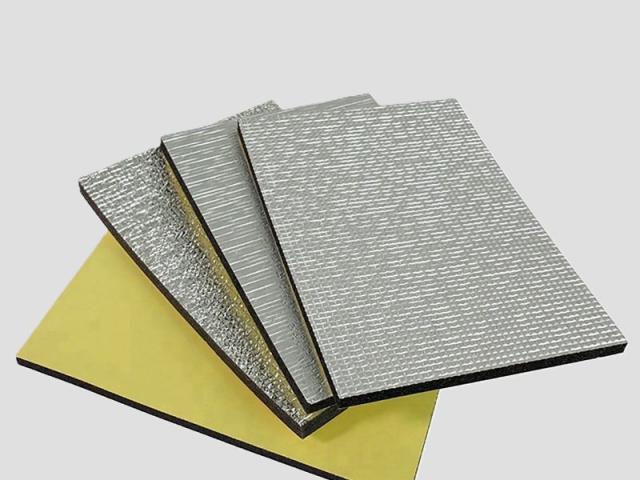
Insulation foam is a cellular material that slows the movement of heat by holding gas inside a solid structure. What it is made of decides everything about how it behaves: how well it insulates, whether it can get wet, whether it can be cut and laminated, and how hot it can run. This article sets out the materials that insulation foam is made from, and where cross-linked polyethylene foam — the material we manufacture — sits among them.
The two families of insulation material
Insulation materials divide into two groups, and the difference between them explains almost everything else.
- Fibrous and mineral materials — glass wool, rock wool, slag wool, ceramic fibre and aluminium silicate fibre. These are spun or drawn from molten mineral and insulate with air held between fibres. They are non-combustible and inexpensive, they handle very high temperatures, and they are the standard choice for building cavities and industrial furnaces. Because they are fibrous they must be kept dry and covered, and they are installed with protection against airborne fibre.
- Cellular plastics — polyurethane, phenolic, polystyrene, EVA and polyethylene foams. These insulate with gas trapped inside closed cells or a porous network. They are lighter than the mineral materials, they can be cut, formed and laminated, and the closed-cell types do not take on water. Flexible insulation, tape, gasket and packaging applications come from this family.
Aerogel does not sit comfortably in either group. It is a nanoporous silica network whose pores are smaller than the mean free path of air molecules, which is why it insulates better than both families and costs more than both.
What polyethylene foam is made of
Polyethylene foam is made from polyethylene resin, a blowing agent that expands the resin into cells, and — for the functional grades — additives compounded into the material before expansion. A flame-retardant grade carries a retardant; the anti-static and conductive grades carry conductive carbon. Because the additive is compounded in rather than coated on, the property holds through the thickness of the foam and across every cut face.
The cross-linking step is what separates the two polyethylene foams we make. In XPE the polyethylene chains are joined chemically, using peroxide as the cross-linking agent. In IXPE they are joined by electron-beam irradiation. Either way the result is a three-dimensional network that stops the polymer chains sliding past one another, which is what allows the material to be expanded up to 40 times and still hold its thickness under a sustained load.
Where cross-linked polyethylene foam is used as insulation
Cross-linked PE foam is the material to reach for when the insulation layer also has to be flexible, thin, or part of a product rather than part of a building.
- Underfloor heating and floor build-ups — directs heat upwards into the floor rather than down into the slab.
- HVAC ducting and refrigerant pipework — the closed-cell structure resists condensation and a foil facing adds a vapour barrier.
- Wall, roof and ceiling build-ups — a foil-faced layer adds a radiant barrier to a cavity.
- Equipment, appliance and battery insulation — thin IXPE layers fit the clearances inside a casing.
It is not the material for a furnace or a kiln lining. Polyethylene foam is a plastic, and its useful ceiling is set by temperature: our heat-resistant grade holds to 110 °C with shrinkage of 8% or less, and IXPP foam extends the range to 140 °C. Above that, the mineral materials are the correct choice and we will say so rather than sell around it.
Insulation materials compared
| Material family | Structure | Behaviour with water | Typical role |
|---|---|---|---|
| Glass wool, rock wool, slag wool | Fibrous, mineral | Absorbs water; needs a separate vapour barrier | Building cavities, industrial pipework and furnaces |
| Ceramic fibre, aluminium silicate fibre | Fibrous, refractory | Unaffected by moisture but fibrous | Kilns and high-temperature industrial equipment |
| Aerogel | Nanoporous silica | Hydrophobic once surface-treated | Space-constrained or high-performance insulation |
| Polyurethane (PU) | Cellular plastic | Closed-cell types resist water | Panels, sprayed insulation, refrigeration |
| Phenolic (PF) | Cellular plastic, closed cell | Resists water | Building insulation where fire performance matters |
| Cross-linked PE (XPE, IXPE) | Cellular plastic, closed cell | Water absorption by grade: 0.2% or less at 3–10×, rising to 0.4% or less at 25–40× (GB/T 1034, method 4) | Flexible layers: underlayment, duct wrap, pipe and equipment insulation |
The thermal conductivity of our dense 3× grade is 0.095 W/(m·K) by the GB/T 10297 test method. Higher expansion ratios produce lighter foam with different conductivity characteristics, so the figure is quoted per grade rather than as a single number for the material.
How to choose between them
Three questions decide it in most projects.
- How hot does it get? Above roughly 140 °C the choice is made for you — no polyethylene foam will survive it, and a mineral or refractory material is required. Below that, foam brings flexibility, low weight and clean cutting that a fibrous material cannot.
- Will it get wet or see condensation? If so, a closed-cell plastic foam avoids the need for a separate vapour barrier, because water absorption is 0.2% or less at 3–10× and no more than 0.4% at 25–40×. Fibrous insulation must be kept dry or it stops insulating.
- What shape does the layer have to be? A flat cavity takes any of them. A pipe, a curved panel, a thin gap inside a casing or a part that has to be die-cut takes a flexible foam.
Insulation foam FAQ
What is insulation foam made of?
Insulation foam is made from either a mineral fibre — glass, rock, slag or ceramic — that traps air between fibres, or from a plastic resin expanded into cells by a blowing agent. Polyethylene foam is in the second group: polyethylene resin, a blowing agent, and any functional additives such as a flame retardant or conductive carbon, expanded into a closed-cell structure after the polymer chains have been cross-linked.
Is polyethylene foam a good insulator?
Yes, within its temperature range. The closed cells hold still gas, which conducts heat far less readily than the solid polymer around it, and the dense 3× grade measures 0.095 W/(m·K) by the GB/T 10297 test method. Its advantages over a fibrous material are that it absorbs very little water, it can be cut and laminated into a part, and it does not release airborne fibre.
Can polyethylene foam get wet?
The closed-cell structure means water absorption of 0.2% or less at 3–10× and 0.4% or less at 25–40× by the GB/T 1034 method 4 test, so rain and condensation do not soak into the material and it does not lose its insulation value in damp service. That is why it is used on cold pipes and ducts, where a fibrous material would need a separate vapour barrier to stay effective.
What temperature can insulation foam take?
Standard XPE and IXPE foam is used at normal building and equipment temperatures. Our heat-resistant grade is rated to 110 °C with shrinkage of 8% or less, and IXPP foam reaches 140 °C. Beyond that, polyethylene foam is the wrong material and a mineral or refractory insulation should be specified instead.
See thermal insulation foam for the full specification and grades, the materials hub for the cross-linked range, or contact us with the duty and we will confirm a grade and a thickness.