
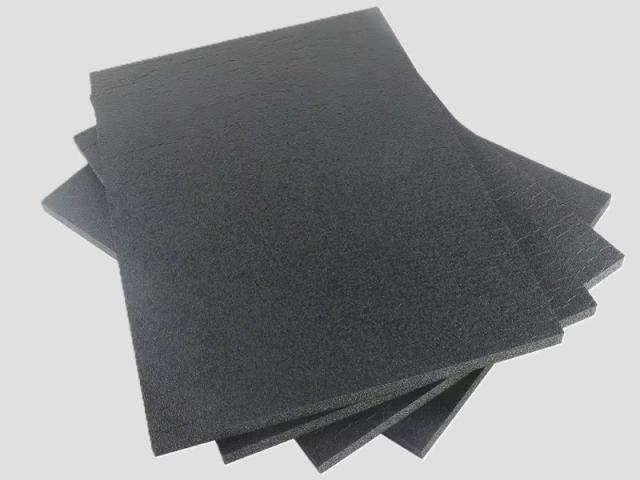
XPE foam sheet is cross-linked polyethylene foam supplied as flat stock in fixed panels. Polyethylene is expanded into a closed-cell foam, and a peroxide cross-links the chains so the cell walls hold their shape. Sheet describes the format, in contrast to roll stock wound on a core. It can be cut, routed, laminated and heat bonded.
Sheet is usually chosen because the next step happens on a flat bed — a cutting table, a router or a die-cutting press. A flat, dimensionally accurate panel saves the work of unwinding a roll and flattening it out.
How a sheet is specified
Thickness. A single expanded layer runs 3–15 mm. Above that, layers are heat-bonded, so laminated sheet reaches 15–200 mm. Heat bonding leaves a bond line, and where sheets are stacked or load-bearing, you need to know where that line is.
Panel size. Panels are cut from master sheet 500–2000 mm wide, and the panel length follows from your equipment and your layout. Set the cutting layout first and the panel length second — doing it the other way round wastes material.
Density. About 26.8 kg/m³ at 40×, about 300 kg/m³ at 3×. For a sheet that will be walked on, take fasteners or carry concentrated loads, choose toward the dense end.
Facing. One or both faces can be laminated to aluminium foil, film, fabric or non-woven. The facing decides whether the surface reflects heat, resists abrasion, or accepts adhesive.
Order of operations. Die-cutting, routing, adhesive coating and heat bonding are all done in our plant. What matters is the sequence: a facing chosen at one step can rule out the next. Asking whether a faced sheet can still be die-cut after the facing is chosen is usually a redesign.
One sheet doing two jobs at once
A closed-cell sheet under a floor does two jobs at the same time.
- It carries the point load of furniture — a density question.
- It blocks moisture vapour from below — a cell-structure question.
Density handles the load and closed cells handle the vapour, and the two parameters do not substitute for one another. Raising density does not make the cells more closed, and closing the cells does not make the sheet stronger. Add a foil or film facing and there is a third job — a reflective surface above a warm floor. Where all three requirements appear together, the usual answer is a dense core with a foil facing.
Sheet, roll or die-cut part
| Item | Sheet | Roll | Die-cut part |
|---|---|---|---|
| Form | Fixed-size flat panels | Wound on a core | Shaped to drawing |
| Suited to | Cutting, routing, die-cutting press | Continuous unwinding, full coverage | Direct assembly |
| Where cutting happens | At your plant | At your plant | In ours |
| Suited to volume | Medium to large batches | Continuous lines, large areas | Complex outlines, any volume |
Choosing the wrong form usually costs more in extra operations than in material: a panel that has to be cut from a roll on site is a roll plus a cutting step you did not need.
Technical data for XPE sheet
Measured values from our XPE technical data, by expansion ratio. Higher ratio, lower density.
| Test item | 3× | 8× | 15× | 30× |
|---|---|---|---|---|
| Apparent density (kg/m³) | 300±40 | 125±15 | 66.7±8 | 33.3±3 |
| Shore hardness (°) | 65–75 | 50–60 | 35–45 | 18–25 |
| Tear strength, cross / machine (kN/m) | ≥12 / ≥14 | ≥9.0 / ≥9.5 | ≥4.5 / ≥5.0 | ≥1.2 / ≥1.5 |
| Compression set (23±2 °C, 22 h) | ≤2% | ≤3% | ≤7% | ≤10% |
| Water absorption (23±2 °C, 22 h) | ≤0.2% | ≤0.2% | ≤0.3% | ≤0.4% |
| Thermal conductivity (W/(m·K)) | ≤0.095 | ≤0.084 | ≤0.065 | ≤0.045 |
Width 500–2000 mm; single-layer thickness 3–15 mm, multi-layer heat lamination 15–200 mm. Thickness and width tolerances are confirmed per project.
Common questions
How thick can XPE sheet be made?
Single layer 3–15 mm. Above that, multi-layer heat lamination reaches 200 mm. A thicker board is not expanded in one pass — it is bonded, and it contains one or more bond lines, which has to be taken into account where the part is load-bearing.
Can sheet be die-cut or routed?
Yes. Die-cutting punches to a cutting die in one stroke and suits fixed outlines at higher volume; routing follows a CNC path and suits complex outlines at lower volume, where a drawing change costs no new tool. The trade-off is set out in custom foam inserts.
Can sheet be foil faced?
Yes, on one or both faces. Foil, film, fabric and non-woven can all be laminated, and the laminating and adhesive coating are done in our plant. A foil facing adds a reflective and vapour-blocking layer, and is common under floors and in equipment cavities. See laminated foam.
Is sheet the same price as roll?
Pricing is by specification, quantity and downstream processing; there is no fixed unit price. For the same material, a roll adds a winding operation and sheet adds a cutting operation, with laminating and adhesive coating costed separately. Send the size, thickness, density and quantity for a quote.
What Bofeng Foam supplies
Bofeng Foam is a manufacturer of cross-linked polyolefin foam, with a 10,000 m² plant, five production lines and 5,000 tonnes of annual capacity in Zhuhai, Guangdong. Sheet is die-cut, routed, laminated and adhesive coated in our plant — changing the formulation and changing the tool path happen in the same building, which removes most of the back-and-forth in sampling and revision.
See sheet sizes and grades · Ask for samples
See also XPE foam roll, high-density XPE foam, what XPE foam is, custom foam inserts, laminated foam and choosing XPE density.