
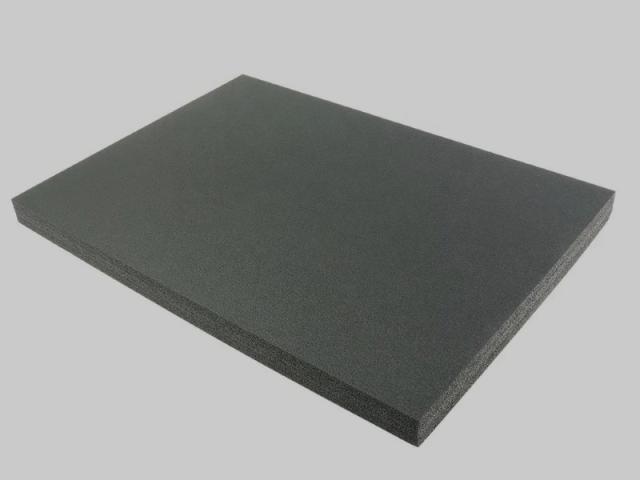
Closed-cell foam has sealed cells with intact walls, so neither water nor air can pass from one cell to the next; open-cell foam has connected cells, so both can travel freely through the material. That single structural difference decides water absorption, thermal insulation, buoyancy, sealing — and, less obviously, whether a laminated part blisters, a vacuum bag lifts, or a thin sheet drifts out of position during bonding.
This page is about the second half of that list. Which structure to choose for a given job is covered in the types of foam material and acoustic foam; how a laminated part’s bond layer is formed and how to check a delivery is in foam lamination.
Splitting “closed cell” into two sentences
“Closed cell” describes a cell structure, and it unpacks into exactly two statements:
- Each bubble has its own wall, and neighbouring bubbles do not connect;
- Therefore water and air can only travel around the outside of the foam — they cannot get in, and they cannot get out.
The first is the structure. The second is the entire consequence, and everything good and everything awkward about closed-cell foam comes from it.
One clarification: closed cell is a description of structure, not a performance grade. Our XPE, IXPE and IXPP are all closed cell, and the grades are separated by density, thickness and surface treatment — not by “degree of closedness”. Asking for “a more closed-cell material” is not a meaningful request.
The measurable half is water. By GB/T 1034 method 4 at 23±2 °C for 22 hours, water absorption for XPE and IXPE runs between 0.2% and 0.4% depending on the grade:
| Expansion | Apparent density (kg/m³) | XPE absorption | IXPE absorption | XPE compression set | IXPE compression set |
|---|---|---|---|---|---|
| 10× | 100±10 | ≤0.2% | ≤0.2% | ≤5% | ≤5% |
| 30× | 33.3±3 | ≤0.4% | ≤0.4% | ≤10% | ≤10% |
Absorption to GB/T 1034 method 4 and compression set to GB/T 6669, both at 23±2 °C for 22 hours; figures from our technical data. The higher the expansion ratio, the looser both numbers become.
These figures are often read as “closed cell means waterproof”. The more accurate reading is that water has no path, which is why absorption is low — and the absence of a path applies to air in exactly the same way. Once those two sentences are held together, the problems below stop needing separate explanations: they are one sentence showing up at different workstations.
Gas is trapped in three places
Break the shop-floor problems down and the gas is only ever trapped in one of three positions:
- Between layers — air carried in during lamination, bonding or adhesive coating;
- Inside the foam — the gas in each cell, which cannot be pumped out or squeezed out;
- Between the foam and another flat surface — bag film, board, or another sheet of foam.
Keeping those three apart is useful because each is changed by a different means: layer-to-layer problems are changed by process parameters, gas inside the foam cannot be changed at all (only the density and thickness can), and foam-to-surface problems usually need part design. Misidentify the position and you will change the wrong thing.
Lamination: the layer of air between two sheets
In flame lamination the interface is formed by the two foam surfaces melting together. The air carried into that interface has no way out: the edges are closed by the nip roller, the middle is closed-cell, and gas cannot cross the foam.
On the floor this looks like blistering, local non-bonding, or a springy feel under the thumb. Cut it open and you find a cavity, not “adhesive that failed to melt”. Those two have different cross-sections; tell them apart before changing the process.
Three knobs are available: roller direction and pressure, which drive the air toward the edges; line speed, which gives it time to leave; and tension and infeed angle, which decide where it gets trapped. Thick parts can also be laminated in stages — bond thin first, build up to the thickness, then bond again — so each interface vents on its own.
Adhesive lamination adds a variable, because the adhesive carries air too. Coating weight, open time and roller direction all change how much. But “bad adhesive” and “nowhere for the air to go” are different faults: poor adhesion is fixed at the adhesive, blistering usually at the air.
A test you can run on the line: with the same machine and the same roll, change only the infeed direction. If the blisters move with it, the problem is the path the air takes, not the formulation. If blisters increase sharply when you change to a different lot of material, then look at the material — thickness tolerance, surface condition, whether it has picked up moisture.
Vacuum packaging: the gas you cannot extract
Evacuating a bag removes the air between the film and the foam. The gas inside each cell cannot be extracted — so closed-cell foam is not flattened the way an open-cell sponge is, the bag cannot press far in, and there is no such thing as pulling it “really tight”.
What happens instead is that the foam springs back. Compression set after 22 hours at 23±2 °C is ≤5% at 10× and ≤10% at 30×, so most of the thickness returns. The bag is already sealed, so the recovery pushes the film up, and the seal carries the highest load.
Two things are commonly said about this and both are wrong:
- A bloated bag is not a leak. It is recovery pushing against the film. Puncture it and air enters from outside — that is not gas escaping from within.
- Not flattening does not mean not secured. The point of vacuum is to locate the part and exclude moisture, not to press foam into paper. To make the part thinner, choose a lower density or a thinner gauge, not more vacuum.
What actually helps in packaging design is to leave compression allowance, fix the part inside the bag so recovery has somewhere to go, and think about where the evacuation port sits: air can only leave from the port side, and the larger the part, the harder the last stretch is. Laying parts out along the evacuation direction, or leaving channels between them, does more than extending the pump time. For liner layout and structure, see packaging foam.
Fast bonding and stacking: cushion, suction, drift
Put two sheets of closed-cell foam together and there is a very thin air cushion between them. When they are pressed, the air can only leave at the edges. Press for too short a time and the air has not finished leaving, so the two sheets float and the positioning drifts — the visible result is off-register bonding, wrinkling, or edges that will not line up, rather than “it did not stick”.
Picking thin sheets off a stack is the same effect: the sheets seal against each other and form a slight vacuum, so a mechanical picker lifts the second sheet as well. Separating methods, pick speed and whether an air gap is left between sheets help more than changing the material.
Die-cut stacks behave the same way: the cut sheets seal together, and lifting the stack carries the top few with it. Sheet separation, air jets, or a small offset between sheets are all more direct than a material change.
In automation the same property becomes an advantage: a vacuum cup can hold a closed-cell sheet because air does not pass through it, and cannot hold an open-cell sheet. Conveying, feeding and forming all rely on this.
The other side: three uses for gas that cannot escape
- Gaskets. The gas inside the cells is the support. Compress it and it comes back — compression set ≤5% to ≤10% — and the seal works through that recovery, not through adhesive. See foam gasket.
- Buoyancy. Each cell is an independent float. For how density relates to buoyancy and what to look at over time, see flotation foam.
- Cushioning and handling. The air cushion is itself the cushioning layer, and vacuum handling depends on the same property. Thin pads inside keyboards and input devices use the same structure: see ultra-thin IXPE.
These three and the problems above are two results of one structure. You cannot keep the benefits and discard the difficulties. The question at specification time is therefore “does this part need gas to be blocked”, not “is closed cell better”.
Why open-cell material does not have this problem
Open cells are connected, so air and water both pass — it does not block water, does not seal and does not float, and it needs no venting because it never blocked gas in the first place.
For reference, published figures for open-cell materials are 60–90% open-cell content and a 30% compression stress of ≤10 kPa for slow-recovery open-cell PE. Those are not our three main products, and that set of numbers serves a different purpose; it is not interchangeable with closed-cell parts.
If the requirement really is breathability or sound absorption, that is a different brief, not an improvement. The difference between the two structures, and how to choose by application, is in the types of foam material and acoustic foam.
One pair of terms is often confused here: sound insulation and sound absorption are not the same thing. Insulation keeps sound out, and depends on mass and enclosure; absorption dissipates sound inside a room, through friction as air moves in the pores, which is why absorbers are usually open-cell. Closed-cell parts usually do the first job and open-cell parts the second — decide which one you need before choosing.
Four knobs the process gives you
- Give the air a path. Groove the part, drill vent holes, or bond in sections; do not press the whole face down at once. One outlet shortens the escape time from “the whole area” to “one edge”.
- Give the air time. Line speed, press time, evacuation rhythm. Whether the air can leave is first a question of time, then of pressure — more pressure on air that has nowhere to go just compresses it in the interface, and it springs back when you let go.
- Change the contact surface. Embossing changes how the two sheets contact each other and reduces full-face suction. But embossing does not change the closed cells inside, and it does not turn the foam into a venting material.
- Change the material. If breathability or absorption is genuinely required, choose open cell. That is a different brief, as above.
One distinction that must be kept clear: corona treatment changes surface energy so that adhesive bonds, and has nothing to do with venting. XPE can be calendered and corona treated; IXPE can be corona treated and embossed. Each treatment has its own purpose, and none substitutes for another.
Three things the material cannot solve
- A vacuum bag lifted by recovery. This is a question of recovery against film stiffness. The material side can only offer a grade with lower compression set; the rest is packaging design.
- Air trapped at a bond interface. This depends on line speed, pressure and bonding method. The material can offer thickness tolerance and flatness, not the removal of the air in between.
- “Venting” a thick part internally. A closed-cell part needs no internal venting and has no channel to vent through. What needs handling is the interface, not the interior — keep those apart and the solution follows.
Writing the parts the material cannot do into a table that looks professional is the easiest mistake to make on a page like this. The next section is what we explicitly do not supply.
The numbers we do not give
Air permeability and venting rate: no manufacturer data. Dimensional hold time after vacuum: no data. Blister rate after bonding: it depends on process, equipment and part shape, and there is no figure we can commit to. Contact area after embossing: no data. Sound reduction: no data — see acoustic foam.
Common questions
Does closed-cell foam really keep water out?
Not absolutely. By GB/T 1034 method 4 at 23±2 °C for 22 hours, XPE and IXPE absorb between 0.2% and 0.4%, and the figure rises with the expansion ratio. What is blocked is the path, not every drop.
Will vacuum packaging flatten the foam?
Not the way an open-cell sponge flattens, because the gas in each cell cannot be extracted. A bag that domes before opening is recovery, not a leak.
Is a blister after lamination an adhesive problem?
Look at the air first. Flame lamination traps air at the interface, and adhesive lamination traps air in the adhesive layer; both blister. “Adhesive that did not melt” is a third case, and the cross-section tells them apart.
Does embossing solve venting?
It reduces full-face suction between two sheets, but it does not change the closed cells inside and does not open a path for gas.
Are thicker parts harder to vent?
What has to escape is the layer of air at the interface, which has no direct relationship to part thickness. What is genuinely harder with a thick part is even pressure — if the middle is not pressed, the air there is not driven out — which is why thick parts are better laminated in stages.
Can open-cell material be substituted?
That is a different brief: open cell does not block water, seal or float. Establish what the part needs before discussing substitution.
What Bofeng Foam supplies
Bofeng Foam supplies three closed-cell cross-linked foams — XPE, IXPE and IXPP — in ten density grades from 26.8 to 300 kg/m³; single-layer XPE 3–15 mm and IXPE 0.1–15 mm, heat-laminated multi-layer 15–200 mm; width 500–2000 mm; XPE calenderable and corona treatable, IXPE corona treatable and embossable; and laminated, die-cut or adhesive backed to drawing.
For how a laminated part’s bond layer is formed and how to check it on arrival, see foam lamination. For what the material itself is, see XPE foam; for the whole range, the materials hub.
If your problem is already pinned to a workstation — blistering after lamination, a vacuum bag lifting, or a picker taking two sheets — tell us the workstation, the part and the foam specification (material, ratio, thickness). We can advise on the specification for your process conditions; we cannot promise venting performance on equipment and part shapes we have not seen.
Further reading
Types of foam material — how foam is classified by base polymer and cell structure, and where closed and open cell sit. Acoustic foam — which part of sound control each structure handles. Foam lamination — what the bond layer is and the four things you can check on arrival. How to choose XPE density. Density and thickness together. Laminated foam materials — foil, non-woven, leather and flannelette.