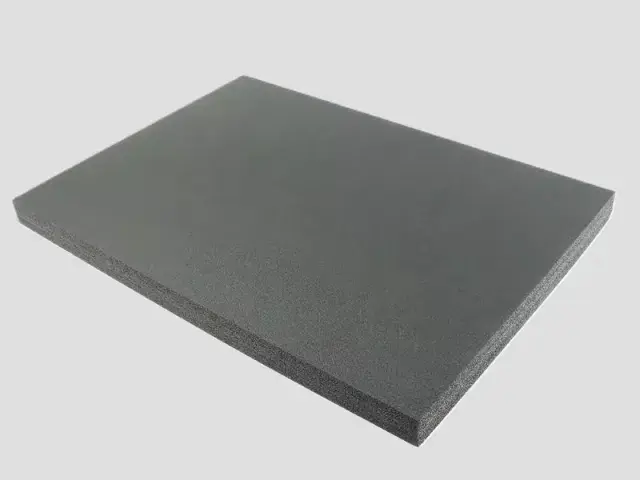
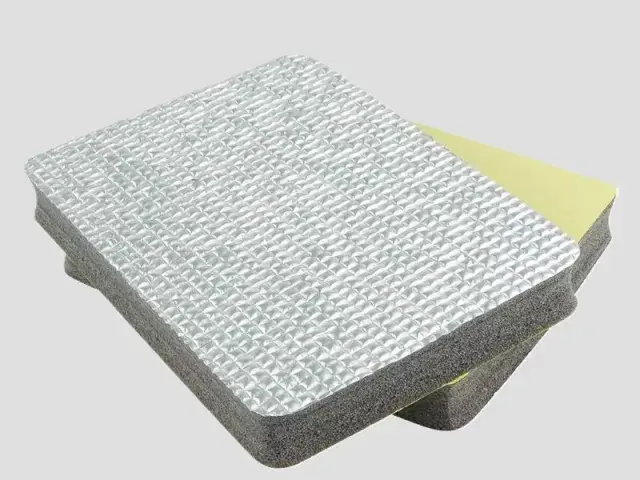
- Material: XPE foam + aluminum foil
- Expansion ratio: 30 times (33 kg/m³)
- Thickness: single-layer 3–15 mm, thermally laminated (multi-layer) 15–200 mm; one-side adhesive backing available
- Width: 1 m, 1.2 m, 1.5 m (width can be customized)
- Flame retardant grade: UL94 HF-1, GB8624-B1
Customization
Made to order: density, thickness, colour and shape to your drawing. Die-cutting, CNC routing, lamination to film or fabric, slitting and adhesive coating all run in-house, so the part we quote is a finished part, not just a sheet. How a custom part is cut and routed explains what to send with the drawing.
Regular material: MOQ 1,000 m², lead time 15–20 days from order confirmation. Custom parts are quoted from the drawing. A4 samples are free, shipping included.
A wall loses heat in two ways: by conduction through the solid, and by radiation across the cavity behind it. Foil-faced XPE foam deals with both. The closed-cell core blocks conducted heat while the aluminium face reflects radiant heat back into the room, which is why the same material is used on external walls, internal drylining and cold-store walls alike.
Features
- Thermal break – cuts conduction through the wall and reduces the load on heating and cooling plant.
- Reflective foil face – turns radiant heat back toward the room rather than letting it cross the cavity.
- Vapour and moisture resistance – closed-cell foam keeps moisture out of the wall build-up, which is what allows mould to take hold.
- Thin for its performance – single-layer from 3 mm, so it fits where a thicker insulant will not.
- Lightweight – no meaningful additional load on the structure, and quick to handle on site.
- Flame retardant – UL94 HF-1 and GB8624-B1 grades available.
Applications
- Residential – external wall insulation on new-build and retrofit projects.
- Commercial – office and retail facades and internal drylining.
- Industrial – workshops and process buildings with a controlled internal temperature.
- Cold storage – cold rooms and freezers, where the vapour barrier matters as much as the insulation.
- Related build-ups – the same foil-faced foam is used for roof and floor warming applications.
Specifications for wall insulation foam
A wall insulation layer needs low thermal conductivity, stable thickness and enough stiffness to stay flat inside a cavity.
| Foam | Expansion | Apparent density | Single-layer thickness | Why this grade |
|---|---|---|---|---|
| XPE | 8–15× | 66.7–125 kg/m³ | 3–15 mm | Thermal conductivity down to 0.065 W/m·K at this density, with a closed-cell structure that does not take up water in a damp cavity. |
| IXPE | 15–25× | 40–66.7 kg/m³ | 0.1–15 mm | Same order of insulation in a thinner, more conformable sheet for uneven or curved wall surfaces. |
Base material specifications are on the XPE, IXPE and IXPP material pages; finished products are on the XPE foam and IXPE foam pages. Tell us the load, the space available and the service temperature and we will confirm the grade against your drawing.
Why Choose Bofeng Foam
- XPE foam with aluminium foil lamination, 30× (33 kg/m³).
- Single-layer 3–15 mm; thermally laminated multi-layer 15–200 mm.
- Widths of 1 m, 1.2 m and 1.5 m.
- One-side adhesive backing available.
- UL94 HF-1 and GB8624-B1 flame-retardant grades.
- Samples and specification sheets available before production.
Conclusion & Inquiry
Flooring foam gathers the construction insulation range, and how XPE foam insulates explains the closed-cell mechanism behind it. Contact us with your wall build-up and target performance and we will quote a supply.