
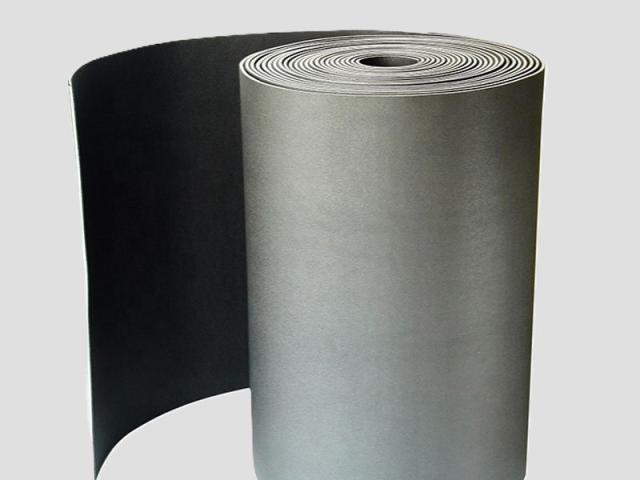
XPE foam roll is cross-linked polyethylene foam supplied on a core. Roll describes the supply format, not the material: the same XPE sheet is expanded, laminated if required, and then wound. A roll is the practical format when it will be unwound onto a line or laid out continuously — as underlayment, pipe wrap or protective interleaving — rather than cut into fixed panels.
How a roll is specified
Width. Rolls are supplied from 500 mm to 2000 mm. A wider roll means fewer seams when covering a floor or a roof; a narrower roll is easier to handle on a bench or a cutting table.
Thickness. A single expanded layer runs 3–15 mm. Anything thicker is multi-layer heat lamination, up to 200 mm — and heat bonding leaves a bond line inside the material.
Density. Density follows the expansion ratio: about 26.8 kg/m³ at 40×, about 300 kg/m³ at 3×. A roll that has to stay flat under a sustained load wants the denser end, for the reasons in high-density XPE foam.
Roll length. Not a fixed value. At the same core diameter, a thicker sheet gives a shorter run. If the roll feeds a continuous line, say so in advance, because a splice matters there and does not matter on a cut-and-lay job. If you have a reel-size or equipment limit, send it and we will quote the length to your constraint.
Surface. Rolls can be calendered, corona treated, embossed, or laminated to aluminium foil or a film. A foil facing adds a reflective and vapour-blocking layer; a film facing resists abrasion better; a plain glossy surface is the easiest to apply adhesive to yourself.
Outdoor exposure. Unstabilised polyethylene is degraded by ultraviolet light. For genuine long-term outdoor use, solve it through the facing (foil, film) or by shading the construction — do not expect bare foam to carry it.
Roll or sheet
Two supply formats of one material. Choose by whether the next step is continuous unwinding or cutting to size.
| Item | Roll | Sheet |
|---|---|---|
| Supply form | Wound on a core | Fixed-size flat panels |
| Ordered by | Width × thickness × roll length | Panel size × thickness × number of panels |
| Next operation | Continuous unwinding, full coverage, overlapping | Cutting table, die-cutting press, CNC routing |
| Transport and storage | Stood on end, small footprint | Stacked flat; prone to pressure marks |
| Typical position | Floor underlayment, roof insulation, pipe wrap | Packaging liners, toolboxes, pads |
Technical data for XPE roll stock
Measured values from our XPE technical data, by expansion ratio. Higher ratio, lower density.
| Test item | 3× | 8× | 15× | 30× |
|---|---|---|---|---|
| Apparent density (kg/m³) | 300±40 | 125±15 | 66.7±8 | 33.3±3 |
| Shore hardness (°) | 65–75 | 50–60 | 35–45 | 18–25 |
| Tear strength, cross / machine (kN/m) | ≥12 / ≥14 | ≥9.0 / ≥9.5 | ≥4.5 / ≥5.0 | ≥1.2 / ≥1.5 |
| Compression set (23±2 °C, 22 h) | ≤2% | ≤3% | ≤7% | ≤10% |
| Water absorption (23±2 °C, 22 h) | ≤0.2% | ≤0.2% | ≤0.3% | ≤0.4% |
| Thermal conductivity (W/(m·K)) | ≤0.095 | ≤0.084 | ≤0.065 | ≤0.045 |
Width 500–2000 mm; single-layer thickness 3–15 mm, multi-layer heat lamination 15–200 mm. Standard colours are black, white and grey, with custom colours available.
Three places roll stock usually goes
- Full-coverage floor and roof layers. A roll unwinds continuously, so there are fewer joints than with panels. Floor underlayment and roof insulation are laid from roll — the construction and thickness are covered on flooring foam.
- Pipe and equipment wrapping. A narrow roll wraps around a pipe, and a foil facing makes it a vapour layer as well. See HVAC insulation foam.
- Interleaving and packaging supplied in roll. Thin gauges are cut by the metre for interlayers, wrapping or rolled liners.
Common questions
What is the difference between XPE roll and XPE sheet?
One material, different delivery form. A roll is wound on a core and suits continuous unwinding and full coverage; sheet is fixed-size flat panels and suits a cutting table or die-cutting press. The specification ranges are shared: width 500–2000 mm, single layer 3–15 mm, multi-layer to 200 mm.
How long is a roll?
Not a fixed number. At one core diameter, a thicker sheet means a shorter length, and the equipment you can load also sets a maximum. Tell us the core diameter or the equipment limit and we will quote the length to that condition.
Can roll stock be foil faced?
Yes — aluminium foil, film, fabric, non-woven, leather and flock can all be laminated, and the laminating and adhesive coating are done in our plant. A foil facing adds a reflective and vapour-blocking layer and is common on pipe, underfloor heating and roof stock. See laminated foam.
Is roll stock waterproof?
XPE is closed-cell and does not absorb water — measured to GB/T 1034, absorption is 0.2–0.4% or less. But water resistance is not the same as being a waterproof layer: water can still get round a cut edge, a seam or a lap. For genuine vapour or water control, the facing and the joint detail have to be specified together.
What Bofeng Foam supplies
Bofeng Foam is a manufacturer of cross-linked polyolefin foam, with a 10,000 m² plant, five production lines and 5,000 tonnes of annual capacity in Zhuhai, Guangdong. XPE roll stock is foamed, laminated and slit in our own plant — foil and film facing, adhesive coating and embossing are all done on the same site, so nothing is handed to a third party for the finishing operations.
See roll widths, thicknesses and densities · Ask for a quote
See also XPE foam sheet, high-density XPE foam, what XPE foam is, laminated foam, flooring foam and HVAC insulation foam.