
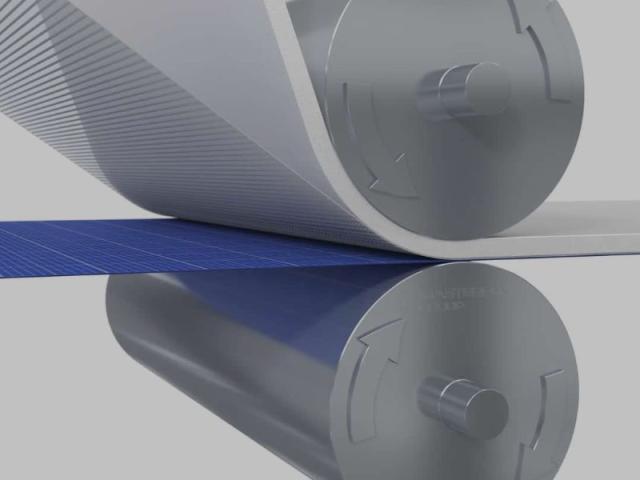
Laminated foam is usually described as two materials pressed together. It is actually three layers: the core, the facing, and the bond layer that holds them. Customers choose the first two, and almost nobody chooses the third — yet the third is what decides whether the part lasts three months or three years.
This page covers three things: what the bond layer is and which limits it brings with it, why the facing’s direction has to be on the drawing, and the four things you can check with your eyes when a delivery arrives.
Which facings exist and what each is for is a separate question, covered in laminated foam materials. Whether foil works as a construction at all — which way it faces, whether there is an air space — has its own page: aluminium foil thermal insulation foam.
A laminated part is three layers, not two
Cut a laminated material and look at the edge: the core is in the middle, the facing on one or both sides, and the line between them is the bond layer. Sometimes it is visible, as a film of adhesive; sometimes it is not, because in flame lamination the bond layer is the foam’s own melted surface with no added material. But it is always there, and it always matters.
| Layer | What it determines | What determines it | What changes if you replace it |
|---|---|---|---|
| Core | Cushioning, insulation, recovery, compression strength | Material (XPE / IXPE / IXPP) and ratio or density | The whole part’s performance |
| Bond layer | Whether it delaminates, the temperature ceiling, whether it die-cuts cleanly | The lamination process, and the adhesive if one is used | Performance unchanged; service life and machinability change |
| Facing | Touch, appearance, reflectivity, vapour barrier, abrasion resistance | The facing material, and its direction | Appearance and surface function |
That table explains the most common complaint about laminated parts: every foam property is in specification and the part still failed — because the second row failed, and the second row has never been on a specification sheet.
Flame lamination: the bond layer is the foam itself
Flame lamination brings the foam surface into brief contact with a high-temperature flame, melting a thin layer of it, presses that molten surface onto the facing while it is still soft, and lets it solidify into the bond layer as it cools.
Two consequences follow, and both are useful:
- No new material is introduced. The bond layer is the foam, so its temperature resistance, weathering and ageing behaviour match the core, and there is no second adhesive to qualify.
- The temperature ceiling is therefore set by the foam. The heat-resistant grade withstands a 110 °C working environment, and IXPP pushes the ceiling to 140 °C. A flame-laminated part has no second weak link on that axis.
The cost is a demand on the facing: it has to survive that instant of heat, and its surface has to key into molten foam. That is why flame lamination is easiest with foam on foam — two identical materials melt together with no compatibility question.
Note that some combinations substitute a hot-melt film for “the foam melting itself”. Structurally that still introduces a third material, and the rules in the next section apply to it.
Adhesive lamination: the bond layer is a third material, and must be qualified separately
Facings such as aluminium foil, film, fabric, leather and flannelette go through adhesive lamination: a solvent adhesive is coated, pressed to the facing, and the other side is often covered with release paper to make a self-adhesive product. Compared with flame lamination, what is added is not a process step but a material.
One more material means one more set of questions that must be answered:
- What is its temperature rating? A laminated part’s ceiling is the weakest of its three layers. When the foam says 110 °C or 140 °C, that is the foam, not the part.
- Is it compatible with the facing? The same adhesive behaves differently on foil, on fabric and on leather; “we used the same adhesive” is not an argument.
- Will it migrate? The adhesive sits between foam and facing, and whether anything migrates into the facing over long service is a question to settle per adhesive type.
We have no data on any of those three, as set out below. The more fundamental point is that “laminated foam withstands 110 °C” is half a sentence. The complete sentence has to name the layer. The foil page already works through the same point — a laminated part’s temperature limit is its weakest component.
The two bonding methods compared
| Flame lamination | Adhesive lamination | |
|---|---|---|
| Where the bond layer comes from | A melted layer of the foam surface | An added adhesive (solvent, or hot-melt film) |
| Is a material added | No | Yes |
| Facings it can bond | Foam to foam; and facings that survive the instant heat and key into molten foam | Foil, film, fabric, non-woven, leather, flannelette |
| What sets the temperature ceiling | The foam (110 °C; IXPP 140 °C) | The weakest of three layers; the adhesive must be qualified separately |
| Common forms | Single or double sided, multi-layer builds | Single or double sided, with optional adhesive backing |
| Downstream processing | Die-cutting, CNC routing directly | Also possible, but the part is stiffer and tooling and feed rates must suit it |
The last row is worth a sentence: a laminated part is stiffer than its core, which is not a defect but does change the machining parameters. That, and the die-cutting versus CNC choice, are covered in die-cutting and CNC routing.
Flame or adhesive is decided by the facing, not by preference
Enquiries often ask “do you use flame lamination or adhesive” as if it were a choice. In practice it was settled the moment the facing was chosen; the process only executes it:
- Facing is foam → either works; flame lamination saves a layer of material.
- Facing is foil or film → adhesive. Foil does not breathe and does not melt, so molten foam has nothing to key into.
- Facing is fabric, non-woven, flannelette or leather → usually adhesive; whether flame lamination is possible depends on whether that particular fabric survives the instant heat and on its surface structure, which cannot be judged from the name.
So the useful question is not “which process do you use” but “what can you do with this facing of mine”. Sending a swatch or a film sample is far more reliable than naming a material in an email — two fabrics both called “flannelette” can differ in weight, backing and surface treatment enough to change the answer.
Facings have a direction too
Foam has machine and cross directions, and that has already been written up as a layout rule for automotive parts. Facings have a direction as well, and it is visible to the eye — which makes it harder to correct afterwards.
| Facing | What the direction is | What happens if it is not marked | How to write it on the drawing |
|---|---|---|---|
| Flannelette | Nap direction: which way the pile lies | With and against the nap reflect differently, so one box of inserts looks like two batches | Mark the nap direction with an arrow and state that a batch must be uniform |
| Non-woven | Web direction versus cross direction; the two stretch differently | Distortion during forming, and inserts of different sizes in one batch | Mark the web direction and align the main stretch axis with the load direction in the layout |
| Leather | Natural hide varies in elongation by area; synthetic leather has a backing direction | Inconsistent tightness within a batch, wrinkling during stitching or wrapping | Mark the grain direction and the usable areas |
| Film | Web direction; shrinkage differs along and across the roll | Wrinkling after lamination, patchy bonding | Mark the web direction |
This column rarely has a place on a specification sheet, but it decides whether the finished goods look like one batch.
What happens when the direction is not marked
The clearest example is a gift-box insert. Put several inserts die-cut from the same sheet into one box, with their nap directions inconsistent, and under showroom lighting some will look bright and some dull — the set looks like two production batches. That is not a quality problem, it is a layout problem, but the customer sees the former.
Avoiding it takes two additions to the drawing: mark the direction (nap, web, grain), and state whether a batch must be uniform. The second is often left out — individually acceptable parts that are inconsistent across the batch still get rejected.
It shows most clearly where the finished part is meant to be looked at: gift box inserts, luggage liners and sports foam.
Thickness and hardness after lamination
Thickness. The facing is thin, usually under 1 mm, so the finished thickness is roughly the core thickness plus the facing. The single-layer core range depends on material: XPE 3–15 mm, IXPE 0.1–15 mm, IXPP 1–6 mm. Anything thicker is built up in layers, with the ceiling set by the core and the process.
Hardness. A laminated part is stiffer than the bare foam at the same thickness, and it is not equally stiff on both faces: the facing side is firmer, the core side still soft. Two practical consequences:
- Machining parameters must suit the part, not the core. Tooling and feed rates follow the whole part’s hardness.
- Orientation is a choice. Facing out for appearance and abrasion resistance, facing in for conformability and scratch protection — the same piece turned over behaves differently. The drawing should state which face goes out.
On a foil part, which face goes out is decisive, because the reflective surface has to face the air space. On other facings it is an appearance and touch question. Different in nature, both belong on the drawing.
Four things to check on arrival
None of a laminated part’s bond quality can be measured with a caliper, but the four items below can be checked by eye and hand, and they point at the usual starting points of failure.
| Check | How | What a reject looks like | Why it matters |
|---|---|---|---|
| Layer misalignment | Look at the edge: are facing and core flush | Facing overhangs one side, core exposed on the other | After cutting, edges show white or show the core — an appearance reject |
| Edge lifting | Lay flat and rest, then look at the four edges | Facing lifts and can be peeled up at a corner | The lift is where delamination starts, and later processing magnifies it |
| Direction consistency | Lay a batch flat and look at one angle of light | Nap directions alternate and the reflection is discontinuous | Parts individually acceptable, batch inconsistent, visible once assembled |
| Curl and waviness | Unroll a metre and lay it flat | Humped in the middle, wavy at the edges | Die-cutting locates badly and bonding is incomplete |
What these four share is that all of them can be done on the day of receipt, without sending samples away. The place laminating goes wrong is not the material but between the layers — and that layer is the one least likely to be described in the shipping documents.
What we do not conclude
Three figures are absent from our authoritative data, and the reason is not evasion: an unconditional number is more dangerous than none.
- Peel strength. We have no test data for how much force it takes to pull a facing off the foam. The phrase appears occasionally on this site referring to tape adhesion to a substrate, which is a tape question and not a measure of a laminated bond — they do not test the same thing. Where you need it, it must be measured for your particular facing and core combination.
- Long-term temperature resistance of the adhesive layer. Different adhesives give different results. What we hold is the foam’s ceiling, not the temperature curve of the adhesive in use.
- How long before it delaminates. No long-term damp-heat ageing data. Any “guaranteed not to delaminate for N years” claim needs a corresponding test behind it.
What we can offer instead is method: give us the facing, the core, the service temperature, whether it is under sustained load, and the intended storage life, and we will propose a combination for your tests to confirm. That is not passing the responsibility back — these properties can only be measured on a specific combination, and no general value exists.
Common questions
Why do laminated parts delaminate?
Usually it is the bond layer that fails first, not the foam: adhesive ageing, tension or temperature not controlled during lamination, or a bend radius so tight that the facing cracks and the crack then propagates. Checking edges for flush alignment and lifting catches most cases early.
Which is stronger, flame or adhesive?
That comparison cannot be made. In flame lamination the bond layer is foam, so there is no compatibility question between foam and foam. Adhesive lamination joins two dissimilar materials, and the strength depends on the pairing. Asking which is stronger is asking whether adhesive or molten foam wins — and the answer changes with the facing.
Can aluminium foil be flame laminated?
In current practice foil goes through adhesive lamination, not flame. Foil does not breathe and does not melt, so molten foam has no structure to key into. This is about the bonding mechanism, not about how good the foil is.
Does the nap direction really matter that much?
Where the finished part is meant to be looked at, yes. With and against the nap reflect differently, and inconsistent directions in one box look like two batches under light. No difference in performance, a large difference at inspection. A single note on the drawing prevents it.
Can a laminated part still be die-cut or routed?
Yes. Lamination, slitting, die-cutting and CNC routing are all done in-house and can run in sequence. Bear in mind the part becomes stiffer, so tooling and feed rates must suit it — which is exactly why doing it in one place is more reliable than splitting the work.
What temperature can a laminated part withstand?
Ask per layer. Foam side: the heat-resistant grade withstands a 110 °C working environment and IXPP reaches 140 °C. Adhesive side: depends on the adhesive, and must be qualified separately. The part’s ceiling is the weakest of the three, so “what temperature can laminated foam withstand” means nothing unless it names the layer.
Can you supply peel strength data?
No. We have no peel strength test data for laminated parts. It depends on facing, core and adhesive, and has to be measured on your specific combination. If it is in your acceptance criteria, raise it at sampling and we will include test pieces for you to measure.
What Bofeng Foam supplies
Bofeng Foam uses XPE (3–40×, apparent density 26.8–300 kg/m³, single layer 3–15 mm, width 500–2000 mm), IXPE (single layer 0.1–15 mm) and IXPP (5–25×, single layer 1–6 mm, maximum service temperature 140 °C) as cores and laminates in-house: flame bonding, adhesive bonding (solvent adhesive, release paper) and adhesive backing, to aluminium foil, film, non-woven, flannelette, leather, or another layer of foam. Laminated stock can still be slit, cut, die-cut, punched, CNC routed, embossed and printed. Standard colours are black, white and grey, with custom colour matching. The plant is 10,000 m² with five production lines and 5,000 tonnes of annual capacity.
Send a swatch, a film sample or a drawing and we will reply with the combinations we can run
See also laminated foam materials, aluminium foil thermal insulation foam, die-cutting and CNC routing, custom foam inserts, all cross-linked polyethylene foam materials, XPE foam, IXPE foam and IXPP foam.